Senior Chinese officials meet US delegation; China, US step up high-level engagements as two nations navigate complex relationship
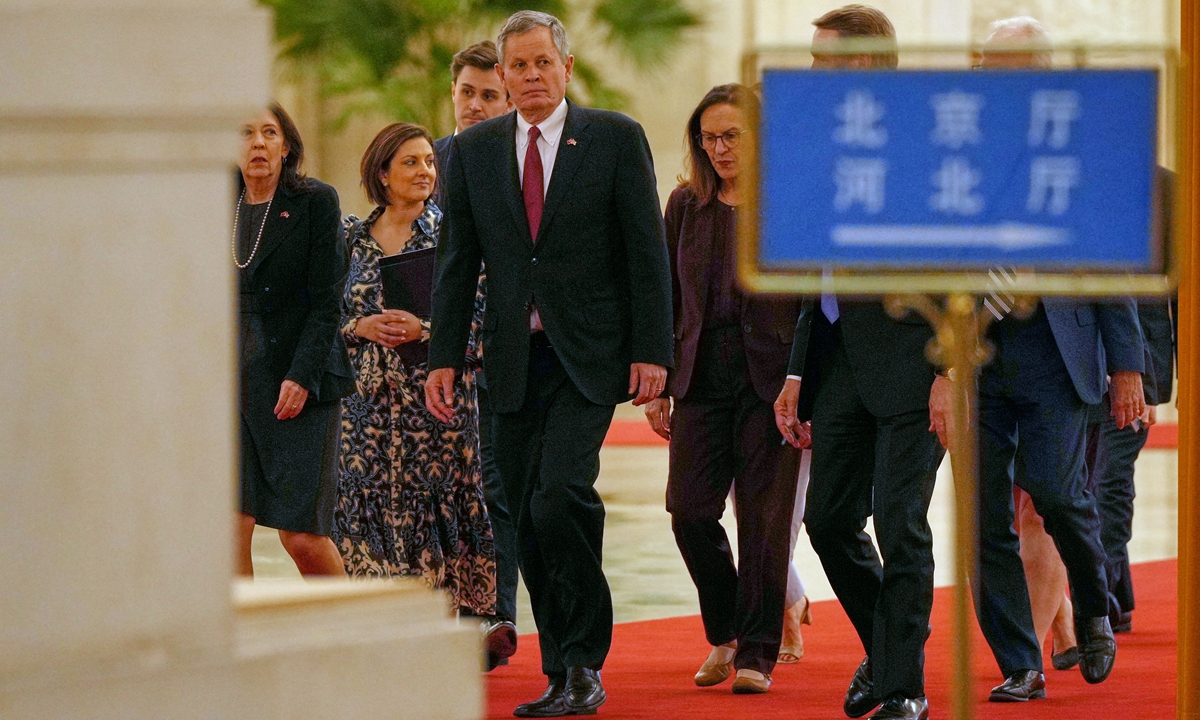
US Senator Steve Daines walks with his congressional delegation as they arrive to the Great Hall of the People to meet with Chinese Foreign Minister Wang Yi, in Beijing, on May 7, 2026. Photo: VCG
In a move signaling renewed diplomatic engagement, senior Chinese officials met with a US bipartisan congressional delegation led by Steve Daines in Beijing on Thursday. The talks, according to analysts, mark the latest effort to navigate the complex relationship between the world's two largest economies.
Observers see the visit as a potential catalyst for broader US-China cooperation. However, Chinese analysts emphasize that for relations to truly improve, Washington must abandon its contradictory approach of calling for collaboration while simultaneously pursuing policies limiting China's development.
China is willing to work with the US to implement the important consensus reached by the two heads of state, enhance dialogue and communication, create a favorable atmosphere for exchanges at all levels and cooperation in various fields, and strive for more practical achievements between the two countries, Chinese Premier Li Qiang said Thursday, when meeting with a visiting delegation of US senators led by Daines in Beijing, according to Xinhua News Agency.
Noting the Taiwan question concerns China's core interests, and is the first and foremost red line that must not be crossed in China-US relations, Li said that it is hoped that the US Congress will proceed from the overall interests of friendly cooperation between the two countries, view and handle China-related issues with caution, and play an active role in the stable, sound and sustainable development of China-US relations.
In a separate meeting with the delegation, China's top legislator Zhao Leji on Thursday called on the US side to look at China and its development rationally and objectively, welcoming more US lawmakers to visit China, according to Xinhua.
Zhao also said the stable, healthy and sustainable development of China-US relations is in line with the common interests of the two peoples and the general expectations of the international community.
This delegation is the first bipartisan group of US senators to visit China since President Trump took office, said Chinese Foreign Minister Wang Yi during his meeting with the delegation, expressing hope that through this visit, they will witness China's development dynamics, according to Xinhua.
Taiwan question
High-level interactions between China and the US are extremely important for building coordination and mutual understanding, helping avoid misjudgments, manage differences and stabilize bilateral ties, Li Haidong, a professor at the China Foreign Affairs University, told the Global Times on Thursday.
Daines is a member of the Senate Foreign Relations Committee and a strong supporter of Trump, according to the Washington Post. This was Daines' second trip to China since Trump took office last year. He previously visited in March 2025, when the two countries were locked in frictions over trade tariffs and fentanyl.
Daines is expected to relay his firsthand observations from China directly to the US president, including China's core concerns, Li Haidong said. Such communication, he added, is important for both sides to better understand each other's priorities, expand cooperation and manage disagreements.
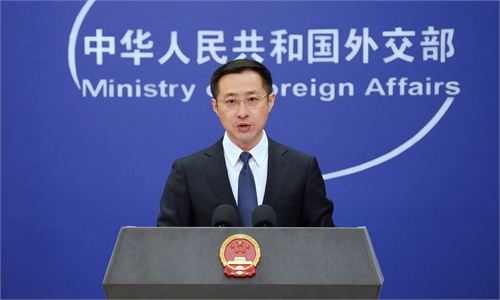
The Chinese Foreign Ministry spokesperson Lin Jian reiterated on Thursday that the Taiwan question "is at the very core of China's core interests, and the bedrock of the political foundation of China-US relations." Lin made the remarks in response to a question over speculation that Taiwan will top Beijing's agenda for the approaching China-US leaders' meeting.
"Abiding by the one-China principle and the three China-US joint communiqués, and honoring the commitments made by US administrations on the Taiwan question is the US' due international obligation and the prerequisite for a steady, sound and sustainable China-US relationship," Lin said.
Earlier on Tuesday, US Secretary of State Marco Rubio said the Taiwan question "will be a topic of conversation" during a possible China visit by Trump, according to a video released by Forbes.
Rubio claimed that "the Chinese understand our position on that topic, we understand theirs," adding that "both countries understand that it is in neither one of our interests to see anything destabilized happen in that part of the world."
China has unwavering resolve in safeguarding national unity and territorial integrity. "Taiwan independence" and cross-Straits peace are as irreconcilable as fire and water. To keep the Taiwan Straits peaceful and stable, there must be unequivocal opposition to "Taiwan independence", Lin said.
AI, as an example
On Thursday, the Wall Street Journal reported that China and the US are weighing the launch of official discussions about artificial intelligence during Trump's visit to Beijing, which the outlet says comes as their AI competition threatens to become the arms race of the digital era.
The report said US Treasury Secretary Scott Bessent is leading the American side on the AI track, citing people familiar with the matter. Responding to a question related to the reported official discussions and who would lead the Chinese side, Chinese Foreign Ministry spokesperson Lin Jian said on Thursday that "as for your specific question, I have no information to offer at the moment," while adding that China and the US are maintaining communication over President Trump's visit to China.
Among the areas where China and the US could potentially expand cooperation, AI has drawn particular attention. Chinese experts noted that developments in this field also reveal contradictions in Washington's approach toward China — simultaneously suppressing China's AI sector while calling for cooperation on global governance.
The Wall Street Journal report said establishing official discussions on AI would mark the start of US-China engagement on the issue under the current Trump administration, reflecting a recognition that the rush to produce more powerful AI models could trigger a crisis neither government has the means to manage.
The report, citing people familiar with the matter, said discussions could address risks such as unexpected behavior by AI models, autonomous military systems and attacks by non-state actors using powerful open-source AI tools.
Li Haidong said the US increasingly treats AI as a critical arena for maintaining strategic competition with China. "At the same time, Washington still hopes to cooperate with China on global rule-making and preventing AI competition from spiraling out of control," Li Haidong said.
"This double-standard approach seriously affects China-US exchanges and dialogue. The US needs to show sincerity rather than building walls while talking about bilateral cooperation," Li Haidong said.
Reuters reported on April 24 that the US State Department has ordered a global warning over Chinese companies, including AI startup DeepSeek, citing a diplomatic cable.
Prior to this, the US had already introduced multiple measures aimed at restricting the development of Chinese AI firms, including bans on exports of Nvidia's most advanced AI chips to China.
Despite US export controls and restrictions, Chinese AI models such as DeepSeek have already approached the level of the most advanced American AI systems on several mainstream benchmarks, Tian Feng, former dean of SenseTime's Intelligence Industry Research Institute, told the Global Times on Thursday.
China advocates AI governance dialogue based on equality, cooperation and mutual respect, while opposing any monopoly by major powers over global AI norms, Tian said.
As global leaders in AI development, both China and the US still need to strengthen cooperation in addressing risks arising from AI misuse, abuse and exploitation by criminals, Tian added.
"Our fates are now fused," Thomas L. Friedman, New York Times opinion columnist and author of The World Is Flat, wrote in a recent article calling for China-US cooperation on AI.
"This is the first era of human history in which we Homo sapiens must govern, innovate, collaborate and coexist at a planetary scale to thrive," Friedman wrote — a view that, according to some Chinese observers, reflects a growing recognition among parts of American society that global challenges require cooperation, including between China and the US.
RELATED ARTICLES