Fiber from lunar soil sent to space station for long-term exposure testing with potential to serve as in-situ materials for lunar research station
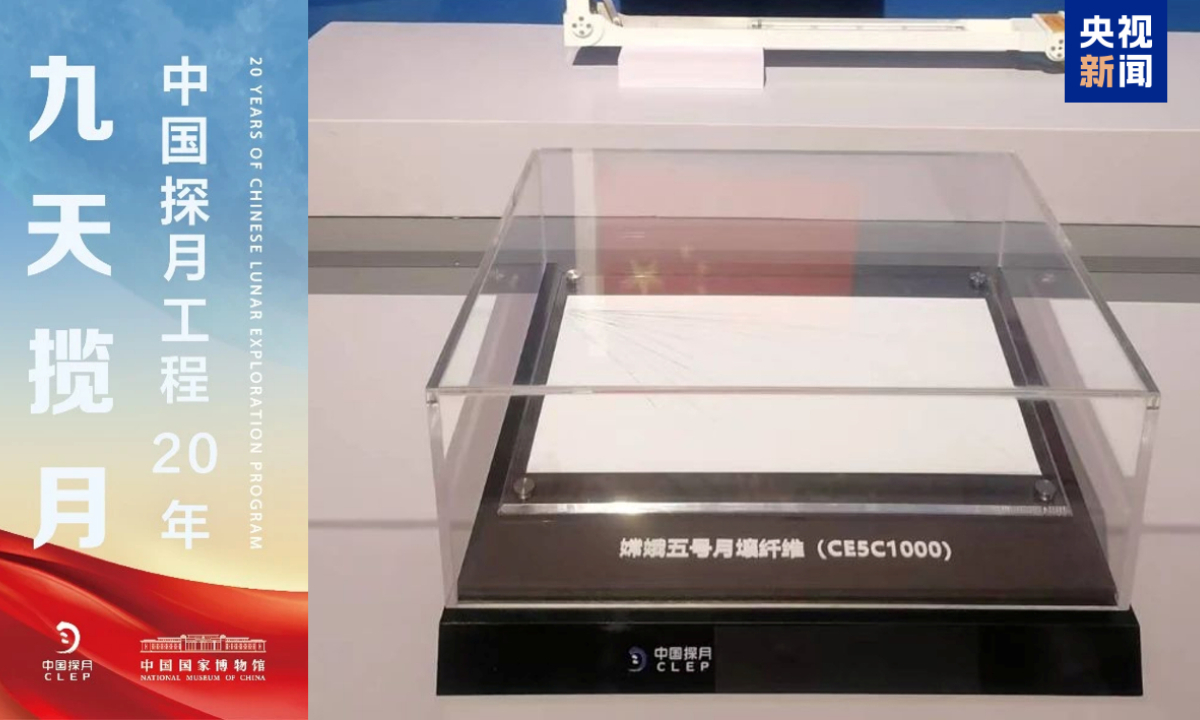
Lunar soil fibers exhibited at the National Museum of China as part of the “Reaching for the Moon – 20 Years of Chinese Lunar Exploration Program” exhibition on April 1, 2025. Photo: Screenshot from CCTV
Chinese scientists on Monday sent China’s first experimental fiber sample made of lunar soil to the China Space Station via the Tianzhou-10 cargo spacecraft for long-term space environment exposure tests under conditions including high vacuum, intense radiation, and extreme temperature fluctuations, expecting to support future lunar research station construction and studies on the potential applications of lunar-soil-derived fibers, The Paper reported on Tuesday.
Considering the high cost of transportation between Earth and the moon, lunar soil fibers, as a form of in-situ resource utilization material, have broad application potential in areas such as flexible structural materials and lunar concrete reinforcement, which could help meet the construction needs of future lunar research stations, The Paper reported citing Shanghai-based Donghua University.
The research team at Donghua University have spun “space silk” from just 0.5 grams of lunar basalt brought back by Chang’e-5 mission. This dust, which is lighter than a coin, had undergone billions of years of space weathering, according to The Paper.
Turning lunar soil into fibers is not that complex in principle. The team compared lunar soil to “space white granulated sugar” and drew inspiration from the traditional technique of making candied sweet potatoes, which involves melt spinning. Under high temperatures, the lunar soil is melted into droplets and then drawn into fibers. The main challenge lies in the fact that the moon’s high vacuum and microgravity environment render conventional equipment inoperable, China Central Television (CCTV) reported.
With no existing technology to draw upon, the researchers designed the world’s first spinning device capable of simulating the lunar environment. With the device, the team managed to melt lunar soil and draw it into filaments, successfully producing continuous fiber samples about three meters long and more than 10 micrometers in diameter – roughly the thickness of a human hair, per The Paper.
Since 2016, the research team led by Zhu Meifang, an academician of the Chinese Academy of Sciences and professor at Donghua University, has advanced from nanomaterials studies to focusing on inorganic fibers and preparation technologies for extreme environments to improve extraterrestrial fiber research, developing three generations of equipment that enabled lunar-soil-based fiber production from milligram-scale samples and continuous manufacturing in high-vacuum environments, The Paper reported.
According to Donghua University, the space station experiment will test the fibers under high vacuum, strong radiation, and extreme temperature conditions to support future research. The relevant research in lunar soil fibers are still in an early validation stage and remains far from practical application.
Future research will focus on deep-space exploration materials, including lunar soil in-situ utilization and fibers for extreme environments, according to the university.
Global Times
RELATED ARTICLES