Illustration: Liu Rui/GT
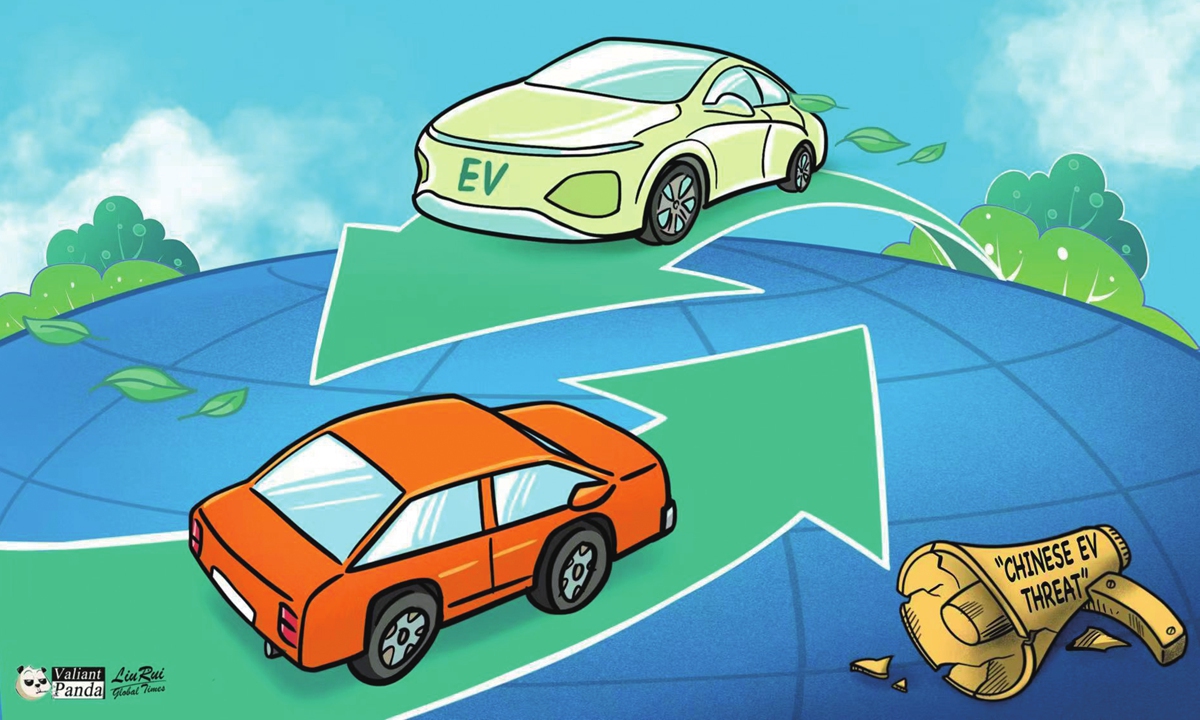
As China's auto industry gains momentum and domestic brands speed up their global expansion, some Western media outlets have been playing up the narrative that the rise of Chinese car brands has brought "shocks" to traditional international automakers.Such rhetoric is misleading and doesn't hold up as it rests on a false premise - that the global auto market is a fixed pie, where one player's gain is another's loss. The reality is just the opposite. The vehicle industry is undergoing a once in a century transformation, with electrification, intelligence, and connectivity opening up entirely new spaces for growth. In this process, the development of China's auto sector is not about taking away anyone's share, but about making the whole pie larger. To frame this transformation as a "shock" is not only a distortion of facts but also a misreading of opportunities.
Looking back at the growth trajectory of China's auto industry, its development is deeply rooted in a long-term, open and competitive market environment, persistent investment in technological innovation, and an understanding of diverse global consumer demands. Especially at the critical juncture of accelerating global electrification, Chinese companies, drawing on years of accumulated technological and industrial chain advantages, have provided mature and complete industrial support, while also significantly reducing the production and usage costs of new-energy vehicle (NEV) models through mass manufacturing.
This process has driven rapid, leapfrog development in China's NEV industry, and the growth has not only created broad development opportunities for China itself, but has also offered global consumers a better, more convenient green mobility experience, bringing the benefits of electrification to all corners of the world.
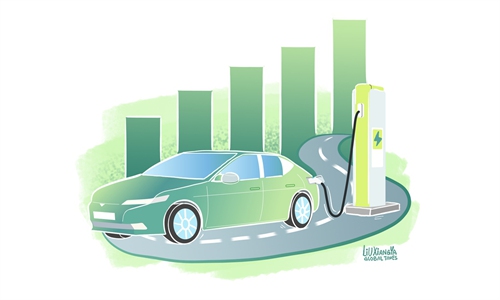
At the same time, the development of the NEV industry has spurred the construction of related infrastructure such as charging stations and energy storage facilities, nurtured new consumer markets and industrial ecosystems, and promoted the coordinated growth of upstream and downstream industrial chains. These contributions help advance the global low‑carbon green transition and inject new momentum into global economic growth. Such contributions deserve full recognition, not groundless stigmatization.
Of course, any major technological change will bring a reshuffling of the industry landscape. Companies that have built deep advantages in the era of fossil-fueled vehicles will naturally feel pain if they fail to adjust their course in a timely manner. However, clear-headed players will not blame others for this pain, but regard it as a motivation for innovation. The fact that more and more traditional international automakers have chosen to embrace the Chinese market and deepen cooperation with Chinese companies is sufficient to show their attitude and approach toward the development of the Chinese auto industry.
For instance, at the recent 2026 Beijing International Automotive Exhibition, German automotive giants Audi, BMW, and Mercedes-Benz, joining forces with Chinese partners such as FAW Group and SAIC Motor, unveiled new electrified products, technologies, and experiences, the Xinhua News Agency reported.
For its part, China has consistently adhered to the principle of open cooperation. It continues to support foreign automakers operating in China, providing them with a fair and transparent business environment, and sharing with the world the opportunities arising from the global auto industry's electrification transition.
In recent years, China has removed all market access restrictions for foreign investors in the manufacturing sector, and caps on foreign ownership in the NEV sector have long been lifted. This steady broadening of market openness is not only a commitment to opening-up but also tangible support for the global automotive industry.
Finally, the transformation of the global auto industry will not be derailed by noise, nor will consumers' genuine demand for high-quality products disappear because of protectionism. The development of China's auto industry is accelerating the spread of technology and driving down costs, ultimately benefiting every consumer around the world who longs for green mobility. This wave is unstoppable, and its dividends will belong to those who embrace change - not those who cling to prejudice.
RELATED ARTICLES