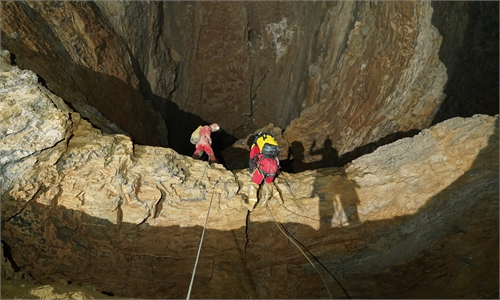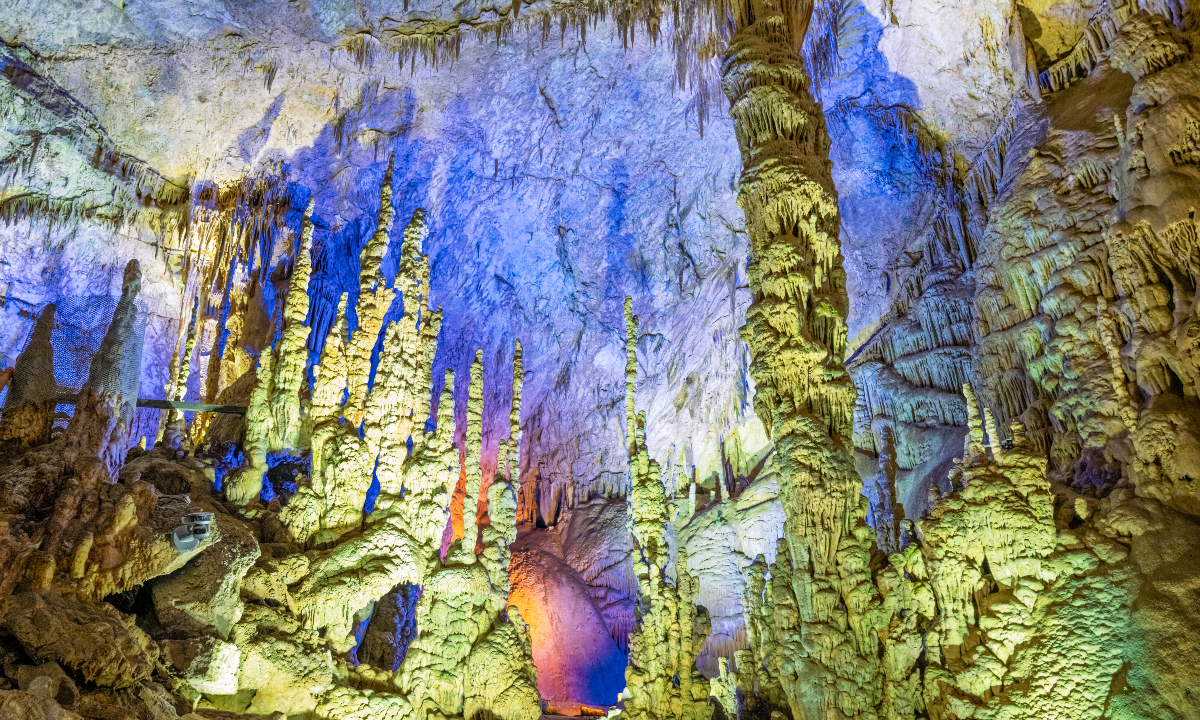
An underground cave karst formation seen in the Zhijindong Cave UNESCO Global Geopark in Bijie, Southwest China's Guizhou Province Photo: VCG
The International Organization for Standardization (ISO) recently released the world's first global technical standard for monitoring of key karst zones, led by China, China Central Television (CCTV) reported on Wednesday.
Karst terrain, a special hydrogeological structure formed through the erosion of soluble rocks by water, is widely distributed worldwide, spanning 22 million square kilometers and supplying domestic and industrial water to roughly a quarter of the world's population, per CCTV.
Due to the easy infiltration and loss of surface water and highly developed underground river systems, karst regions often face a unique set of resource and environmental challenges, including water scarcity, pollution, and land degradation.
Therefore, in-depth monitoring of hydrological, geochemical, and biological processes in key karst zones is regarded by the international academic community as essential for addressing these challenges, and has become a long-term focus of collaborative research among more than 40 karst-rich countries, including China, the US and Russia, according to CCTV.
The newly released China-led standard on monitoring hydrological, geochemical, and biological processes in key karst zones is based on China's long-term research achievements in karst carbon cycles and carbon sinks. It systematically establishes a comprehensive technical system, ranging everything from monitoring network setup to data services, according to the report.
Global key karst zones are classified into seven climate-based categories, ranging from tropical and subtropical humid karst to arid, Mediterranean, polar, alpine, and glacial karst, the report said.
In terms of monitoring network construction, the standard outlines spatial layouts for key monitoring stations, specifying requirements and detailing methods for monitoring soil, vegetation, hydrology, carbon cycles, and water environments in karst zones, CCTV reported.
The standard provides guidance for the entire karst monitoring data workflow, covering data collection, transmission, storage, processing, quality assurance, sharing, and related services, per the CCTV report.
Experts from China, Austria, Canada, Iran, Russia, Saudi Arabia, Serbia and several other countries collaborated on developing this standard, CCTV reported.
Global Times
RELATED ARTICLES