Elon Musk calls Unitree Robotics' manned mecha cool; experts point to new phase of robot development
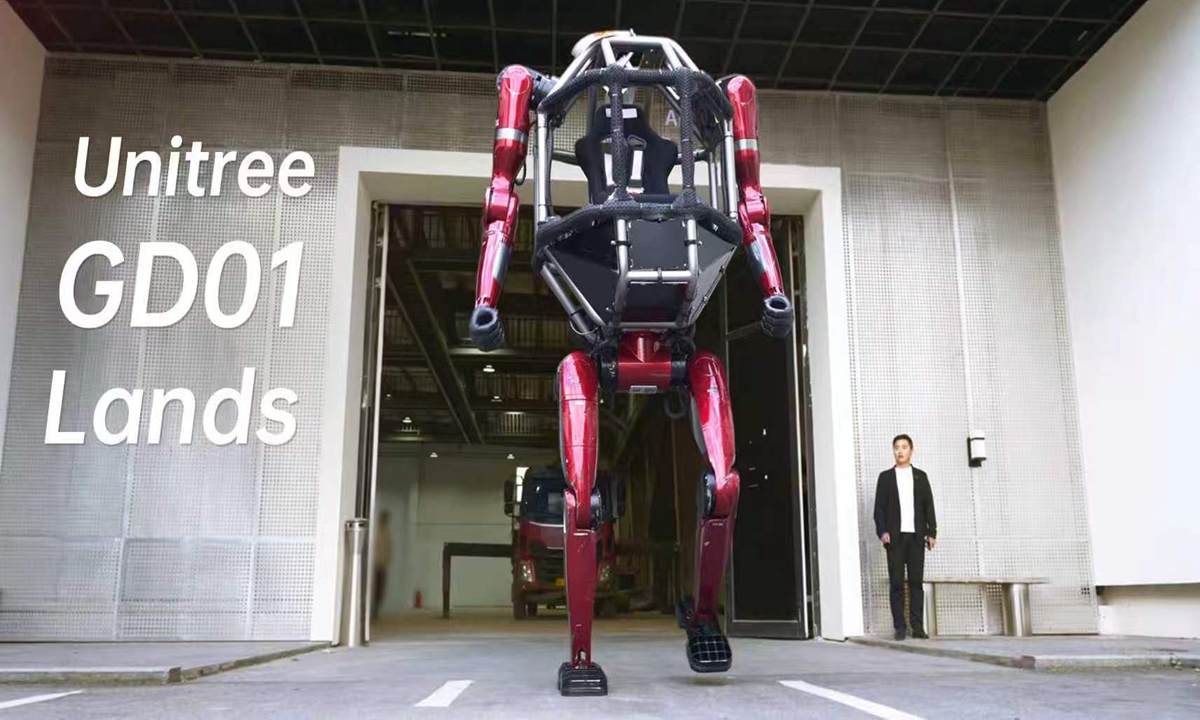
Unitree Robotics unveils the world's first production-ready manned mecha, the GD01. Photo: Courtesy of Unitree Robotics
Chinese robotics firm Unitree Robotics drew global attention after unveiling the GD01, billed as the world's first production-ready manned mecha, with footage of the machine rapidly spreading across Chinese and international social media, sparking heated discussions about the intensifying China-US robotics competition.
The 2.7-meter-tall machine, billed as a civilian vehicle and priced from 3.9 million yuan ($650,000), can transform between humanoid and quadruped modes while carrying a rider, and it weighs about 500 kilograms with a person inside.
Shortly after videos of the machine circulated online, Tesla CEO Elon Musk commented "cool" on X.
One netizen on YouTube commented, "US made cool robots in Hollywood movies, while China made practical robots in real life." JasonSmith, an American journalist in China, said on X that "China is building everything we dreamed of as kids" and "China is way, way, way ahead of the rest of the world," while commenting on Unitree's mecha.
Another X user from the US state of Texas seemed to express concern over China's rapid advances in robotics and automation, writing: "Aren't you concerned about the growing competitive pressure from China in robotics and automation? They can produce these systems for roughly 20 percent of US costs."
Chinese experts said that Unitree's latest mecha launch reflects a new phase in the US-China robotics rivalry and cooperation. China's robotics industry is no longer limited to vacuum robots or industrial robotic arms, but is now moving into large-scale, complex manned mechas — an engineering field long confined to science fiction — while demonstrating faster engineering execution and commercialization capabilities.
Chen Jing, vice president of the Technology and Strategy Research Institute, told the Global Times that the GD01 shows China has crossed a key "engineering threshold" in embodied artificial intelligence (AI). "It is no longer just a proof-of-concept machine confined to laboratories, but a product with a clear price tag and commercialization roadmap," Chen said.
He added that the product is also challenging the traditional notion that the humanoid form is the ultimate endpoint for robots, signaling that future robotics may evolve into more diverse human-machine hybrid forms.
Chen said that the GD01 signals a shift in robotics from being mere "tools" to becoming "mobility platforms." When robots can carry humans and perform tasks, they evolve from replacing human labor to extending human capability, similar to how cars and airplanes transformed mobility.
"At a cultural level, it completes the loop for the 'sci-fi generation.' Industrially, it opens new markets and creates disruptive momentum. Strategically, it challenges the claims that China only 'follows'," he added.
In recent years, major international media outlets and related agencies have increasingly highlighted China's rapid advances in humanoid robotics, embodied AI and robotics manufacturing ecosystems. Morgan Stanley recently said that China's early lead in humanoid robots could help drive "the next phase" of the country's global manufacturing and export dominance.
According to US media outlet Wired, "experts say the company's mastery of China's vast and complex hardware supply chain has helped it gain an edge in building robots cheaply." Wired also reported previously that Unitree's legged robots are incredibly cheap, costing tens of thousands of dollars or less, one-tenth of what a typical humanoid cost in the US.
"Chinese companies control 90 percent of the humanoid robot market, dominating the technology that will reshape manufacturing and labor. The West is barely competing," US media outlet Rest of the World reported in February.
"China is very good at AI, very good at manufacturing, and will definitely be the toughest competition for Tesla," Musk said at the World Economic Forum in January, as cited by the Rest of the World. "To the best of our knowledge, we don't see any significant competitors outside of China."
According to the South China Morning Post, Tesla began engaging hundreds of Chinese component suppliers for its Optimus humanoid robot project as early as three years ago, with some suppliers participating in research, development and hardware design. The report noted that Chinese suppliers have already sent multiple prototype components to Tesla, including new curved-glass head prototypes for Optimus in recent months.
Ma Jihua, a veteran tech insider, told the Global Times that "China is the only country in the world with all major industrial categories. Capabilities in high-performance motors, reducers, sensors, batteries and carbon-fiber materials are all very strong. With such a mature supply chain, companies can rapidly source components, accelerate product iteration, and significantly reduce development costs."
"As long as there is creativity, China can provide the technologies, components and manufacturing capabilities needed to turn ideas into reality," Ma said.
Among industrial robots used in the global electronics industry, 64 percent are installed in China, while Chinese manufacturers supply 59 percent of the sector globally. In the metal and machinery industry, Chinese robot suppliers have a domestic market share of 85 percent, underscoring China's growing strength across key robotics manufacturing sectors, according to a report by the International Federation of Robotics on May 5.
According to a report by Rest of World, the three non-Chinese companies that made Omdia's list of top-selling humanoid robot producers last year — Figure AI, Agility Robotics, and Tesla — each sold only about 150 units, far trailing their Chinese rivals. In contrast, Chinese firms such as Unitree and Agibot each sold more units than Tesla's overall 2025 production target of 5,000 humanoid robots, which Tesla ultimately did not meet.
Ma noted that while the US still has strong research and design capabilities in high-end manufacturing, many products struggle to move beyond the prototype stage or achieve large-scale commercialization. "In China, once a product is developed, companies quickly begin exploring real-world applications. Once applications are found, mass production follows, costs fall rapidly and a new round of iteration begins," he said, adding that this cycle is becoming one of China's biggest advantages in robotics competition.
The "new landscape" of US-China robotics competition means the rivalry is no longer limited to traditional industrial robots, but is rapidly expanding into embodied AI, humanoid robots and even large-scale manned mechas. The competition is shifting from simply developing smarter AI "brains" to determining who can integrate AI into real-world hardware faster and bring products into large-scale engineering and commercialization, experts said.
While the US maintains advantages in frontier AI models, software ecosystems and core algorithms, China is increasingly building strengths on the "physical world" side of robotics through its complete manufacturing system, dense supply chains and rapid commercialization capabilities, Ma said.
As the robotics industry moves from laboratories into real-world deployment, the capabilities to mass produce, iterate quickly and scale applications at lower cost are becoming key battlegrounds in the next phase of global competition, he said.
RELATED ARTICLES