Hantavirus crisis underscores the need for global co-op
By Published: May 13, 2026 08:47 PM

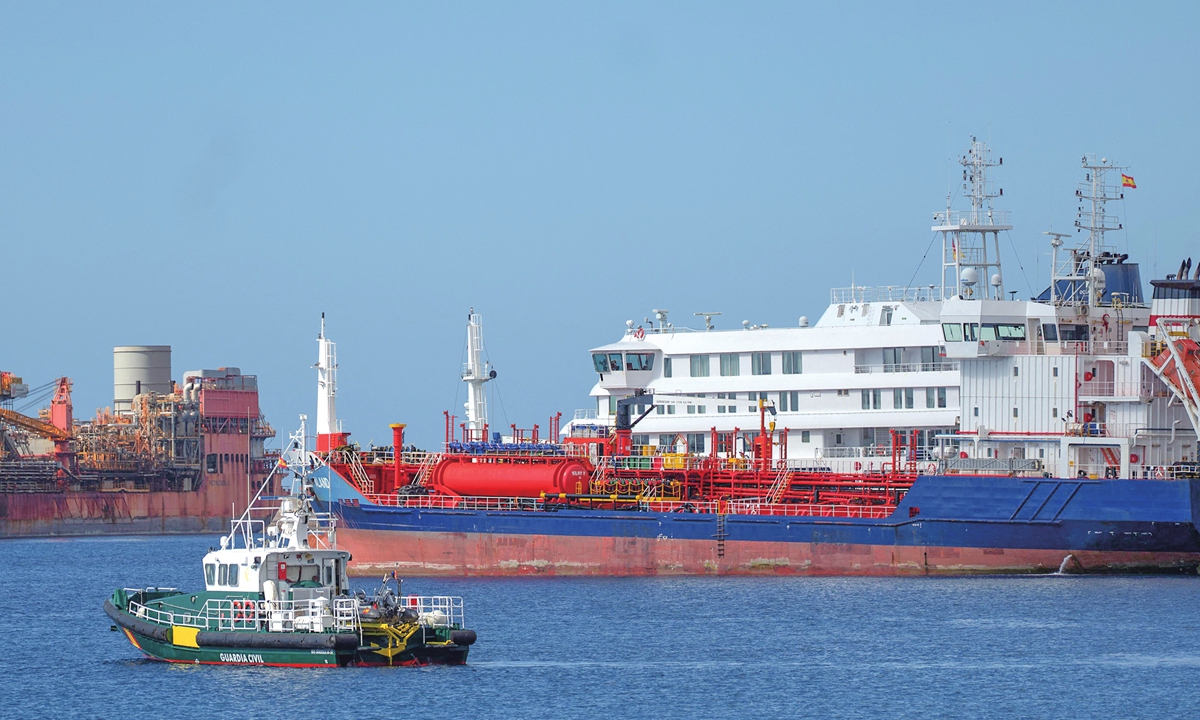
The hantavirus-hit cruise ship MV Hondius sails next to a tanker during a refueling operation in the port of Tenerife in Spain's Canary Islands on May 11, 2026. Spanish Health Minister Monica Garcia said on Monday that the final group of evacuees from the cruise ship will fly to the Netherlands later in the day. Photo: VCG
The hantavirus outbreak aboard the MV Hondius cruise ship has left three dead and nine confirmed infected as of press time. Some 122 guests and crew from 23 countries were scattered across the globe. This was a textbook transnational public health crisis - one that no country could manage alone, and no government could afford to ignore.
Viruses do not check passports. This is an old saying, but during this outbreak, it has become more vivid than ever. It also underscores the critical importance of cooperation.
The outbreak was first detected in Johannesburg, South Africa, on May 2, after a British man became critically ill and was taken into intensive care. From there, the map of cases spread rapidly - France, Spain, the US, Australia and the Netherlands. One ship had connected the entire world.
The WHO stepped in immediately. Working in coordination with the Spanish government, it oversaw the evacuation and repatriation of passengers.
UN Secretary-General António Guterres publicly voiced his support on X earlier this week: "I want to express my support for the government of Spain & others as they manage the hantavirus in close coordination with our @WHO colleagues. While the current public health risk from the virus remains low, it's important that international health efforts ensure the safety of all, including passengers & crew of the MV Hondius."
The hantavirus has an incubation period of up to six to eight weeks. Among those being monitored in California was a person who had never even set foot on the MV Hondius - they had simply sat near an infected passenger on an aircraft in South Africa. The virus' transmission chain respects no national boundary.
This is precisely why the WHO exists.
It is not any single country's instrument. It is the minimum collective line of defense that humanity has built to face shared threats.
The responsibility of great powers is not measured only in military strength or economic weight. It is measured by whether they are willing to remain at the same table when humanity faces a common danger.
The MV Hondius is sailing toward Rotterdam, carrying the body of a German passenger who died aboard the ship on May 2. Those scattered across Nebraska, Atlanta, Madrid, Paris and South Africa are waiting out a long and uncertain incubation period.
They come from different countries, but they face the same virus, the same unknowns, the same fear.
The virus does not distinguish between those who stayed in the WHO and those who left. Norway faces the same hantavirus. A grandmother in Nebraska and a student in Madrid wait out the same incubation period.
This is not a metaphor about global solidarity. It is a simple, stubborn fact of microbiology.
The question is not whether nations need each other when pathogens strike. They do. The question is whether the institutions built to turn that need into coordinated action will still be standing - and fully staffed, fully funded and fully trusted - when the next outbreak begins.
The author is a senior editor with the People's Daily and currently a senior fellow with the Chongyang Institute for Financial Studies at the Renmin University of China. dinggang@globaltimes.com.cn. Follow him on X @dinggangchina
RELATED ARTICLES