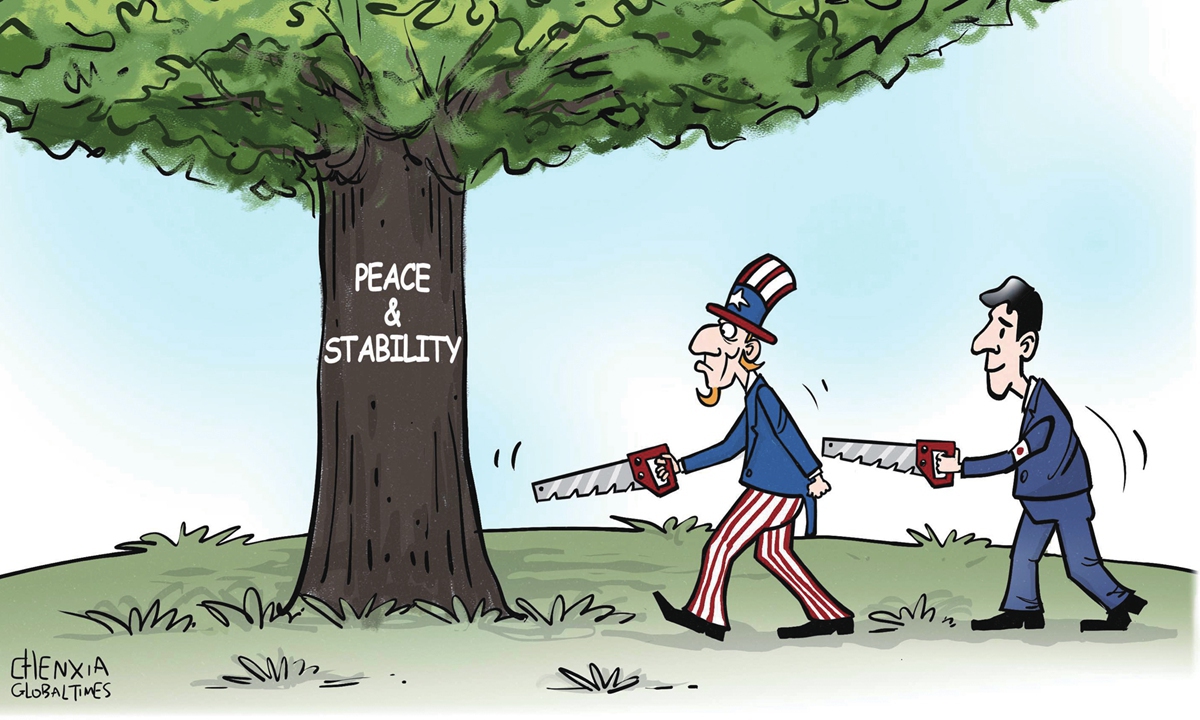
Illustration: Chen Xia/GT
The US-Israel attacks on Iran have not only plunged the Middle East into chaos and reshaped the global geopolitical landscape, they have also shattered Japan's long-held image as a "model upholder of international law." The crises in Ukraine, Venezuela and the Middle East have exposed Tokyo's double standards in international affairs. The sovereign principle and international justice are merely convenient tools for Japan in service of US hegemony.
Japan has a long record of double-standard diplomacy - treating countries differently based on political alignment. Following the full outbreak of the Ukraine crisis, Japan immediately positioned itself as a "guardian" of international order in the Western bloc. Then prime minister Fumio Kishida declared in his Message on the G7 Hiroshima Summit in March 2023 that "Russia's aggression against Ukraine is not a matter for Europe alone, but a challenge to the rules and principles of the international community as a whole." In the two-plus years since, successive Japanese governments rolled out dozens of sweeping sanctions against Russia, including financial asset freezes, energy trade restrictions, and visa bans, among others.
These measures have severed critical economic and trade cooperation between the two countries in defense, energy, and high-end manufacturing, causing Japan's exports to Russia to decline. By doing so, Japan was trying to convince others that nothing would stop it from "defending" international law, even its own energy import stability.
But this self-proclaimed "defender" of international law turns a blind eye when the US breaks the law. On January 3, in total disregard of the UN Charter, the US raided Caracas, Venezuela, and illegally captured the democratically elected President Nicolás Maduro. In the face of this lawless military operation, the Japanese government, which never shies away from lecturing others in international disputes, remained completely silent. Its "cherished" principles of sovereignty and justice were instantly cast aside, laying bare its blatant double standards.
The recent crisis in the Middle East has once again unmasked Japan's hypocrisy. US-Israel strikes against Iran ignited conflicts across the region, and disrupted global energy supplies. To the US and Israel, which launched the strikes in the first place, Japan immediately reverted to silence mode. It neither demanded an end to US military adventurism nor condemned Israeli provocations. Yet when it came to Iran, which acted in self-defense, Japanese officials were quick to unleash a steady stream of tough rhetoric. Prime Minister Sanae Takaichi, in a parliamentary response, parroted the US official line and publicly said "Iran must stop activities that bring instability to the region." Foreign Minister Toshimitsu Motegi telephoned Iranian Foreign Minister Abbas Araghchi, demanding Iran to lift control of the Strait of Hormuz and de-escalate tensions.
Takaichi administration's selective application of international law has drawn domestic backlash. Opposition lawmakers grilled the government in parliament: Why did it only demand de-escalation from Iran, the target of preemptive attacks?
Opposition parties and media slammed the government for abandoning the rule of law in its blind alignment with Washington, thereby eroding Japan's international credibility. Netizens railed that the government was a "US puppet" and asked it to stop serving hegemony. More than 8,000 citizens held an anti-war rally outside the parliament on March 10; four civil groups in Nagasaki issued a joint statement on March 13, demanding that the US and Israel immediately stop military operations, and urging the Japanese government to publicly condemn them and mediate for peace.
Ironically, at such a moment, the Japanese government announced it would set up a new "International Peace Mediation Unit" under the Foreign Policy Bureau of the Ministry, claiming to act as a "neutral third party" to mediate global conflicts and contribute to world peace and security. On the one hand, it openly takes sides with the US and Israel, and further complicates the situation; on the other, it presents itself as a self-styled "peacemaker" and puts on a mediating facade. Such contradiction and hypocrisy are utterly shameless, and will only make Japan a laughingstock in the international community.
In essence, Japan's double-standard diplomacy means completely abandoning diplomatic independence - whatever America says goes. Moreover, emboldened by US support, Japan feels empowered to provoke and suppress other countries. Such an approach has bankrupted its diplomatic credibility and left it strategically isolated and economically diminished.
Until it changes course, Japan will never become the "normal nation" that it aspires. Choosing to be a hegemonic pawn and practicing double standards will only reduce Japan to an international outlier, reaping the bitter fruit it has sown for itself.
The author is a commentator on international affairs. opinion@globaltimes.com.cn
RELATED ARTICLES