Trump arrives in Beijing for state visit after almost 9 years; China, US shoulder global governance responsibilities as major powers: experts
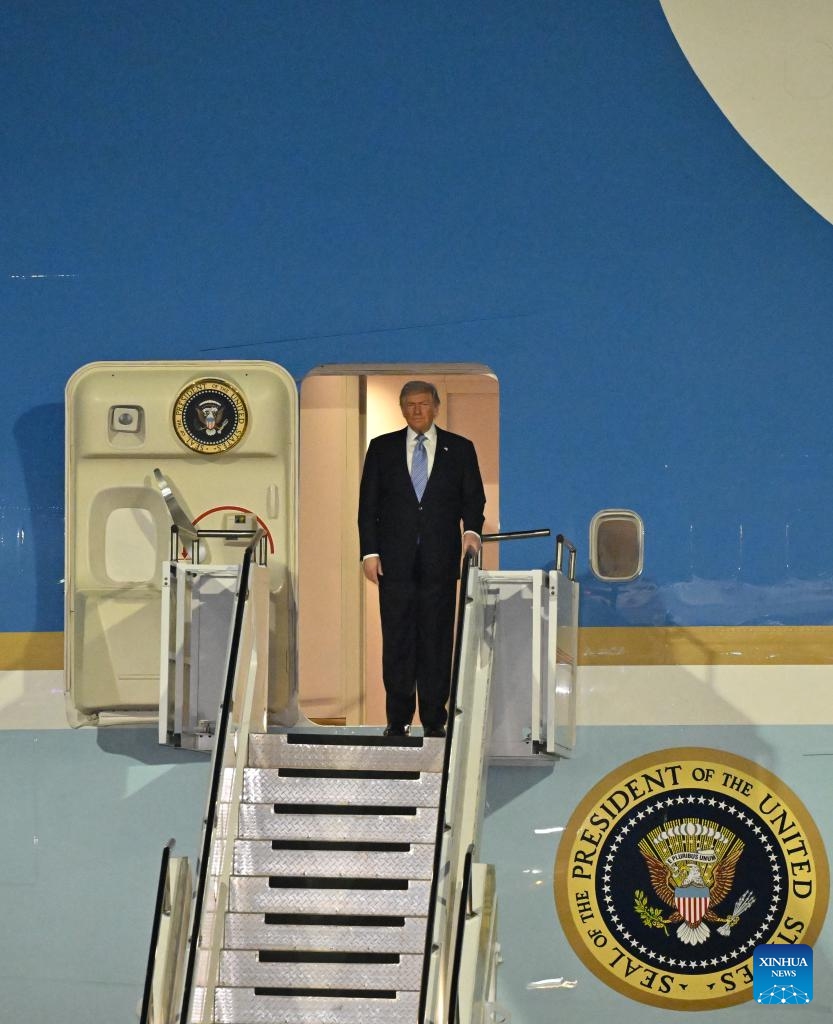
U.S. President Donald Trump arrives in Beijing on May 13, 2026, for a state visit to China. (Photo: Xinhua)
US President Donald Trump arrived in Beijing on Wednesday evening for a state visit to China, the first US presidential visit to China in almost nine years and Trump's second since November 2017, the Xinhua News Agency reported on Wednesday.
At the invitation of Chinese President Xi Jinping, Trump is visiting China from May 13 to 15, Xinhua reported.
Trump was welcomed by Chinese Vice President Han Zheng at the airport, according to Xinhua.
Before Trump departed the US, he told reporters "good things are gonna happen" in China, according to video clips released by China News Agency, which cited the Associated Press.
Heads-of-state diplomacy plays an irreplaceable role in providing strategic guidance for China-US relations. We welcome President Trump's state visit to China, Chinese Foreign Ministry spokesperson Guo Jiakun said on Wednesday.
During the visit, the two heads of state will have an in-depth exchange of views on major issues concerning China-US relations and world peace and development, Guo said, adding that China stands ready to work with the US to expand cooperation and manage differences in the spirit of equality, respect and mutual benefit, and provide more stability and certainty for a transforming and volatile world.
Chinese observers expect the leaders' summit to chart the course for the development of China-US relations in the period ahead, hoping the two major powers can expand the list of dialogue and cooperation, advance positive agendas, scale down the list of negative issues, and properly manage differences. This will not only set the tone for bilateral relationship to develop in a stable and sustainable manner, but also explore a correct way of future engagement, they noted.
Delicate and consequential
As CEOs from big American conglomerates, including Tesla's Elon Musk, Apple's Tim Cook, BlackRock's Larry Fink, Boeing's Kelly Ortberg and Blackstone's Stephen Schwarzman joined Trump's delegation to China, a dramatic moment came when Nvidia CEO Jensen Huang boarded the Air Force One unexpectedly in Alaska during a refueling stop, according to media reports. A report by The New York Times was headlined "Nvidia CEO hitches ride with Trump to China after last-minute invite." Earlier, media reported that Huang would not join the delegation.
There is broad scope and enormous potential for pragmatic cooperation between China and the US. We look forward to deeper exchanges and cooperation between the Chinese and US business communities under the strategic guidance of the two heads of state, making new contributions to the stable, sound and sustainable development of China‑US relations, a spokesperson for China Council for the Promotion of International Trade said on Wednesday when commenting on the accompanying delegation of US business representatives.
As Air Force One was heading toward Beijing, Chinese and US delegations held candid, in-depth and constructive exchanges in South Korea on Wednesday on economic and trade issues of mutual concern, as well as on further expanding practical cooperation.
According to Xinhua, Chinese Vice Premier He Lifeng, also China's lead person for China-US economic and trade affairs, and US lead person Treasury Secretary Scott Bessent conducted the consultations.
Guided by the important consensus reached by the two heads of state, the two sides upheld the principle of mutual respect, peaceful coexistence and win-win cooperation.
Economic and trade issues are expected to remain one of the major topics among all the issues on the table for the high-stakes heads-of-state summit, Da Wei, director of the Center for International Security and Strategy at Tsinghua University, told the Global Times on Wednesday.
The inclusion of more high-tech and financial firms in the US delegation compared with Trump's 2017 visit to China sends a clear signal of the importance both sides attach to cooperation in these areas, He Weiwen, a senior fellow at the Center for China and Globalization, told the Global Times.
According to a report released by the American Chamber of Commerce in China (AmCham China) on April 23, half of the surveyed US companies still rank China among their top three global investment destinations, while 79 percent of respondents hold a positive or neutral outlook on the future of China-US relations in 2026, up 30 percentage points from last year.
Analysts noted that despite of differences and conflicts, an "equal and constructive" approach is essential to achieving practical outcomes, rather than relying on unilateral pressure. Many US economic and trade restrictions targeting China will ultimately hurt the US' own economic interests.
Farhan Haq, deputy spokesperson for the UN Secretary-General noted that China and the US are two of the main economic powerhouses of the world and any way they can deal with any of their differences in economic policies would be beneficial for the world as a whole, according to the UN website.
According to a CNBC earlier report, China and the US are supposed to "seal outcomes on potentially a huge range of issues."
Among a wide range of issues, the Taiwan question remains the most sensitive as it concerns the political foundation of China-US relations, analysts said.
The Taiwan question is at the core of China's core interests, and concerns peace and stability across the Taiwan Straits and in the region, and naturally also bears on China-US relations, Wu Xinbo, Dean of the Institute of International Studies of Fudan University, told the Global Times on Wednesday.
Bilateral to global
Compared to President Trump's previous China visit in 2017, there have been major changes in both countries as well as the international landscape. Da describes 2017 as being a time at the tail end of neoliberal globalization, while in 2026, China and the US represent two major powers in a multipolar world that is polarizing and fragmenting.
Guo Jiping, an international commentary column of the People's Daily, published an article on Wednesday titled "China-US relationship cannot go back to the old days, but it can embrace a brighter future."
As this future takes shape under close global watch, international media outlets are paying high attention to Trump's visit and the upcoming meeting between the two leaders.
The Diplomat wrote that the summit's primary function is one of signal stabilization - providing a political assurance that competition, however intense, remains bounded within controllable limits.
Viewed from a broader perspective on history, the importance of China-US cooperation in the global landscape is growing ever greater, read an article published by the People's Daily on Tuesday.
To understand the global significance of bilateral relations, Wu noted that on one hand, China's communication with the US on many topics, including tariff issues, actually represents not only China, but also the interests of the majority in the international community, particularly developing countries.
On the other hand, China-US consultations are needed to address a slew of global challenges, ranging from regional hotspot issues and energy security to global recovery and global public goods, Wu said.
For China and the US, competition cannot replace coexistence, nor can differences overshadow cooperation. Rational engagement and pragmatic coordination represent the most rational and sustainable choice for both sides, according to Wang Dong, executive director of the Institute for Global Cooperation and Understanding at Peking University.
Through rational communication and cooperation, China and the US can not only stabilize the fundamentals of bilateral ties, but also inject certainty into global governance, resist the resurgence of bloc confrontation, and contribute to global development, regional peace and the steady transformation of the international order. This is also the global responsibility that both countries ought to shoulder, Wang told the Global Times.
As President Trump expects "good things" before his departure, Da Wei noted that despite issues and challenges, both China and the US share the will to maintain stability and are taking actions, which is in itself a positive news.
RELATED ARTICLES