Chinese Zhuque-2E rocket completes high-capacity launch mission
Flight marks large-scale application of liquid oxygen-methane vehicles
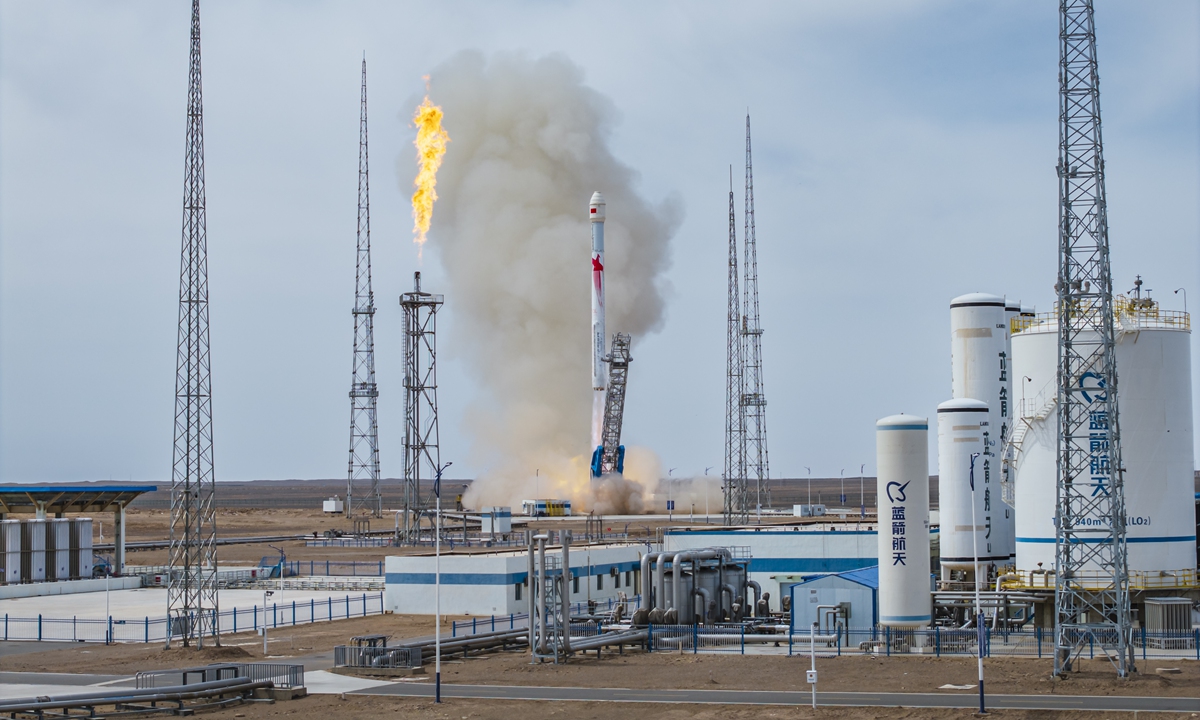
The Zhuque-2E Y5 carrier rocket blasts off from the company's launch site at Dongfeng Commercial Space Innovation Test Zone on May 14, 2026. Photo: Courtesy of the LandSpace
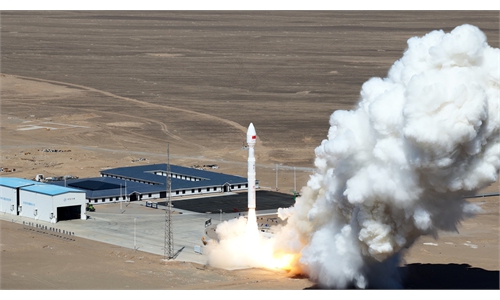
The Zhuque-2E Y5 carrier rocket, developed by Chinese commercial aerospace firm LandSpace, blasted off from the Dongfeng Commercial Space Innovation Test Zone at 11 am on Thursday. The rocket successfully completed all flight mission procedures as planned, and the launch was declared a complete success, said the company, marking nation's liquid oxygen-methane propelling rocket entering the stage of large-scale application.
The Global Times reporter observed the mission from the company's headquarters in Beijing, where an internal livestream event was held for its employees. The venue was packed, with many attendees standing near the large screen to follow the launch in real time. At each key stage of the mission, and especially after the chief commander announced the mission's success, the room erupted in applause and cheers.
The launch carried a 2.8-ton customized experimental payload designed for large-scale constellation networking to the 900-kilometer-orbit. A representative from the company told the Global Times that this marked a breakthrough for the ZQ-2E model in heavy payload delivery capability, providing mature and reliable launch support for future large-scale constellation networking projects.
The Zhuque-2E is a two-stage cryogenic extended liquid carrier rocket that was developed through systematic iterative design, drawing fully on the proven technical heritage of its predecessors Zhuque-2. The rocket measures 3.35 meters in diameter, with a maximum fairing diameter of 4.2 meters and an overall length of 55.9 meters. Its liftoff mass is 267 tons (excluding payload), with a liftoff thrust of 338 tons.
The first stage is powered by four TQ-12A liquid oxygen-methane engines, each producing 828 kilonewtons of sea-level thrust — an increase of 108 kilonewtons per engine over previous iterations — and newly features an autonomous thrust self-correction function. The second stage is equipped with a TQ-15A liquid oxygen-methane engine delivering 858 kilonewtons of vacuum thrust. The rocket also features an elongated first-stage body, increased propellant capacity, and structural weight reductions to further boost performance and payload capacity.
This marks LandSpace's first launch mission since the Zhuque-3 mission on December 3 last year. In that mission, its first-stage booster suffered anomalous combustion during recovery, failing to achieve a soft touchdown on the landing pad. The recovery test was unsuccessful, and the specific cause remains under investigation, Xinhua News Agency reported.
The Zhuque-3 second flight vehicle will conduct another recovery test in the first half of 2026, making an all-out push toward the core goal of first-stage booster recovery, said Zhang Xiaodong, chief designer of LandSpace's Zhuque-3 reusable rocket, in April at an industrial conference, according to another Xinhua report.
China is on track to conduct over 100 space launches this year, including more than 60 commercial missions. Private rockets are expected to undertake more than 30 launches, according to the Securities Times.
Under this backdrop, commercial space companies are developing larger and more efficient carrier rockets. On March 30, the Kinetica-2 liquid-propellant rocket, developed by China's commercial space firm CAS Space, completed its maiden flight.
According to the developers, the rocket stands 53 meters tall, with a liftoff weight of 625 tons and produces 753 tons of thrust. It can deliver up to 12 tons to a 200 kilometers low Earth orbit or 8 tons to a 500 kilometers sun-synchronous orbit. These figures give it strong capabilities for heavy payloads while maintaining high reliability, ease of manufacturing, simple operations, and great potential for future reusability.
Notably, its unique design uses a uniform 3.35-meter diameter for both the core stage and boosters, allowing tanks, interstage sections, and other components to be fully interchangeable, making its building like assembling building blocks, according to the company.
RELATED ARTICLES