Photo: Science and Technology Daily
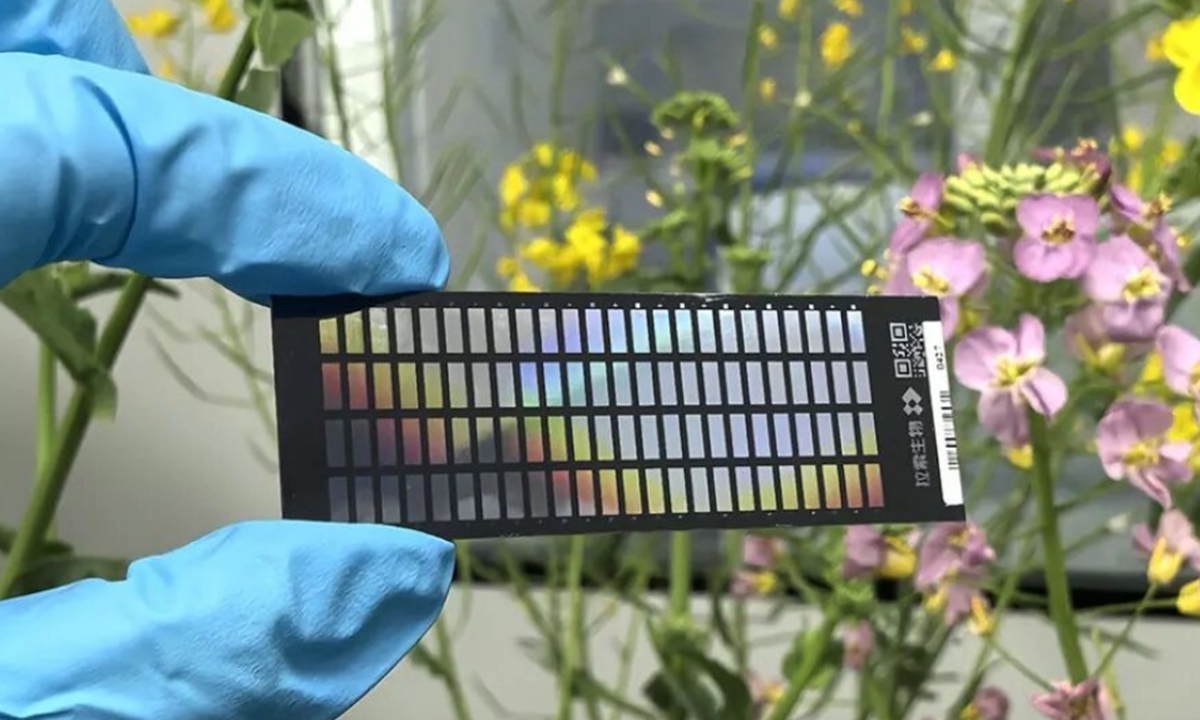
China's first 20K solid-phase gene chip for Brassica napus, codenamed "Zhongxin Oil No. 1," has been officially released by the Jiangxi Academy of Agricultural Sciences in collaboration with Huazhong Agricultural University and Suzhou Lasuo Biochip Technology Co, China's Science and Technology Daily reported on Thursday. The launch breaks the nearly 20-year foreign monopoly on solid-phase gene chip technology, and this breakthrough marks the transition of China's rapeseed breeding industry's from traditional "weather-dependent" methods to a new era of precision "smart breeding," per the report.According to the report, the solid-phase chip spotting process had long been monopolized by a handful of US companies, which maintained extremely tight technological blockades. Over six years, the Chinese research team compiled more than 1,600 experimental notebooks, wrote over 2,700 experimental reports, and collected more than 10 million scanning images. Yet the failure rate reached 99.9 pert, with 80 billion microbeads scrapped.
The turning point came in 2024 through industry-academia-research collaboration with the Chinese Academy of Sciences and Nanjing University. A group of daring young scientists - born between the 1990s and 1995s - finally turned the spotting process from blueprint to reality, giving "Zhongxin Oil No. 1" a solid foundation.
In 2025, the research team led by from the National Rapeseed Improvement Center at Huazhong Agricultural University took the lead in providing a large amount of critical gene locus information. Subsequently, Chief Scientist Hua Wei from the Oil Crops Research Institute of the Chinese Academy of Agricultural Sciences also joined the effort, expanding the number of gene loci from thousands to 20,000 — nearly covering all universal research needs and creating a comprehensive "gene dictionary" for rapeseed.
To integrate this "dictionary" into the chip, the research team established a high-frequency communication mechanism with enterprise to bridge the gap between technological breakthroughs and industrial application. Officially launched in October 2025, the small chip "Zhongxin Oil No. 1" carries more than 17,000 genome-wide background markers and more than 1,500 functional loci.
"Breeding a new variety used to take up to 10 years. Now it can be shortened to as little as three years. A single test costs only 25 yuan and results are available within 72 hours," Li Shuyu, a researcher at the Jiangxi Academy of Agricultural Sciences, was quoted as saying in the report.
"Zhongxin Oil No. 1" is just the beginning. According to the report, version 2.0 is already in preparation and will contain 60,000 gene loci. Meanwhile, a product matrix covering major livestock such as pigs, chickens, cattle and sheep, as well as key crops including wheat, corn, soybeans, rice, and rapeseed, has taken shape.
Global Times
RELATED ARTICLES