IN-DEPTH / IN-DEPTH
Young volunteers turn tree-planting into rising public welfare trend, showcasing nationwide commitment to building a Beautiful China
Let's go plant trees
By Global Times reporter and People's Daily reporter Jiang Jie Published: May 14, 2026 11:06 PM

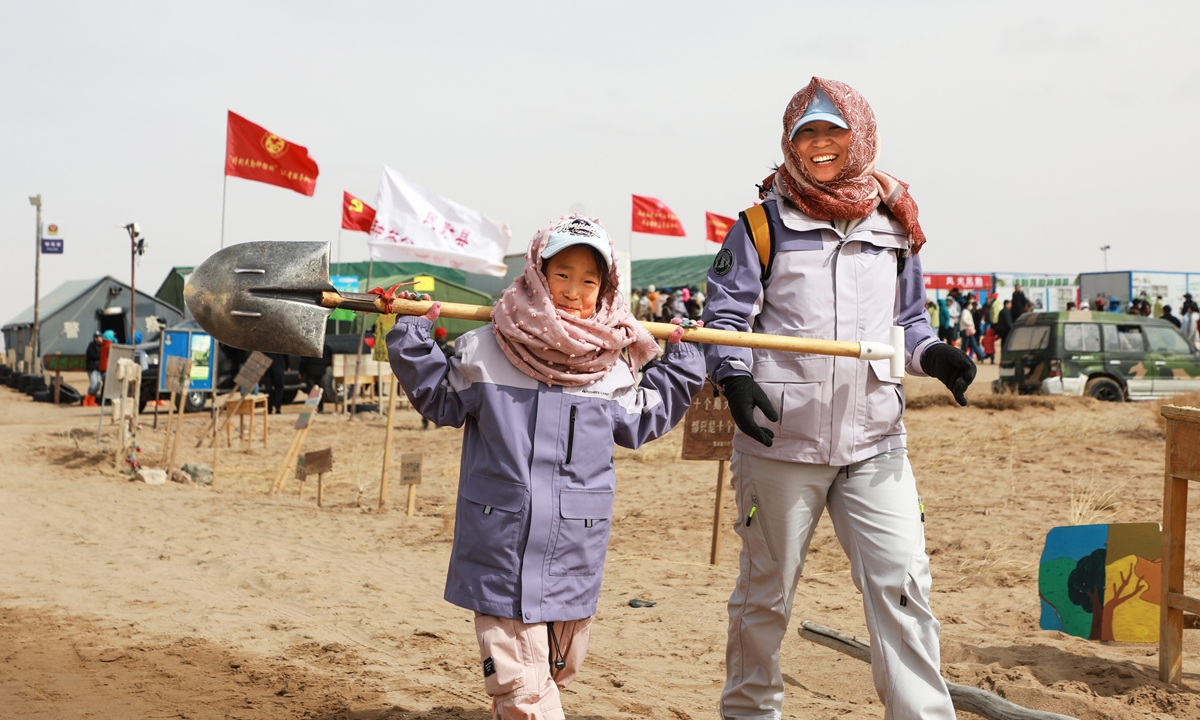
A child and an adult walk together with a shovel, ready to join the reforestation effort in the desert of Minqin County. Photo: Courtesy of publicity department of Minqin County
Editor's Note:"Building an ecological civilization concerns the well-being of the people and the future of the nation."
Chinese President Xi Jinping, also general secretary of the Communist Party of China (CPC) Central Committee and chairman of the Central Military Commission, pointed out: "Respecting, adapting to, and protecting nature is essential for building China into a modern socialist country in all respects."
As outlined in the 15th Five-Year Plan (2026-2030) for national economic and social development, securing major breakthroughs in strategic tasks of overall importance to Chinese modernization and making major new progress in the Beautiful China Initiative are set as key objectives.
The Global Times is launching a series of articles titled "BeautifulChinaING." From the perspectives of the beauty of nature, the beauty of system and the beauty of lifestyle, the series uses both Chinese and international cases as entry points. Through field reporting and video storytelling, it explores how green development has become a defining feature of Chinese modernization while showcasing China's role as a responsible major country providing global public goods.
In this installment, we turn our focus to China's broader fight against desertification and the growing public participation behind it. Through the stories of young volunteers planting trees in Minqin County, Northwest China's Gansu Province, and similar efforts across the country, this story examines how grassroots action, youth engagement and long-term ecological restoration are becoming part of the wider practice of building a Beautiful China.
This spring, many young Chinese people have chosen not to spend their holidays at popular tourist attractions, but on the edge of the desert in Minqin County, Northwest China's Gansu Province.
On social media, "Come to Minqin and plant a tree" has become a trending topic. Young people from across the country have paid their own way to travel there, carrying shovels and saplings on their backs, planting native sand-fixing plants amid wind and sand. In doing so, they have turned "going to the desert to plant trees" into a new public welfare trend.
As of May 5, the 2026 "Come to Minqin and plant a tree" volunteer campaign had received more than 50,000 online registrations and attracted 46,000 volunteer visits in total. At its peak, more than 4,000 volunteers booked slots in a single day via the online platform to come to Minqin to plant trees, the People's Daily reported.
This trend also stands as a vivid testament to the country's broader green development efforts.
According to the Xinhua News Agency, China completed afforestation of 36.6 million hectares over the past five years, restored 289,600 mu (19,307 hectares) of wetlands, and treated 10.13 million mu of desertified land. The country has continued to see reductions in both desertified and sandy land areas, becoming the first in the world to achieve "zero growth" in land degradation.
Zhao Yu, who works in the internet industry in Beijing, is one of the volunteers coming to Minqin. She first came across stories about Minqin's desertification control efforts on short video platforms and was moved by the persistence of Zhong Lin, a young man born in 1998 who returned to his hometown, and local residents who have spent years guarding the oasis.
In March, she arrived in Minqin. She had originally thought planting trees was simply about "digging a hole and putting a sapling in it." But after truly stepping into the desert, she found that preventing and controlling desertification was far more arduous than she had imagined - and far more concrete.
"I used to think ecological civilization and green development were somewhat distant from ordinary people," Zhao told the Global Times. But in Minqin, she said, she felt for the first time that ecological civilization could be a tree planted by ordinary people with their own hands. It could also be the genuine efforts of a group of young people bending over in the wind and sand to bring more green to the desert.
From screen to sand
The first thing Zhao felt after arriving in Minqin was a strong sense of contrast.
Before setting off, Minqin had been, to her, simply a destination many young people were heading to under related topics on social media platforms like Douyin and RedNote. Only after arriving did she realize that the wind and sand pressure borne by this land was far more direct and heavier than what she had seen on screen.
On the way to Minqin, the scenery outside the car window gradually turned vast and desolate. Along the way, she heard local residents explain that Minqin lies between the Tengger Desert and the Badain Jaran Desert like "a sandwich," and has long faced the pressure of being hemmed in by the two deserts.
Planting trees in the desert was not as easy as she had imagined. This year, the base adopted a new planting method, putting sand-tolerant plants into nutrient cups for mixed planting, in order to improve the survival rate and enrich biodiversity.
Saxaul trees, also known by their scientific name Haloxylon ammodendron, are highly drought-resistant plants that help stabilize sand dunes and form shelter belts. A single saxaul tree can help stabilize about 10 square meters of desertified soil.
Volunteers were divided into different groups. Some distributed saplings, some filled soil, some dug holes, and others watered and backfilled them. Since the nutrient cups were relatively tall, the holes had to be dug deep - sometimes above knee level. The loose sand would quickly slide back into the hole soon after being shoveled aside, so one hole often required several people to work together.
Zhao's group had eight or nine people, and over several days, they planted nearly 100 saplings.
The physical hardship soon became tangible. When the wind and sand were strong, sand would get into their hats, masks, shoe covers and the seams of clothing. Under the noon sun beating down on the sand, those working would soon be drenched in sweat.
But what impressed Zhao most was not the hardship, but the tacit understanding that formed among the young people on site. She saw that many volunteers were around 20 years old, and quite a few had never participated in environmental protection activities before or even held a shovel. Yet after arriving, they all carefully learned how to distribute saplings, dig holes and backfill them, worried that the saplings they planted might not survive.
One detail particularly touched her. A teenage girl in her group said while planting trees, "I must make sure the tree I plant survives."
Zhao said the remark helped her immediately understand the state of mind of many young people after arriving in Minqin: "They were not there for an easy visit and a selfie. They truly hoped that the trees they planted with their own hands would take root, sprout and grow."
She also noticed that local residents were especially warm toward volunteers from other places, whether in terms of accommodation, meals, transportation or other services.
The thought deeply touched her. "Planting trees here carries not only the enthusiasm of young people from outside, but also Minqin people's cherishing of and expectations for their homeland," Zhao told the Global Times.
After returning to Beijing, Zhao posted her experience online, and the response surprised her. She said the questions she received most often from netizens were how to sign up, how to get to Minqin and whether they could make donations. Many people also sent her long private messages expressing a keen interest to take part.
After receiving all these messages, and seeing how enthusiastic people were, she made a separate guide video, compiling information on registration methods, travel routes and precautions.
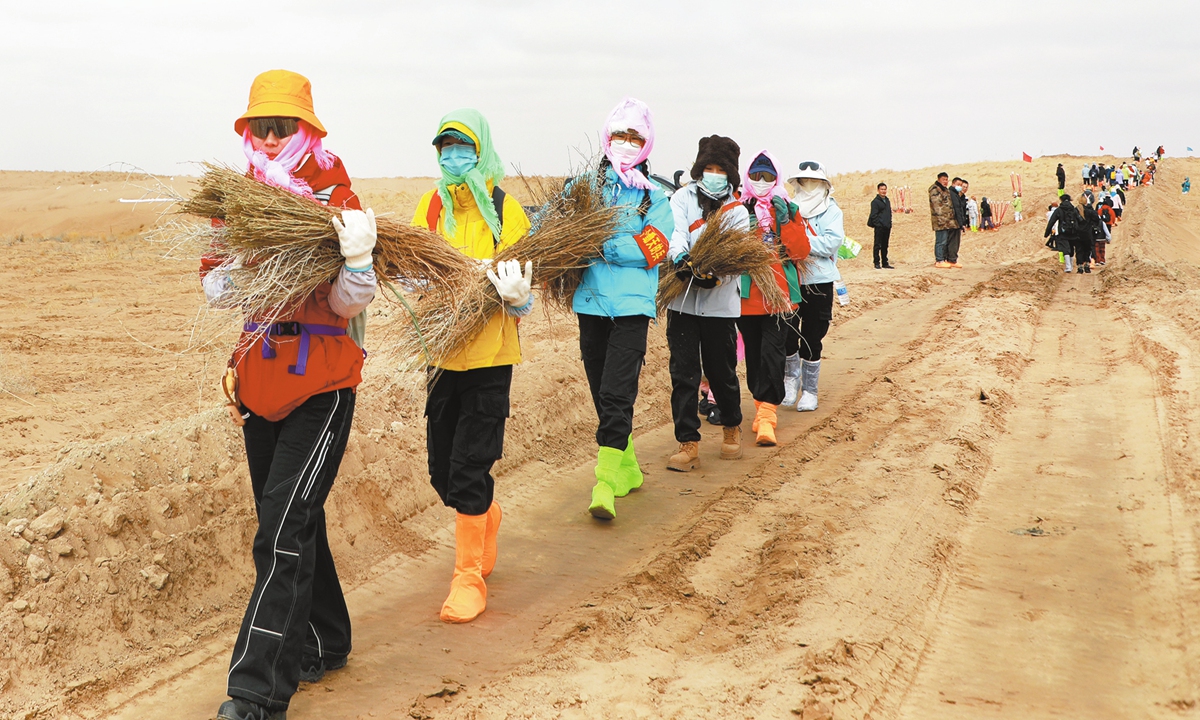
Volunteers walk in a line across the desert in Minqin County, carrying bundles of saplings for a reforestation project. Photo: Courtesy of publicity department of Minqin County
Growing grovesIn Minqin, the arrival of young people did not begin only this year.
According to the People's Daily, as early as 2006, Ma Junhe, a local resident of Minqin, and his friends jointly launched a volunteer association. In 2007, they organized volunteers online for the first time to come to Minqin to plant trees and fight desertification. In the first year, only around 20 people answered the call and came to the desert to plant trees.
More than a decade later, the internet has continued to play a role, but in a different way. Short videos, variety shows and social media platforms have brought Minqin onto the phone screens of more young people.
The Global Times learned from the Minqin county publicity department that in February 2024, the production team of an online variety show filmed a program in the county, where the guests and Zhong Lin, a young entrepreneur who returned to his hometown in Minqin, jointly planted 180,000 saxaul trees on the edge of the Tengger Desert.
After watching the program, many young people made the journey to the county, and took part in tree-planting activities.
In February 2025, the county issued a recruitment notice for the "Come to Minqin and plant a tree" public welfare tree-planting campaign. Soon afterwards, more volunteers from across the country began arriving in Minqin to take part in voluntary tree planting.
The Global Times learned from the Minqin county publicity department that since the campaign was launched, it has attracted more than 92,000 volunteer visits from across the country.
Zhong said he experienced failure when he first began working on nonprofit desertification control.
When he first tried to plant 500 saxaul trees, most of them failed to survive due to his lack of experience. He later studied materials on desertification control, sought advice from local villagers, summarized the lessons learned and planted another 53 hectares of saxaul trees. He also moved his home to the edge of the desert to guard the saplings as they grew. The survival rate of that batch of saxaul trees reached 80 percent.
"Planting trees in the desert is something Minqin people have been doing for generations," Zhong told the Global Times. Now, through the "Come to Minqin and plant a tree" initiative, more and more young people from across the country have joined in, and many parents have brought their children here to plant trees, Zhong said. "This is the meaning of what I am doing."
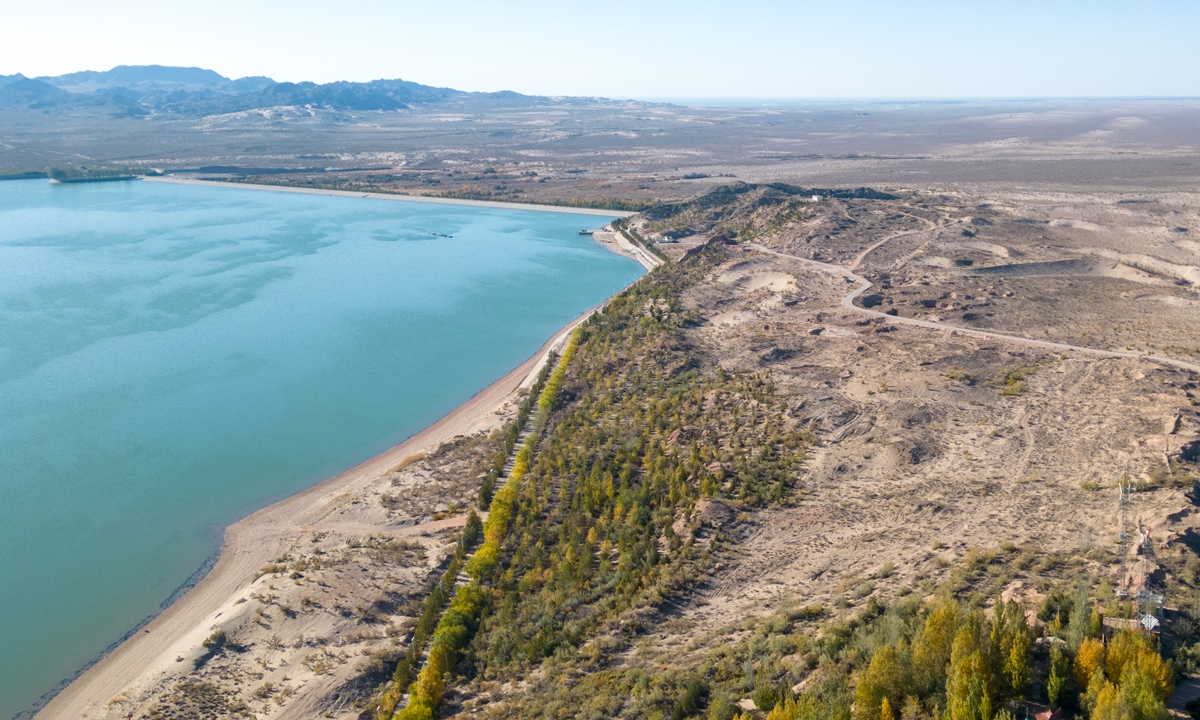
A view of Minqin County, Northwest China's Gansu Province Photo: VCG
Grassroots synergyThe continuous influx of volunteers has also brought new tests to this northwest China county, which has a relatively small permanent population.
The Global Times learned from the Minqin county publicity department that, since 2025, in order to ensure the smooth and orderly operation of the "Come to Minqin and plant a tree" volunteer campaign, Minqin has refined services and support around the full process of volunteers' needs, covering meals, accommodation, transportation and tree planting. Local authorities have also set up police, medical and emergency service points.
Such efforts are emerging in more places. In the Hunshandake Sandy Land in North China's Inner Mongolia Autonomous Region, spring tree planting has also attracted many volunteers.
During this year's May Day holidays, a public welfare spring planting campaign was launched in the Hunshandake Sandy Land in Inner Mongolia. On the first day, more than 300 volunteers from different places planted drought-resistant and sand-fixing species such as yellow willow and caragana on 6.7 hectares of mobile sandy land, with professional technicians providing on-site guidance, reported the Inner Mongolia TV.
From Minqin to Hunshandake, and from offline volunteer tree planting to internet-based public welfare platforms, the ways in which the public participates in desertification prevention and control are becoming more diverse.
Behind this public participation is China's long-term process of advancing large-scale land greening and desertification prevention and control. According to a report released by the National Greening Commission, by 2025, various regions across China had built 3,071 "internet + voluntary tree planting" bases, launched 62,000 responsibility-fulfilling activities throughout the year and received more than 33 million visits.
For Zhao, these grand figures eventually came back to a small detail in everyday life.
One day, her niece, who is still in kindergarten, suddenly said to her, "Auntie, I want to plant a tree." Zhao asked what kind of tree she wanted to plant. The child replied, "A saxaul tree."
The answer surprised Zhao. She said she had not told the child in detail about the tree-planting process in Minqin, yet the name "saxaul tree" had already taken root and begun to sprout in the child's heart.
RELATED ARTICLES