Xi, Trump hold talks, agree on new vision for bilateral ties
Historic meeting underscores ‘renewed prospects for relations’
By and Shen Sheng Published: May 15, 2026 12:52 AM

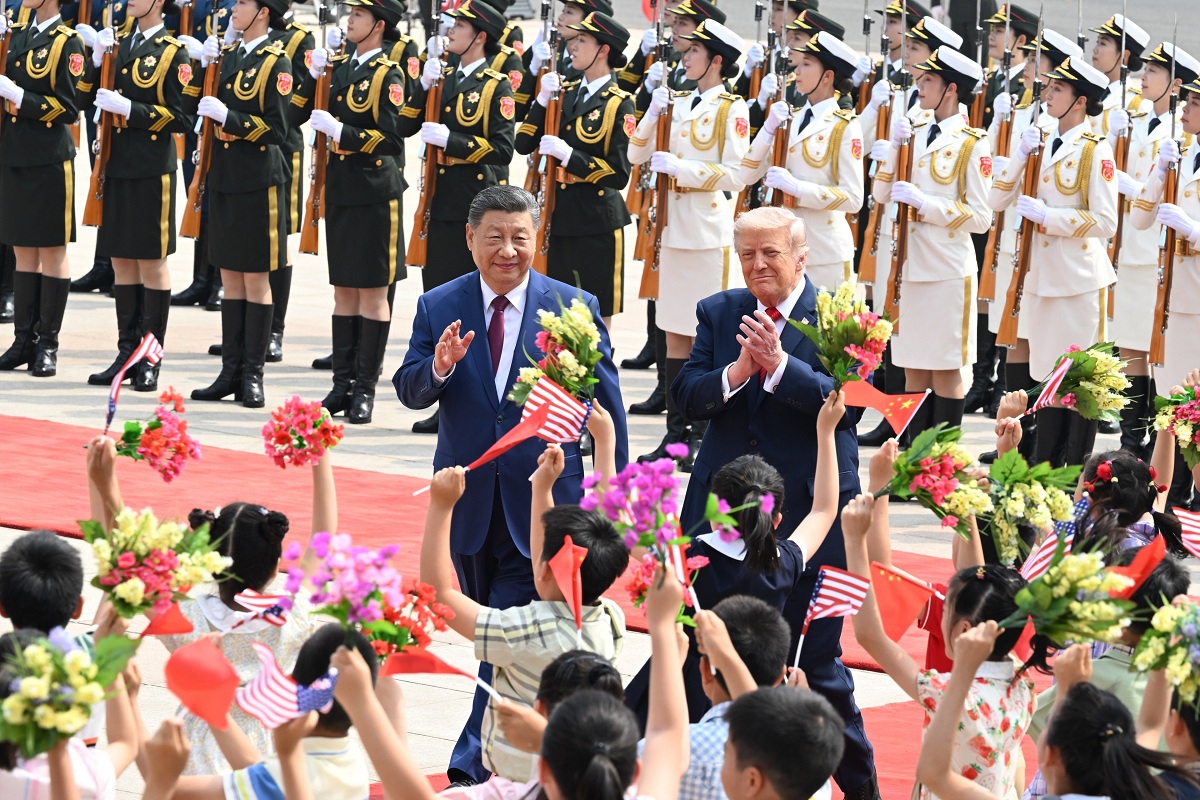
Chinese President Xi Jinping holds a welcome ceremony for US President Donald Trump, who is on a state visit to China, outside the Great Hall of the People prior to their talks in Beijing, capital of China, on May 14, 2026. Photo: Xinhua
Trump's state visit—the first by a sitting US president in nearly nine years—unfolded at a rapid pace. Tucked between a meeting at the Great Hall of the People and a grand evening banquet, the visit to the 600-year-old Temple of Heaven carried deep symbolic weight. During the tour, Xi explained the site's rich history to Trump, noting that ancient emperors once held state rituals there to pray for national prosperity, social harmony, and favorable weather for good harvests, according to Xinhua.
The Chinese leader said it reflects the traditional Chinese concept that the people are the foundation of a state, adding that the Communist Party of China has inherited and carried forward this people-centered philosophy rooted in the Chinese civilization.
Trump is visiting China from Wednesday to Friday. This is Trump's second visit to China since November 2017.
Chinese analysts noted that the visit and the historic meeting between the two leaders underscored renewed prospects for China-US ties. They added that such progress is widely regarded internationally as a constructive force for safeguarding peace, enhancing security, and supporting global economic growth.
New vision
President Xi held talks with visiting President Trump at the Great Hall of the People in Beijing on Thursday, Xinhua reported.
"Can China and the US overcome the Thucydides Trap and create a new paradigm of major-country relations? Can we meet global challenges together and provide greater stability for the world? Can we build a bright future together for our bilateral relations in the interest of the well-being of the two peoples and the future of humanity? These are the questions vital to history, to the world and to the people," said Xi, per Xinhua.
"I look forward to working together with you to set the course and steer the giant ship of China-US relations, so as to make 2026 a historic, landmark year that opens up a new chapter in China-US relations," he said.
"I have agreed with President Trump on a new vision of building a constructive China-US relationship of strategic stability," Xi said.
The new vision will provide strategic guidance for bilateral relations over the next three years and beyond, and should be welcomed by the people of both countries as well as the international community, he noted, according to Xinhua.
Some US media outlets also noticed the mentioning of this new positioning in the bilateral relationship.
AP said the Chinese side called for stability in its relationship with the US. CNBC, citing an economist at Economist Intelligence Unit, said that it signals a period of "managed stability" that will hold for some time.
"I believe this new positioning will, on the one hand, help enhance the stability of China-US relations, and on the other hand, set forth positive expectations for the future direction of bilateral ties," Wu Xinbo, Dean of the Institute of International Studies of Fudan University, told the Global Times on Thursday.
The idea of enhancing the stability of China-US relations refers to the fact that since the meeting between the two heads of state last October, the relationship has in fact entered a phase of what could be described as "tactical stability." However, because it lacks strategic consensus on major issues and is not supported by substantive cooperation in key areas, it is inherently fragile, Wu continued.
The newly proposed constructive China-US relationship of strategic stability is intended to elevate China-US relations from the level of "tactical stability" to that of "strategic stability." This means that China and the US need to build greater consensus on major issues and engage in active cooperation across many important fields, thereby providing more durable and long-term support for bilateral relations, Wu said.
Taiwan question
Another topic in focus that was addressed during the meeting is the Taiwan question.
When holding talks with Trump on Thursday in Beijing, Xi said that safeguarding peace and stability across the Taiwan Straits is the biggest common denominator between China and the US, per Xinhua.
Noting that the Taiwan question is the most important issue in China-US relations, Xi told Trump that if it is handled properly, the bilateral relationship will enjoy overall stability.
Otherwise, the two countries will have clashes and even conflicts, putting the entire relationship in great jeopardy, Xi said, emphasizing that "Taiwan independence" and cross-Straits peace are as irreconcilable as fire and water, according to Xinhua.
China's position is very clear: the Taiwan question lies at the very core of China's core interests, constitutes the foundation of the political foundation of China-US relations, and represents the first red line that must not be crossed, Diao Daming, a professor at the Renmin University of China in Beijing, told the Global Times on Thursday.
From the US perspective, the Trump administration's national security strategy unveiled in November 2025 outlined preventing conflict over Taiwan as a top priority, which reflects Washington's desire to avoid a crisis in the Taiwan Straits that could draw the US into conflict against its will, Diao noted.
Therefore, peace and stability across the Taiwan Straits are in fact also regarded by the US side as being in America's own interests. This, in turn, forms the "biggest common denominator" that both sides hope to achieve, the expert said.
Constructive engagement
During the meeting, Trump repeatedly called Xi a great leader, Xinhua said.
Trump also highlighted the high-level American business delegation accompanying him, describing their presence as a gesture of respect toward China and its leader. "They look forward to trade and doing business," Trump said, according to Xinhua.
"It's an honor to be your friend and the relationship between China and the USA is going to be better than ever before," Trump said, Xinhua reported.
During the visit to the Temple of Heaven, Trump said the US and China are both great countries, and that both peoples are wise and great. He added that the two countries should deepen mutual understanding and strengthen friendship between their people, per Xinhua.
During remarks at a state banquet Thursday evening, Trump called the day's discussions "extremely positive and productive" and thanked the Chinese leader for the "great honor" of what he described as a "magnificent welcome" ceremony earlier in the day.
Trump drew parallels between the two countries throughout history, calling it "one of the most consequential relationships in world history." He referenced US merchant Samuel Shaw's trade with China 250 years ago, Benjamin Franklin's citations of Confucius in his newspaper, President Theodore Roosevelt's efforts to help establish Tsinghua University, along with more modern examples, CNN reported.
"As allies in World War II, President Franklin Roosevelt's mentions of the brave people of China — that's what they were — drew loud cheers and his speeches in the United States," Trump said, according to a video clip released by China Central Television News (CCTV News).
When speaking with the Chinese media following the meeting, US Secretary of State Marco Rubio commented on the future of China-US relations, describing the bilateral relationship as "constructive" with "continued engagement," noting that "obviously, it's in everyone's interest to see stability in the world."
US Treasury Secretary Scott Bessent also called the relationship "very constructive", according to a report from CCTV News.
Mainstream media such as CNN, New York Times, NBC News and Fox News also updated the meeting on live coverage. Global Times noticed that those media outlets also put the relevant stories on their home page as of press time on Thursday.
CNN described this high-stakes meeting as historic, and the New York Times said that Trump's visit to China is taking him to some of China's most politically and historically significant places, including the Temple of Heaven and the Great Hall of the People.
Several reports also highlighted that former US secretary of state Henry Kissinger visited the Temple of Heaven as many as 15 times, underscoring its enduring symbolic resonance in China-US exchanges.
As China News Service reflected, the Temple of Heaven stands not only as a witness to history, but also as a custodian of the future—an idea reflected in Kissinger's inscription in its guestbook, "A country with such a great past will have an even greater future."
RELATED ARTICLES