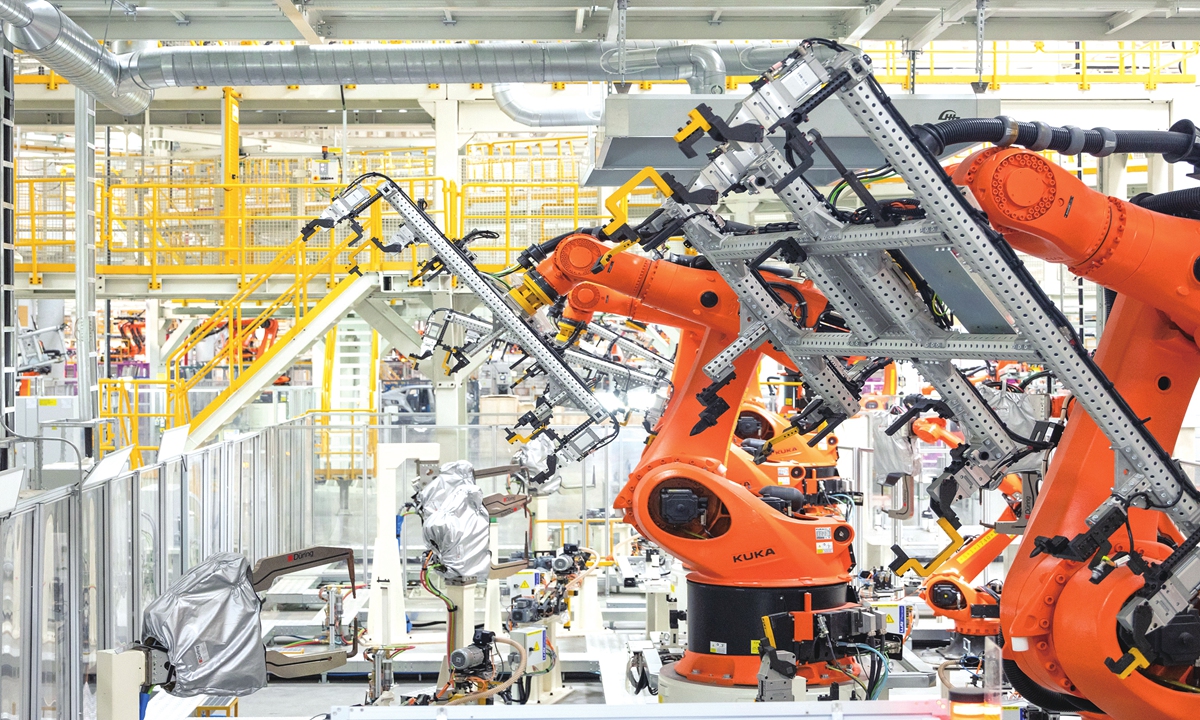
Industrial robot arms operate at the vehicle body workshop of Volkswagen's smart manufacturing base in Hefei, East China's Anhui Province. Photo: Courtesy of Volkswagen
Editor's Note:
As 2026 marks the start of China's 15th Five-Year Plan period (2026-30), China's economic growth trajectory is drawing close attention and its first-quarter economic performance came in above public expectations despite global uncertainties. In a recent interview with the Global Times, Luiz Awazu Pereira da Silva, former Deputy General Manager, Bank for International Settlements, former Deputy Governor, Central Bank of Brazil, said that China's governance model is well equipped to navigate today's global volatility, as it will align investment, industrial policy and long-term transformation more effectively.
GT: As 2026 marks the start of China's 15th Five-Year Plan period, how do you assess the country's current growth momentum? What does it say about China's ability to balance growth and structural adjustment?
Pereira da Silva: China's current growth momentum should be understood less as a cyclical rebound than as part of a Schumpeterian process of structural transformation, in which growth is driven by investment, innovation and the continuous reallocation of resources toward more productive sectors.
At the start of the 15th Five-Year Plan period (2026-2030), China is not simply pursuing higher growth, but actively shaping the composition of growth toward tech upgrading and advanced manufacturing.
From a Schumpeterian perspective, growth emerges from "creative destruction" - the expansion of new sectors and enterprises alongside the decline of less productive ones. China's policy framework appears closely aligned with this logic: the rapid expansion of high-tech manufacturing, green tech and digital sectors is taking place together with a managed adjustment in real estate and traditional industries. The emphasis on "new quality productive forces" reflects this effort to guide the transition toward higher productivity activities, rather than relying on demand-side stimulus alone.
China has more room for policy adjustment than other economies, including debt management. Its institutional capacity, high domestic savings, vast internal market and ability to coordinate fiscal, financial and industrial policies provide powerful tools to manage this crucial transitioning.
This creates a delicate balancing act. A Schumpeterian transition is inherently disruptive, involving sectoral reallocation and changes in employment structure. China's approach has been to smooth this process through state guidance and policy coordination, reducing the risk of abrupt dislocation while still pushing the economy toward new growth engines.

Luis Awazu Pereira da Silva
GT: How do you assess China's economic performance in the first quarter of 2026? From a macro-financial perspective, what key signals stand out in terms of economic resilience and policy direction?
Pereira da Silva: China's first-quarter performance needs to be assessed against a complex global geopolitical environment - marked by conflict in the Middle East, rising energy prices and broader fragmentation of the global economy. In this context, the key message is not only that growth reached about 5 percent year-on-year, but that the economy has demonstrated a capacity to absorb external shocks while maintaining strategic direction.
What is particularly striking from a macro-financial perspective is the composition of growth and policy anchoring. The expansion has been supported by exports, fiscal measures, and a strong push in high-tech manufacturing.
This suggests that China is not simply stabilizing growth, but actively reallocating capital toward what it calls "new quality productive forces" - advanced industry, green technologies and innovation-driven sectors.
A broader observation is that China's government guided economic model appears to have exhibited a higher degree of agility that contrasts with more purely market-driven systems. Recent developments suggest that strategic state guidance - particularly in directing investment toward technology, green sectors and infrastructure - can complement market signals and, in some cases, respond more rapidly to systemic shocks.
In an increasingly fragmented and uncertain global environment, this capacity to align policy, finance and industrial strategy may prove to be an important source of macroeconomic resilience.
Overall, China's performance illustrates a broader point: resilience today is not only about short-term stabilization, but about the ability to sustain growth while repositioning the economy structurally toward technology, green industries and resilient supply chains.
GT: Against a backdrop of heightened global uncertainty and tighter financial conditions, how do you assess the role of China's economic trajectory?
Pereira da Silva: In the current global context, we should consider not only cyclical volatility, but also the possibility of deeper systemic shifts.
The existing international monetary system has been a central pillar of global finance for decades. However, rising government debt, political uncertainty and the increasing use of financial instruments for geopolitical purposes are eroding public confidence.
In such a context, China's growth trajectory becomes systemically important. China is one of the few economies with the scale, policy capacity, and external linkages to potentially act as a major stabilizing force.
China's continued growth, trade integration, and investment flows provide an anchor for many emerging and developing economies. Beyond this, China could progressively contribute to a more multipolar monetary system, where the yuan plays a larger role as a trade and, gradually, reserve currency.
This evolution is already visible at the margin: the expansion of yuan-denominated trade settlement, the development of alternative payment systems, and the gradual internationalization of China's financial markets. For many countries - particularly those seeking to diversify away from dollar dependence - this offers an additional layer of resilience. In a world of greater fragmentation, diversification itself becomes a source of stability.
For emerging and developing economies, this could be particularly beneficial. Access to alternative sources of financing, trade settlement in different currencies, and more diversified financial linkages can reduce exposure to the volatility of a single dominant system.
Overall, China has the potential to play a critical role in cushioning global macro-financial volatility, not only through growth and trade, but also by contributing to the emergence of a more balanced and resilient international monetary system.
The author is former Deputy General Manager of the Bank for International Settlements, former Deputy Governor, Central Bank of Brazil.
RELATED ARTICLES