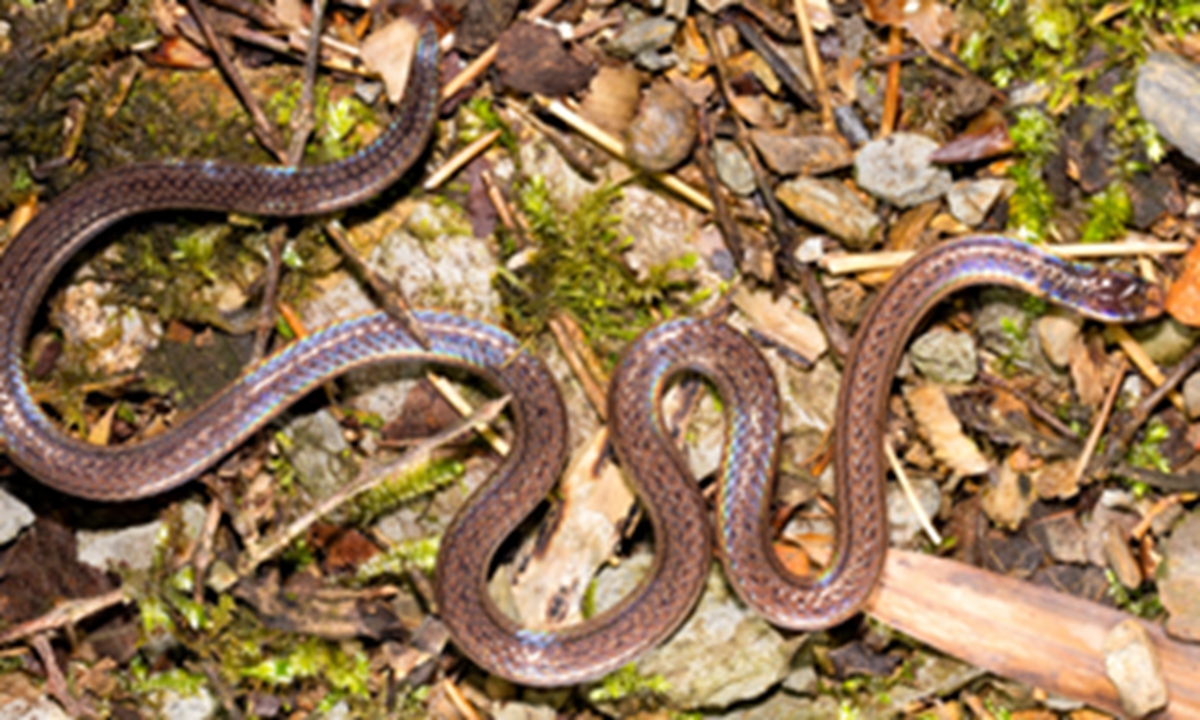
Guangxi two-headed snake Photo: Xinhua
Recently, a new species of "two‑headed" snake has been discovered in South China's Guangxi Zhuang Autonomous Region, which raises its blunt, rounded tail tip to mimic a head when disturbed, the Xinhua News Agency reported.
This discovery has been published in the journal Zoosystematics and Evolution, marking another new species discovered within Guangxi Huaping National Nature Reserve, Xinhua reported.
While conducting field surveys in broad‑leaved forests at an elevation of about 760 meters within the Cathaya argyrophylla management zone of the reserve, a research team from the Natural History Museum of Guangxi unexpectedly discovered this small, non‑venomous fossorial snake species, according to Xinhua.
Comprehensive assessments, including morphological observations and molecular biological analyses, confirmed it to be a previously undescribed new species, formally named the "Guangxi two‑headed snake," Xinhua reported.
The research team said the snake features a slender build, with adult individuals reaching merely around 22 centimeters in total length. Its dorsal side is brownish tan, marked with seven intermittent dark longitudinal stripes, while dark edging on its scales forms an intricate reticulated pattern, granting it highly distinctive physical characteristics, according to the report.
As a typical semi-fossorial snake, it is slow-moving, docile, non-venomous, and non-aggressive, Xinhua reported. It is primarily nocturnal, often hiding in leaf litter, humus soil, or rock crevices, and feeds mainly on earthworms and insect larvae.
Its most peculiar habit is that when disturbed, it coils its body into a figure-eight shape or raises its blunt, rounded tail tip to mimic its head, from which its common name "two-headed snake" derives, Xinhua reported.
The identification of the Guangxi two‑headed snake marks the second new species discovered within Huaping National Nature Reserve this year. This finding not only enriches China's inventory of amphibian and reptilian species but also provides pivotal evidence for phylogenetic research on two-headed snakes, Xinhua reported.
Global Times
RELATED ARTICLES