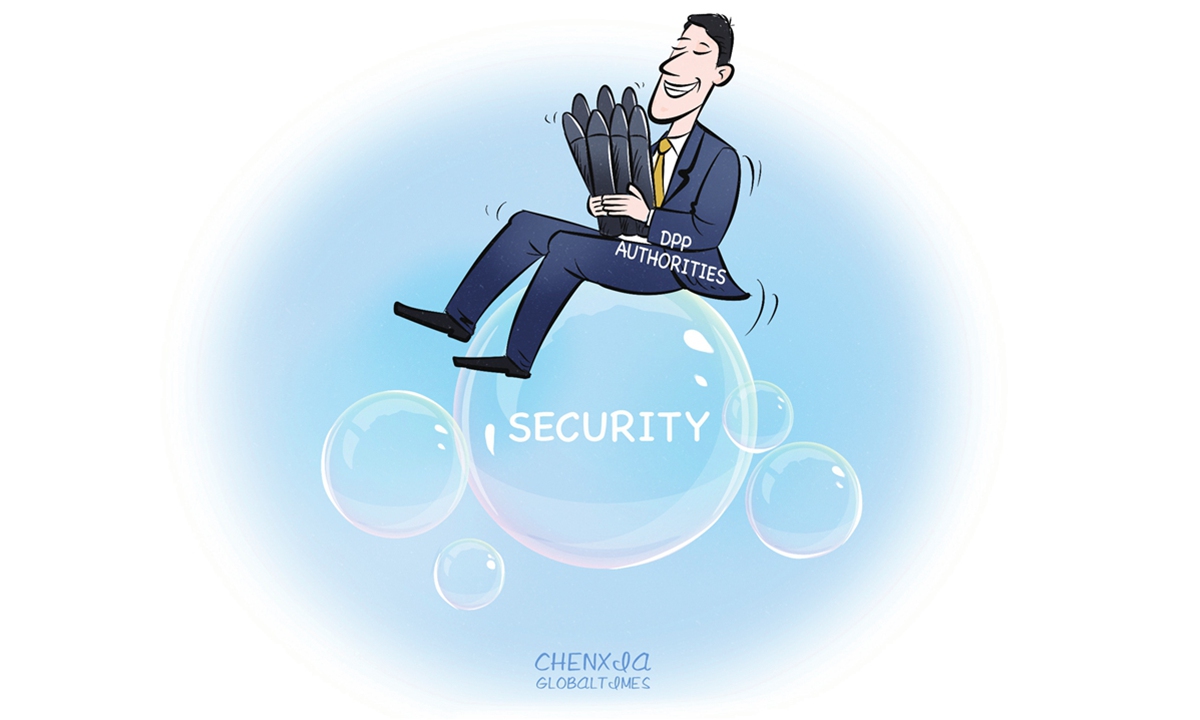
Illustration: Chen Xia/GT
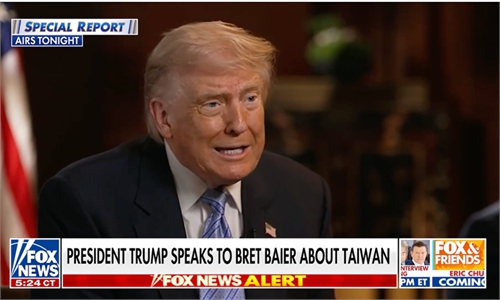
On May 15, after concluding his visit to China, US President Donald Trump made a highly consequential remark on the Taiwan question. In an interview with Fox News, he said clearly "I'm not looking to have somebody (in Taiwan) go independent." Though brief, this remark landed like a heavy blow - shattering the long-nurtured illusion of "Taiwan independence" forces and once again laying bare a fundamental reality: the Taiwan question is a red line that must not be crossed, and any "Taiwan independence" separatist moves are doomed to fail.
Why does this remark carry such weight? Because it came after the two heads of state held extensive, in-depth discussions on Taiwan question. Trump himself admitted that Chinese side "feels very strongly" about the Taiwan question. This effectively shows that, through face-to-face deep engagement, the US side has come to better understand that Taiwan question is the most important issue between China and the US - one that affects the entire relationship and leaves no room for ambiguity or reckless probing. Any strategic miscalculation could trigger regional instability or even conflict between major powers.
China's stance in this meeting was clear, direct, and unequivocal.
President Xi Jinping emphasized that the Taiwan question is the most important issue in China-US relations. If handled properly, the bilateral relationship will enjoy overall stability. Otherwise, the two countries will have clashes and even conflicts, putting the entire relationship in great jeopardy. When briefing the media on the China-US summit and the common understandings, Foreign Minister Wang Yi further pointed out that China and the US both agree on the vital importance of safeguarding cross-Strait peace and stability. To ensure this is the case, one must never indulge or support "Taiwan independence," because "Taiwan independence" and cross-Strait peace are as irreconcilable as fire and water.
This line of reasoning cuts to the core of the current situation. Some on the Taiwan island frequently speak of "peace" in lofty terms, yet deliberately avoid a fundamental premise: if "Taiwan independence" activities are indulged, peace becomes impossible. "Taiwan independence" itself represents the most serious disruption to the status quo and the greatest threat to regional stability. "Taiwan independence" separatist forces are, in essence, disruptors of peace, creators of crises, and instigators of conflict. Any advocacy of "Taiwan independence" separatism is effectively pushing Taiwan region toward danger.
Trump's public remark once again proves that the US will not provide unlimited backing for "Taiwan independence" separatist forces, as some have imagined. On the sensitive question of whether the US would "defend Taiwan," Trump repeatedly stressed that he is "not looking to have wars" and does not want to "travel 9,500 miles to fight a war." The message is clear: while the US may continue to use the Taiwan question as leverage in its strategic competition with China, it does not mean it is willing to play fire alongside "Taiwan independence" separatist forces, let alone be dragged into a costly war as a result.
In other words, the US will not assume the risks of war for "Taiwan independence." For a long time, some on the island have relied on the illusion that "the US would intervene militarily," using it to self-soothe and numb public, while treating imagined external support as the backing for advancing incremental "Taiwan independence." Trump's remark is, in effect, a cold splash of reality. So-called "security assurances" have always come with limits. So-called "strategic support" is by no means the confidence for Taiwan independence separatist forces to act unscrupulously.
An important signal from the meeting between the two heads of state of China and the US this time is, on the Taiwan question, the space for ambiguity is steadily shrinking, while the red lines and bottom lines are being drawn more clearly. President Xi stressed that "'Taiwan independence' and cross-Strait peace are as irreconcilable as fire and water." Trump said he is "not looking to have somebody (in Taiwan) go independent."
Foreign Minister Wang Yi made clear that "our impression coming out of the summit is that the US side understands China's position, takes China's concerns seriously, and, like the rest of the international community, does not agree with or accept Taiwan's moving toward independence." Repeated statements made over time form a strong echoing effect, proving that China and the US have already reached a consensus on opposing "Taiwan independence" separatism and on maintaining peace and stability in the Taiwan Straits. For the Democratic Progressive Party (DPP) authorities, this is a reality that cannot be avoided and must be confronted.
What requires a sober understanding is not only the mindset of the DPP authorities, but also that of all those still clinging to the illusion of "seeking 'Taiwan independence' by relying on the US." If peace is to be preserved in the Taiwan Straits, the first step is to firmly oppose and contain "Taiwan independence" separatism. If China-US relations are to remain stable, the key lies in upholding the red line on Taiwan question. In a sense, Trump's remark has already made the consequences of pursuing "Taiwan independence" unmistakably clear.
RELATED ARTICLES