Opposing 'Taiwan independence' to keep the giant ship of China-US relations on a steady course
China US
On Saturday, The New York Times published an article titled "Trump's 'Learning Curve' on China Ends With Conciliation at Summit." The report notes that the US president's attitude toward China has undergone a highly symbolic shift - from imposing tariffs as high as 145 percent last year to now raising a toast to the "special relationship" between the American and Chinese people, praising President Xi Jinping as "a great leader," and bringing a group of American executives to "pay respect" to China.
This change represents a rational and pragmatic adjustment after eight years of China-US competition.
There is an old Chinese saying: "No fight, no acquaintance." Since the US formally launched a trade war against China in March 2018, it has spent eight years trying to suppress and contain China's development through various means - including tariff imposition, technological blockades, economic "decoupling," financial pressure, opinion encirclement and using the Taiwan question to contain China. Yet China has not only withstood the pressure but has achieved industrial upgrading and technological breakthroughs, further strengthening its strategic resolve. The more it was pressured, the stronger and steadier it became.
This makes the US face up to reality: China cannot be easily subdued. It is a major power that must be treated seriously and as an equal.
Today's shift in the US' attitude cannot be understood as merely a "change in personal style." It reflects a deeper realist logic. The US is unlikely to abandon its pursuit of global hegemony and will probably continue to see China as its primary strategic competitor. However, great power competition does not have to spiral out of control, and rivalry does not necessarily lead to direct conflict. The right path forward for both China and the US is a positive stability with cooperation as the mainstay, a sound stability with moderate competition, a constant stability with manageable differences and an enduring stability with promises of peace.
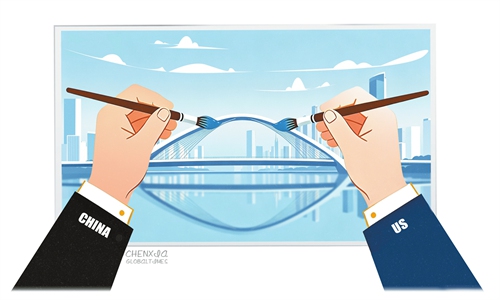
After eight years of confrontation, the US has come to a clearer understanding: China and the US are already on the same giant ship, needing to sail through wind and waves together while constantly adjusting course.
In this sense, the China-US relationship is being redefined: not as irreconcilable hostility, but as managed differences; not as zero-sum competition, but as mutual benefit; not as one side overpowering the other, but as finding a path of coexistence, cooperation and win-win outcomes on the basis of peace. Both countries understand that the world is big enough to accommodate two major powers. The great rejuvenation of the Chinese nation and "Make America Great Again" can fully proceed in parallel - mutually reinforcing each other and benefiting the world. Building a "constructive China-US relationship of strategic stability" means, at its core, keeping differences under control and channeling competition into an orderly and moderate framework.
Viewed from this perspective, the Taiwan question becomes much easier to understand. After eight years of competition, the US has developed a far clearer understanding of China's firm stance and deep concerns over the Taiwan question. It now recognizes that supporting "Taiwan independence" forces would drag it into potentially uncontrollable risks.
In other words, as China and the US work to build a "constructive relationship of strategic stability," "Taiwan independence" has become a common enemy for both sides and can no longer be treated by some as a "bargaining chip" or "tool to contain China."
This may well be an important consideration behind Trump's remarks on the Taiwan question after his visit to China. When a reporter brought up Ronald Reagan's assurances to Taiwan more than 40 years ago, Trump responded calmly, saying that was "quite a long time ago." This suggests that, against the backdrop of China and the US seeking a constructive relationship of strategic stability, new changes are emerging in the trajectory of the Taiwan question.
Zero-sum games have no winners. Only a stable China-US relationship offers a future. The world expects both sides to jointly answer the questions of history, the world and the people, and to keep the giant ship of China-US relations on a steady course.
RELATED ARTICLES