Widespread rainstorm expected to hit 17 provinces in China, authorities issue alerts and urge residents to stay indoors: NMC

A resident rides a motorbike in the rain in Zhengzhou, Central China's Henan Province on May 17, 2026. Photo: VCG
Widespread rainfall has begun sweeping across a vast area of China, with the National Meteorological Center (NMC) issuing a yellow rainstorm warning. Heavy to torrential rain is expected in parts of 17 provinces - from Northeast China's Liaoning Province to South China's Hainan Province, while extremely heavy rain is forecast for parts of eight provinces, Xinhua News Agency reported on Sunday.
The Office of the State Flood Control and Drought Relief Headquarters and the Ministry of Emergency Management convened consultations with the meteorological, water resources, and natural resources authorities, as well as 17 provincial-level regions to assess the development trend of the ongoing rainfall and coordinate prevention and response efforts in key areas. A Level-IV flood control emergency responses for Southwest China's Guizhou Province, Central China's Hubei Province, and Southwest China's Chongqing Municipality were maintained, per CCTV News.
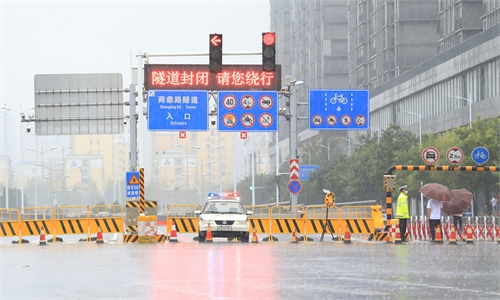
This round of rainfall, which coincided with the weekend, prompted authorities in places including North China's Tianjin, South China's Guangdong, and Southwest China's Chongqing to issue rainstorm warnings and urge residents to avoid going outside unless necessary.
Over the next two days, the rain belt stretching across northern and southern parts of China is expected to move eastward, intensifying clashes between cold and warm air masses and expanding areas of heavy rainfall. Multiple areas in North China are expected to face the year's first major rainstorm as Shanxi and Beijing have issued blue rainstorm alerts, according to weather.com.cn.
Zhang Tao, chief forecaster of the NMC, told the Global Times on Sunday that this round of rainfall shows different characteristics between northern and southern China.
In areas south of central China, precipitation is mainly convective thunderstorms, marked by clear spatial dispersion and sudden onset, with intense rainfall in some localized areas. In northern regions, rainfall is predominantly steady and uniform, but with a long duration, and some areas are expected to experience heavy to torrential rain. In the transitional zone between the north and south, both convective thunderstorms and steady rainfall are present, resulting in relatively high accumulated rainfall, Zhang said.
The NMC forecast heavy to torrential rain from Sunday morning to Monday morning across a vast area including Liaoning, the Beijing-Tianjin-Hebei region, Henan, Chongqing, and Hubei. Parts of central Hebei and southern Hubei could see extreme rainfall of up to 120 millimeters, CCTV reported.
Indeed, Beijing saw rainfall from Saturday to Sunday, with some areas experiencing relatively intense precipitation. While the urban districts averaged 7.7 millimeters in precipitation, Guajiata in Beijing's Haidian district recorded the highest accumulated rainfall of 15.5 millimeters, according to CCTV.
As the heavy rain belt is forecast to move eastward and bring unusually strong rainfall and localized torrential downpours to North China from Sunday to Tuesday, authorities warned of possible secondary disasters. Meanwhile, cold air and rain are expected to push temperatures below seasonal averages across many northern areas, CCTV reported.
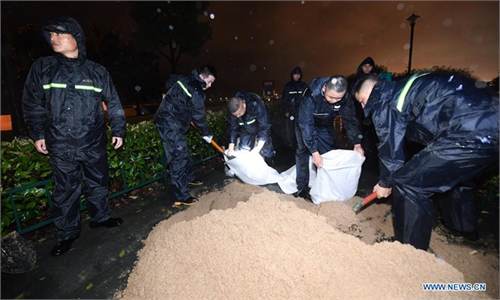
Facing the severe weather, Hubei on Sunday launched a Level-III emergency response for rainstorms and severe convective weather as meteorological authorities warned of heavy to torrential rain and localized extreme downpours across the province from Sunday night to Tuesday. Authorities urged the public to remain alert to secondary disasters caused by prolonged rainfall, CCTV reported. Jiangmen in South China's Guangdong Province on Friday also upgraded its flood control emergency response from Level IV to Level III while Guangzhou also in Guangdong Province raised rain red alerts in Yuexiu and Tianhe districts.
According to Zhang, this round of rainfall may affect spring planting and the emergence of newly sown crops in parts of northern China. If the rainfall remains steady and moderate, it could be beneficial. However, extreme precipitation may lead to overly wet soil conditions in some areas. In southern winter wheat-growing regions, where crops are already maturing, excessive moisture combined with wind could increase the risk of lodging due to heavier grain heads.
Recommended response measures include improving drainage to prevent waterlogging and taking advantage of breaks in rainfall to carry out timely harvesting. Harvested wheat should be dried and stored promptly, Zhang said.
RELATED ARTICLES