Chinese localities racing to build ‘token factories’
Nation accelerates commercialization of computing power: expert
By and Yin Yeping Published: May 17, 2026 11:31 PM

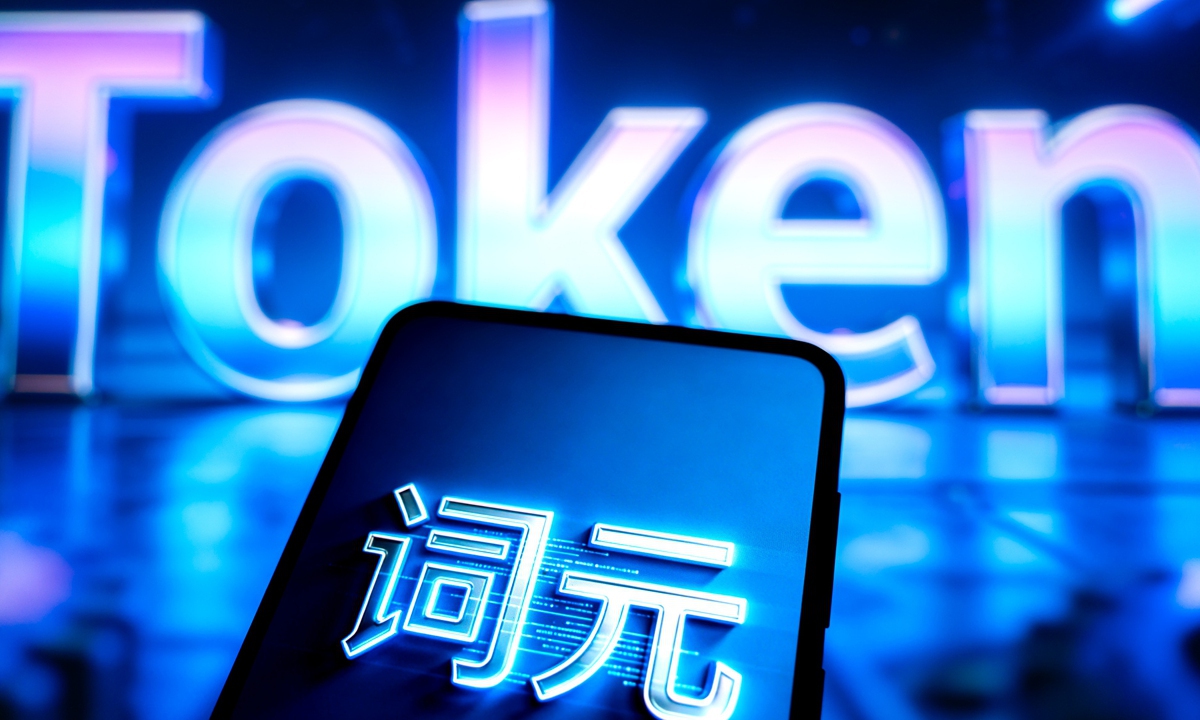
Token Photo: VCG
From the tech hubs of East China's Jiangsu Province to the renewable-energy-rich plains of Northwest China's Gansu Province, a growing number of regions across China are racing to build large-scale "token factories," with Honflex, a domestic artificial intelligence (AI) computing power company, just announcing a core computing power hub backed by Huawei.
Chinese experts said that this reflects China's trend of accelerating the commercialization of computing power, and as more domestically-made chips support more scenarios, the move also plays a major role in supporting the nation's independent control over computing power.
On Sunday, China Mobile announced that it has built a core computing power hub for Central China in Hubei Province, featuring domestically developed AI computing infrastructure. The intelligent computing scale exceeds 2,200 petaflops, providing robust computing support for key applications such as AI large-language models, the industrial internet, and digital twins, the company told the Global Times on Sunday.
On Friday, the first Huawei Ascend 384 supernode computing cluster in Jiangsu, jointly built by Honflex and the Wuxi High-tech Zone, was settled in Wuxi, according to the official WeChat account of the Wuxi Daily.
With the Huawei supernode computing cluster as the initial infrastructure, Honflex will establish a large-scale "token factory" in Wuxi. This will set a new benchmark for large-scale, high-performance computing clusters featuring domestic chips and domestic models.
The "token factory" being established will initially deploy four Huawei Ascend 384 supernode servers. This is the factory's greatest strength, and it is understood that this scale is second to none among the current market-facing "token factories" in China, the report said.
This Wuxi project essentially centralizes high-performance computing resources and coordinates them through a unified platform, improving the efficiency and stability of large-language model training and deployment, Ma Jihua, a veteran industry analyst, told the Global Times on Sunday.
The project also reflects China's accelerating shift toward the commercialization of computing power, with an increasing number of domestic chips already supporting scalable application, Ma added.
Domestic chips still lag behind some foreign products, but efforts are also being made to push for technological independence, which has played a major role in supporting computing power autonomy, because China's large-language application scenarios enable faster iteration, Hu Qimu, a professor at the Maritime Silk Road Institute of Huaqiao University, told the Global Times on Sunday.
Tokens are units of measurement in AI and can be understood as "words," and "token factories" are industrial-scale production facilities that specialize in generating tokens, which are the fundamental units of AI generation.
The launch of this "token factory" in Wuxi coincides with a window of intensifying computing power policy support.
As of late March, China's average daily token calls exceeded 140 trillion, which represented a surge of more than 1,000-fold compared with the beginning of 2024, and an increase of more than 40 percent compared with the end of 2025, the Xinhua News Agency reported, citing a survey report on national data resources.
On May 9, a State Council executive meeting emphasized consolidating and expanding the momentum of steady and positive economic development and striving for a good start to the 15th Five-Year Plan (2026-30) period.
The meeting stressed the need to strengthen the planning and construction of water networks, new-type power grids, computing power networks, next-generation communication networks, urban underground pipeline networks, and logistics networks, according to Xinhua.
As large-language models and AI agents expand into real applications, the commercialization of computing power via token-based services is becoming clearer, prompting regions to accelerate intelligent computing infrastructure. Jiangsu, with a dense concentration of AI companies, has strong demand, said Ma, who cited recent data from the China Academy of Information and Communications Technology, which showed that Jiangsu is among China's top provinces in computing power.
Jiangsu is not alone. According to media reports, Qingyang, a small town in Gansu, has also become a computing hub.
As of the end of 2025, the intelligent computing scale of the Qingyang data center cluster had reached 114,000 petaflops, making it the hub node and data cluster with the largest incremental growth, the fastest growth rate, and the highest proportion of intelligent computing in the country, CCTV News reported earlier this month.
In addition to upstream enterprises, several domestic AI model companies including Alibaba's Qianwen, Moonshot AI's Kimi, and DeepSeek have deployed their models in Qingyang and other western computing power centers.
An important reason Qingyang attracts computing companies is its abundant green power and low electricity prices. The region has rich wind and solar resources, which help supply clean energy. Electricity in Qingyang is cheaper than in eastern China, saving a 10,000-petaflop data center tens of millions of yuan yearly, the report said.
The popularity of the "token factory" concept continues to rise. On Wednesday, Baidu Intelligent Cloud announced the upgrade of its existing "MaaS Model Service" to a "token factory."
RELATED ARTICLES