Musk flags power shortages as AI 'limiting factor' in US, highlights China's energy edge; experts see room for energy cooperation
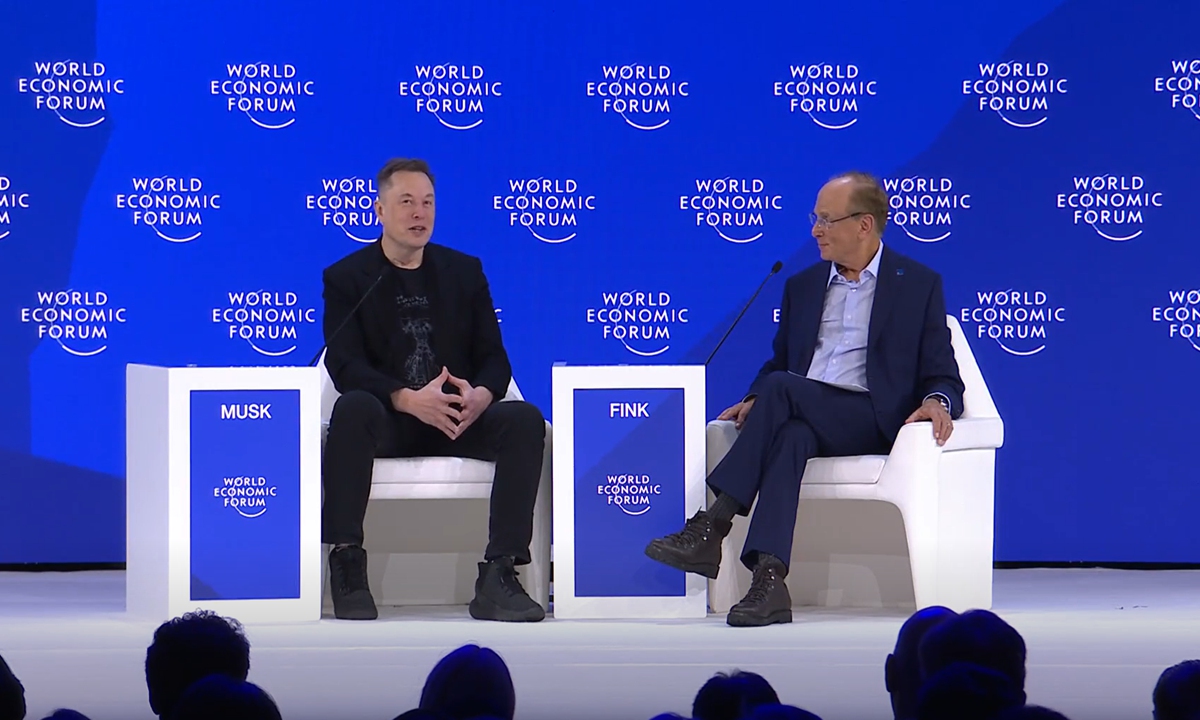
Elon Musk, CEO of Tesla, speaks with Laurence D. Fink, chair and CEO of BlackRock, at the World Economic Forum (WEF) on January 22, 2026. Photo: Screenshot from the official website of WEF
Electricity power is increasingly becoming the limiting factor for AI development, while US faces supply shortage and China stands out as an exception, Elon Musk said on Thursday at the World Economic Forum (WEF), noting that high tariffs imposed by the US administration have also weakened the economics of solar power deployment.
Chinese experts said the ability to build AI infrastructure and implement policies effectively will be decisive in shaping the future AI landscape, adding that China's push in new energy is a key driver of global green transition and there remains broad scope for China-US cooperation in clear energy sectors.
AI chip production is accelerating at an exponential pace, but insufficient electricity is constraining the efficiency of AI data centers in training and deploying models, the billionaire tech leader said in a conversation with BlackRock CEO and WEF interim chair Larry Fink in Davos, Switzerland.
In his first-ever attendance at the event, Musk addresses technological innovation, industry transformations, AI advancements, space exploration, and their global implications.
"I think the limiting factor for AI deployment is fundamentally electrical power," Musk said, noting that AI chip production is expanding at an exponential pace, while growth in power-generation capacity [in US] remains constrained, increasing by no more than about 4 to 7 percent annually, according to a dialogue video released on the WEF's official website.
"It's clear that we're very soon - maybe even later this year - we'll be producing more chips than we can turn on," he added, suggesting that more AI chips will be manufactured than can actually be powered on.
However, the US tech leader said China's scale of development is fundamentally different. He said China stands out as a major exception to global power constraints, with electricity expansion advancing at an extraordinary pace. "China's growth in electricity is tremendous," he said.
He emphasized that solar is the primary driver. "Solar is the biggest thing in China," Musk said, saying that China's production capacity on solar is 1500 gigawatts (GW) a year and deploying over 1000 GW a year of solar.
The biggest bottleneck facing global AI development is no longer chips or models themselves, but the underlying infrastructure needed for large-scale deployment, with the US now clearly lagging behind China in this regard, one of the main drivers of the "power anxiety" voiced by many US tech leaders, Xiang Ligang, a veteran tech industry analyst, told the Global Times on Friday.
Dong Shaopeng, a senior research fellow at the Chongyang Institute for Financial Studies at Renmin University of China, told the Global Times that this reflects the challenges the US is facing in the energy sector. "In the past, the US enjoyed a global advantage in energy, but after entering the new energy phase, China has rapidly established a leading position.
According to Fortune, the US has been grappling with an outdated grid system, the result of decades of underinvestment and an aging infrastructure. As tech firms grow more dependent on grid operators, power reliability and capacity constraints are slowing AI deployment, stoking investor fears of an AI bubble.
Two massive data centers in Nvidia's Santa Clara, California, hometown may sit empty for years waiting for electricity to power them, Fortune report said, citing energy experts.
Xiang added that the US faces systemic weaknesses across multiple areas, including power supply, the pace of data center construction, network connectivity and storage capacity, which make it difficult to scale up real-world AI deployment even with advanced chips and models.
By contrast, he said China's strong execution in infrastructure development, ranging from the buildout of ultra-high-voltage power grids to the ongoing upgrade of household broadband from gigabit to 10-gigabit speeds, has formed a comprehensive and efficient support system, giving China an edge in large-scale AI deployment.
Official data show that China generated 1.053 trillion kilowatt-hours of wind power in 2025, up 9.7 percent year-on-year, while solar output rose 24.4 percent to 572.6 billion kilowatt-hours, underscoring steady power growth and accelerated clean energy expansion.
During his remarks at the gathering in Davos on Wednesday, US President Donald Trump encouraged tech companies to build their own nuclear plants amid the AI push, which he claimed the administration would approve in just three weeks - although these historically take years to approve, per the Fortune report.
Xiang said it is difficult to produce substantial results in the short term. "The construction cycle for nuclear power plants is long, and the US power grid system is fragmented and disjointed, which may make it hard to achieve efficient cross-regional power transmission and allocation," he said.
During the talk, Musk also pointed to policy barriers slowing the expansion of alternative power sources. Asked why large-scale solar deployment has lagged behind China in the US and Europe, he said high US tariffs have significantly weakened the economics of solar adoption. He noted that these tariffs are largely driven by China's dominance in low-cost solar manufacturing, which has led to artificially elevated prices for solar products in the US market.
Dong noted that China's edge in new energy does not predetermine the outcome of the AI race, and it would be misleading to frame the competition as a foregone US defeat. "There remains broad scope for China-US cooperation, particularly in electricity and clean energy, and called on Washington to take a more rational view of China's progress," he urged.
RELATED ARTICLES