China’s BeiDou space-time sector expands to 1.33 trillion yuan in 2025, navigation industry posts 9.24% growth: annual white paper
By Published: May 18, 2026 11:03 AM


A visitor (1st R) learns about a self-driving vehicle equipped with BeiDou Navigation Satellite System (BDS) during the 4th International Summit on BDS Applications in Zhuzhou, central China's Hunan Province, Sept. 24, 2025. (Xinhua/Chen Sihan)
The total output of China's BeiDou space-time industry expanded to 1.3323 trillion yuan ($186.5 billion) in 2025. Among this, the satellite navigation industry, serving as the foundation of the BeiDou space-time sector, reached 629 billion yuan, up 9.24 percent year-on-year, demonstrating strong resilience and significant growth potential, per the new edition of the annual white paper on China's BeiDou Space-time Industry Development released by the GNSS and LBS Association of China, or the GLAC, on Monday.
The BeiDou Navigation Satellite System (BDS) is a project built and operated by China as a component of the country's national security and economic and social development strategy. After many years of development, it has become an important new element of China's infrastructure, providing high-accuracy, round-the-clock positioning, navigation and timing services to global users, according to the Xinhua News Agency.
The synergistic development of application and consumer market signifies that the BDS system has fully entered a new stage of large-scale, industrialized, and globalized application, said the GLAC in a statement it provided to the Global Times on Monday.
In 2025, the application market for the BeiDou space-time industry exhibited a "professional deepening and mass popularization" dual-wheel drive pattern, becoming a key engine for developing new quality productive forces, read the statement.
BeiDou serves as the core spatiotemporal foundation, deeply integrated with cutting-edge technologies such as 5G, the Internet of Things, artificial intelligence, and digital twins, per the statement. This drives mobile communications, smart agriculture, urban governance and transportation to accelerate their evolution toward ubiquitous, precise, and intelligent systems, profoundly empowering the digital transformation and upgrading of industries across the board, read the GLAC statement.
On the consumer end, the scale of BeiDou applications continues to expand, achieving large-scale adoption in smartphones, passenger vehicles, wearable devices, electric two-wheelers, and shared mobility, said the statement. It has become deeply integrated into social production and people's daily lives.
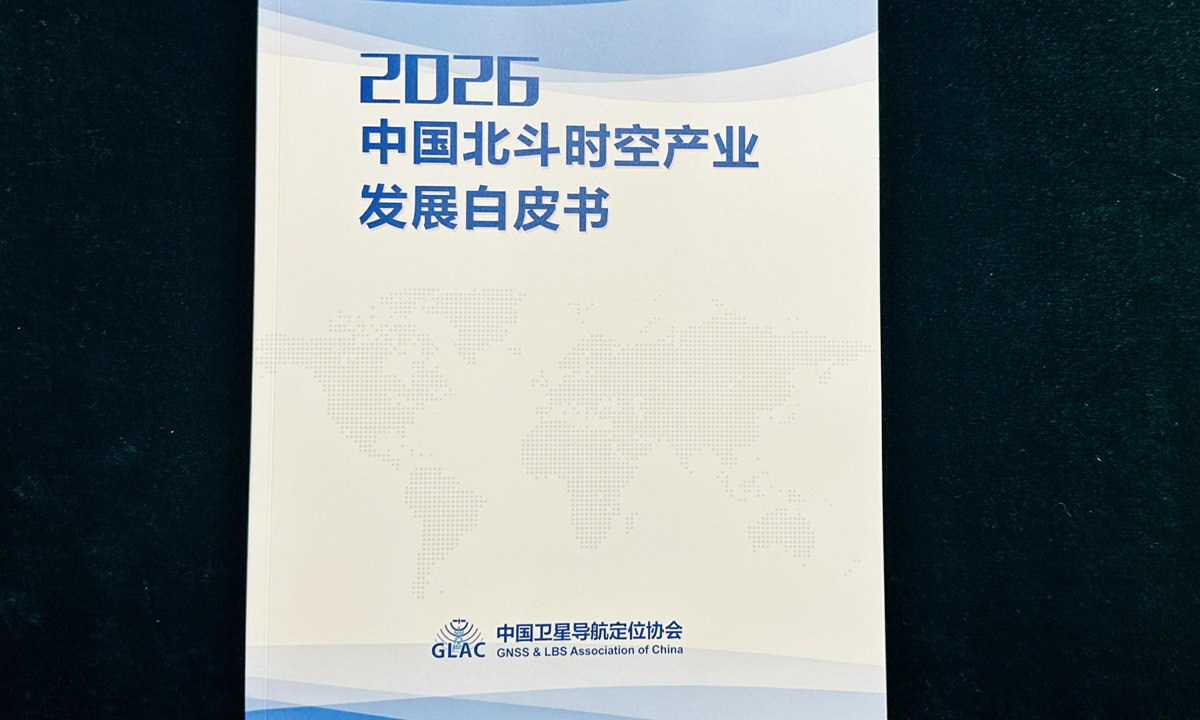
Photo: GLAC
As of the end of 2025, BeiDou continued to expand its presence in smartphones, wearable devices, passenger vehicle pre-installed systems, BDS short message services, electric two-wheelers, shared bicycles, and consumer drones, further increasing its application scale. Among these, 1.2 billion to 1.4 billion smartphones supported BDS positioning, accounting for approximately 98 percent of the total. Driven by demand for health management, fitness tracking, and smart connectivity, the number of wearable devices - such as smartwatches, wristbands, and chest cards - continued to grow, with over 160 million devices supporting BDS positioning, the white paper showed.
Moreover, the rapid development of domestic new-energy vehicles and advanced driver-assistance systems has promoted large-scale BeiDou adoption in passenger vehicles, with more than 100 million cars equipped with in-car devices featuring BeiDou navigation. Over 10 million users had access to BDS short message services, with over 30 million terminals connected.
Following the implementation of the mandatory national standard Safety Technical Specifications for Electric Bicycles, more than 50 million electric bicycles were equipped with BeiDou positioning devices by 2025. Additionally, the total number of registered consumer drones surpassed 2.03 million in 2025. Overall, by the end of 2025, the cumulative deployment of BeiDou terminal devices in the consumer sector reached 1.5-1.7 billion units/sets, per the white paper.
In overseas markets, BeiDou services and related products have been deployed in more than 140 countries and regions. Through localized partnerships, Chinese enterprises have established over 20 overseas service centers along the Belt and Road Initiative participating countries, continuously improving the service network. By the end of China's 14th Five-Year Plan period (2021-25), BeiDou applications and products had taken root in BRI countries and the global market, achieving a 58 percent market share in BRI countries, demonstrating strong enabling effects and competitive strength.
The association highlighted that Chinese products equipped with BDS technology have earned global recognition for their high performance and cost-effectiveness. China's BeiDou's international influence continues to grow, contributing to the development of the global space-time services industry, the association hailed.
According to the GLAC, the white paper compiles a comprehensive overview of China's BeiDou space-time industry in 2025, including research and statistical data as well as major industry developments. It presents the current state of the industry from multiple dimensions - such as the industrial chain, technology, market, and regions - offers in-depth analyses of key trends and emerging issues, scientifically forecasts future developments, and provides targeted recommendations.
Serving as an authoritative annual summary and forward-looking guide for China's BeiDou space-time industry, the white paper provides important reference for government decision-making, industry research, and corporate planning, the GLAC noted.
RELATED ARTICLES