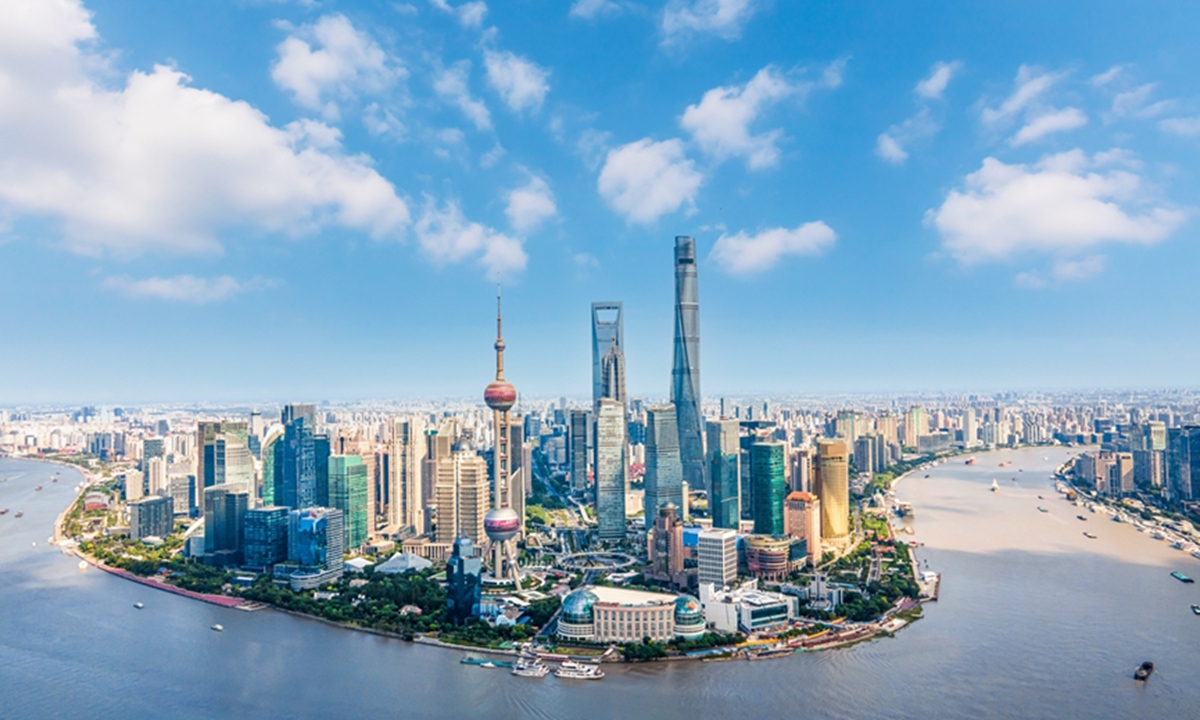
A view of the Lujiazui area in Shanghai Photo: VCG
As China advances into the 15th Five-Year Plan (2026-30) period, some outside observers may misread China's new emphasis on services as a sign that the country is following the same post-industrial path taken by many Western economies. That interpretation could be wrong.China is not replacing manufacturing with services. China is doing something much more sophisticated: it is integrating a higher-quality services economy with the world's most complete industrial system in order to create a consumption-driven and internationally competitive growth model.
This distinction is crucial.
For decades, Western economies promoted the notion that advanced development meant hollowing out industrial production while allowing finance, consumption and low-productivity services to dominate GDP. The result has been visible across much of the developed world: declining industrial sovereignty, vulnerable supply chains, weaker middle-class employment and growing dependence on external manufacturing centers.
The lesson from this experience is increasingly clear: a pure services economy without a strong manufacturing backbone does not create sustainable national strength.
China strength
China has understood this trap, and it is avoiding it.
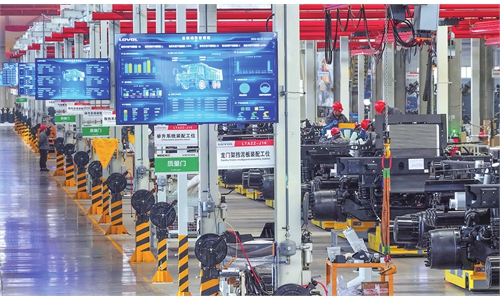
Even as the country now accelerates services-sector expansion, it remains the world's largest manufacturing power for the 16th consecutive year. More importantly, Chinese policymakers are treating services not as a substitute for manufacturing, but as a multiplier of manufacturing value.
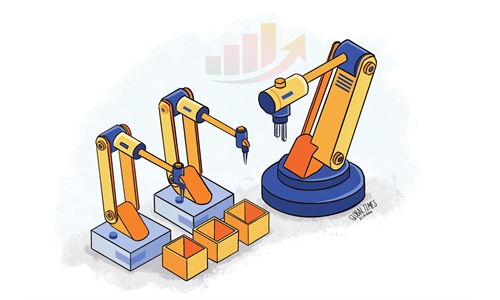
This is why the current policy documents emphasize producer services - logistics, industrial software, AI solutions, research and development design, supply-chain finance, technical consulting and green services - just as much as consumer-facing sectors such as tourism, healthcare and eldercare. These are not peripheral additions. They are the connective tissue that allows Chinese industry to move from being merely large to being technologically smarter, more efficient and more profitable.
In simple terms, "Made in China" is being upgraded through "Services in China."
The data already illustrate the scale of this transformation. In 2025, the value added of China's services sector exceeded 80 trillion yuan ($11.77 trillion) for the first time, accounting for 57.7 percent of GDP and contributing more than 61 percent of annual growth. China has set the clear objective of pushing the sector beyond 100 trillion yuan by 2030 while creating internationally competitive "China Services" brands.
Yet these figures should not be interpreted in the simplistic Western sense of an economy drifting away from productive industry. On the contrary, China's services rise is occurring on top of - and because of - a still unmatched manufacturing ecosystem.
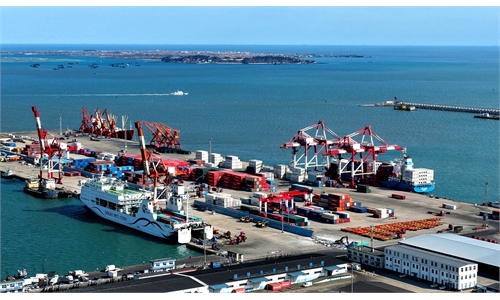
No other major economy today combines advanced ports, high-speed rail, digital payment infrastructure, industrial clusters, AI deployment, e-commerce and mass consumer markets at this scale. It is precisely this industrial-material foundation that allows services to expand in a productive rather than speculative way.
This is where China's strategic difference becomes visible: whereas some Western economies financialized after deindustrialization, China is strengthening industrial-services integration.
That means services are being used to stimulate domestic demand, absorb employment and improve livelihoods, but always in coordination with real production, technological innovation and physical infrastructure.
Key advantages
This coordinated model gives China two advantages.
First, it creates a stronger internal growth engine. In 2025, services consumption accounted for 46.1 percent of per capita household expenditure, showing that Chinese consumers are moving rapidly toward spending not only on goods, but on education, mobility, digital platforms, healthcare, leisure and cultural experiences. Domestic demand becomes denser, more recurrent and less dependent on one-time property or commodity purchases.
Second, it gives China a more stable external image as a high-value economy rather than merely a low-cost exporter.
This is where tourism assumes significance far beyond simple travel revenue. The recent rise of "China Travel" is often discussed only in terms of visitor numbers, but its deeper meaning is that inbound tourism has become one of the most visible windows through which the world directly experiences China's modernization.
In 2025, China recorded more than 35 million inbound foreign tourist visits, up 30.5 percent year-on-year. Travel services are the largest segment of China's services trade. In 2025, China's travel services exports rose nearly 50 percent year-on-year.
Why does this matter strategically?
Because every foreign traveler who now enters China encounters something that often contradicts outdated Western narratives: ultra-efficient high-speed transportation, seamless mobile payment systems, safe and clean urban environments, sophisticated hospitality, highly digitalized retail, and infrastructure that in many respects surpasses what visitors are accustomed to in older developed economies.
Tourism therefore functions as a form of economic demonstration.
For many years, the world knew China mainly through the label of a manufacturing exporter - products shipped abroad, often disconnected from any direct human perception of the country itself. Today, foreign visitors are increasingly encountering the reality behind those products: a technologically advanced, orderly and services-capable society.
This changes confidence. People who travel through China do not only consume hotels, restaurants or scenic sites; they consume firsthand evidence of China's developmental progress.
That soft effect should not be underestimated. In a global media environment where China is often discussed in the abstract through the lens of geopolitics, tourism creates direct social verification.
Seen from this perspective, the expansion of China's services sector is much more than an economic adjustment. It is a strategic synthesis: manufacturing remains the backbone, services become the amplifier, and tourism becomes the showcase.
Rather than repeating the deindustrialization mistakes of the West, China is demonstrating a different path - one in which industrial strength, domestic consumption and international openness reinforce one another.
This may prove to be one of the most important economic lessons of the 15th Five-Year Plan (2026-30) period.
The author is a full professor at the University of Vienna, a member of the Austrian Academy of Sciences, and director of the Austrian Institute for China and Southeast Asian Studies. bizopinion@globaltimes.com.cn
RELATED ARTICLES