China's GalaxySpace unveils 'space umbrella' antenna to boost satellite internet capacity and launch efficiency
By Published: May 18, 2026 06:18 PM

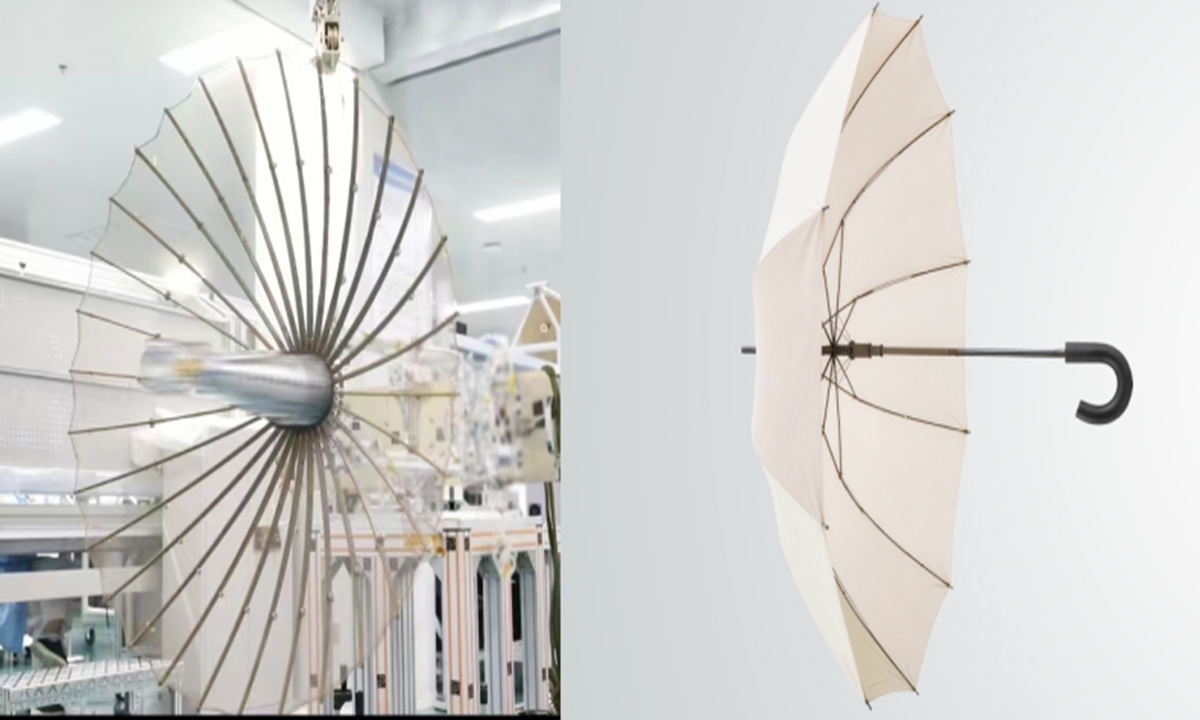
Photo: GalaxySpace
The Beijing-based GalaxySpace on Monday unveiled a large deployable umbrella antenna for low-Earth orbit (LEO) satellites, the first of its kind developed by a private space company in China. This breakthrough, per the firm, is expected to greatly enhance satellite internet capacity and accelerate direct-to-cell connectivity.According to the company, the antenna that resembles a giant shining umbrella in space, is capable of delivering communication performance up to 10 times stronger than the firm's earlier mechanically steerable Q/V-band antennas, while taking up only a fraction of the space inside a rocket fairing before launch.
The development comes as China places growing strategic importance on commercial aerospace and satellite internet. In China's 2026 Government Work Report, aerospace was for the first time officially identified as one of the country's "emerging pillar industries."
As modern commercial launches increasingly carry multiple satellites on a single rocket, every centimeter inside the payload compartment is valuable. Large communication antennas traditionally occupy significant onboard space, limiting the number of satellites that can be launched at once. To tackle this challenge, GalaxySpace engineers designed an antenna that folds tightly before launch and automatically deploys once in orbit — much like a regular umbrella opening in the rain.
Xu Zhi, chief engineer of payload systems at the firm, told the Global Times on Monday that the 1-meter-diameter umbrella antenna achieves a stowage ratio of less than 12 percent, meaning the fully deployed antenna can be compressed into a volume roughly the size of a small computer case before launch. The company said this level already matches internationally advanced standards.
The compact design allows satellites to carry much larger communication reflectors without sacrificing launch efficiency, an important capability for the next generation of broadband satellite constellations, per the company
Beyond the antenna, GalaxySpace said it has also transformed how such space hardware is manufactured. Traditionally, space-grade mesh antennas around the world relied heavily on manual craftsmanship. Engineers often sew and adjust the mesh surface point by point to achieve the precise shape required for high-frequency communications - a slow and labor-intensive process that makes mass production difficult.
GalaxySpace stated that its researchers independently developed a new integrated mesh-forming technology that improves manufacturing efficiency by more than 70 percent.
The effort reflects a broader trend in China's commercial space industry toward what some firms call "industrialized aerospace" — applying high-efficiency manufacturing methods from China's industrial sector to traditionally bespoke space engineering, Chinese space observers said on Monday.
The company said the new umbrella antenna could be used not only in broadband communication satellites, but also in remote sensing and navigation systems. In the future, it may work together with large flat-panel phased-array antennas to support direct-to-cell communications, a technology race currently drawing global attention.
RELATED ARTICLES