ARTS / CULTURE & LEISURE
17,000-year-old furnace in North China sheds light on ancient fire technology
By Published: May 18, 2026 08:01 PM

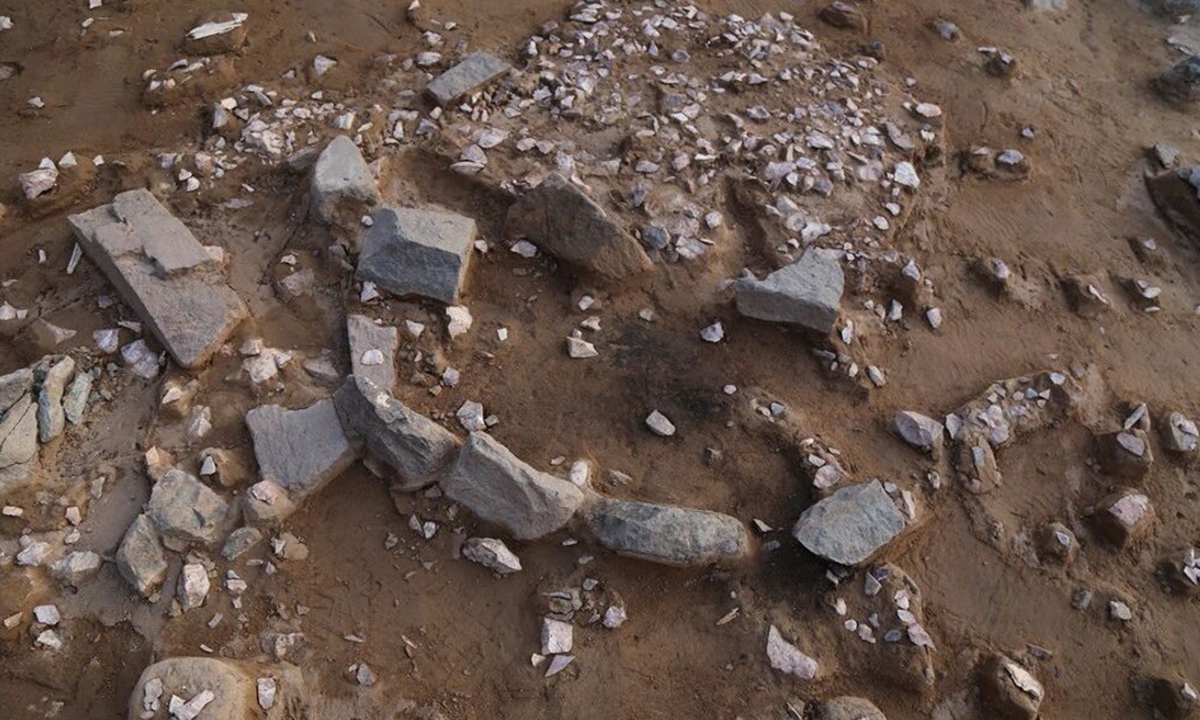
The remains of a furnace used for heat-treating stone tools at the Xinmiaozhuang site Photo: Screenshot of a report released by the National Cultural Heritage Administration
The remains of a prehistoric furnace used for heat-treating stone tools around 17,000 years ago has been discovered at the Xinmiaozhuang site in Yangyuan county, North China's Hebei Province. This remains paint a clear and complete picture of the past, showing that people in the late Paleolithic era had already mastered complex fire technology and were able to use heat to transform natural materials with skill and understanding, Gao Xing, a research fellow at the Institute of Vertebrate Paleontology and Paleoanthropology under the Chinese Academy of Sciences (CAS), confirmed to the Global Times on Monday.The Xinmiaozhuang site is located in the remote mountains of the Nihewan Basin in northwestern Hebei Province. It is a large cluster of Paleolithic sites dating from about 120,000 to 10,000 years ago. Discoveries from this site offer new clues for understanding the origins and technology of stone blade and micro-blade tools, the appearance and craft of early ornaments, the process of heat-treating stone, and the innovative ways in which ancient people used fire.
The findings are also vital for researchers studying the spread of Neanderthals, the evolution of ancient humans in North China, and the important transition from the Paleolithic to the Neolithic ages, according to a report by the Guangming Daily.
The excavation at Xinmiaozhuang was carried out by experts from the Hebei Provincial Institute of Cultural Relics and Archaeology together with the Institute of Vertebrate Paleontology and Paleoanthropology at CAS and other organizations. The ancient furnace uncovered at the site is an irregular oval-shaped structure, about one meter in diameter. Inside, they found traces of ash and reddish burnt soil, while around the furnace were many stones and stone products that had been heat-treated, as well as waste flakes.
The discovery brings to life scenes of late Paleolithic humans using fire to process stone. Dating results show that the furnace is about 17,000 years old, from the key period when people were moving from the Paleolithic age toward the Neolithic age, according to Wang Fagang, director of Paleolithic archaeology at the Hebei Provincial Institute of Cultural Relics and Archaeology.
Gao said that compared to similar Paleolithic sites around the world, the Xinmiaozhuang furnace offers the most complete evidence chain for this kind of heat treatment and is of unique archaeological value. Combined with the discovery of some of the world's earliest pottery artifacts at other sites in recent years, it suggests that the fire technology mastered by early people had begun to spark the early flames of civilization.
Gao told the Global Times that this pushes the timeline for Chinese civilization to even greater historical depths.
In addition to the furnace, Chinese archaeologists found more than 4,000 stone artifacts and animal fossils at the Xinmiaozhuang site. The stone tools belong to the typical flake stone technology of the time. They also found over 100 ornaments, including beads, pendants, and perforated shells, many featuring regular lines on their edges, according to information released by the National Cultural Heritage Administration.
These ornaments are diverse and reflect complex manufacturing skills. Most are beads, but the collection also includes pendants and other objects. The beads were made from shells, snail shells, ostrich eggshells, and tiny bone tubes. Archaeologists even found semi-finished beads in different stages of processing, providing a systematic look at the manufacturing process. Some, such as tiny beads made from bone tubes, are extremely intricate, explained Wang.
Gao noted that these ornaments are not only solid evidence of the aesthetic pursuits of people at the time, but also carry information about ancient migration, long-distance trade and exchanges, specialized crafts, the identity and social status of the wearers, and the beginnings of social complexity. Together with technological advances in fire use and refined stone tools, these discoveries signal an impending technological and social revolution with far-reaching impact on human history.
RELATED ARTICLES