Lai Ching-te first Taiwan regional leader to face impeachment vote, though motion falls short; public discontent rises as agenda deepens social division, heightens tension: observers
By Published: May 19, 2026 11:06 PM


Latest news
Lai Ching-te has become the first regional leader in Taiwan's contemporary history to face an impeachment vote, marking a striking moment in the island's political landscape.
Although the motion failed to pass, the vote - held just one day before Lai's second anniversary in office on May 20 - highlighted rising public dissatisfaction with his performance.
The impeachment itself was initiated months ago due to a legislation on revenues, but it reflected the mounting dissatisfaction with Lai and the DPP authorities, which have been adhering to a pro-independence approach stubbornly while ignoring real issues on the island, according to observers from both the mainland and Taiwan.
The erroneous path has deepened social divisions, disrupted the island's development, and heightened cross-Straits tensions, fueling public dissatisfaction and anger, they said.
'Day of shame' for Lai
The impeachment motion against Lai was initiated by the main opposition Kuomintang (KMT) and the smaller Taiwan People's Party (TPP). Lawmakers voted 56-50 in favor of impeachment, but the 56 votes fell short of the 76 required for the motion to pass, according to Taiwan regional media CNA.
An impeachment motion against the leader or deputy leader of island must first be proposed by at least half of all members of the legislature and approved by a two-thirds majority before being submitted to the judicial body for review, according to Taiwan region's ctinews.com.
The KMT and TPP hold 54 and eight seats, respectively, in the island's 113-seat legislature, compared with 51 seats held by the Democratic Progressive Party (DPP). Seven lawmakers from the KMT, TPP and DPP did not vote, according to ctinews.com.
The impeachment was initiated by KMT and TPP lawmakers in December 2025, after Lai did not promulgate an amendment passed by the legislature that would have given local governments a larger share of public revenues. It was the first time in contemporary Taiwan history that a regional leader had failed to promulgate a law enacted by lawmakers, according to the Taipei Times.
In a statement released on Tuesday at its website, the KMT said Lai had become the first leader in Taiwan island's constitutional history to face a formally proposed impeachment motion in the "Legislative Yuan" that proceeded to a vote. It said the motion reflects Lai's record over his two years in office, accusing him of abusing administrative power, undermining the constitutional order, creating political disorder, and tearing society apart. Although the motion failed to pass, the KMT said history would record this as a "day of shame" for Lai.
The statement also cited US President Donald Trump's warning against "Taiwan independence" and slammed Lai's repeated evasion and ambiguous words on the topic.
TVBS News cited Taichung Mayor Lu Shiow-yen as saying that, for the sake of Taiwan's security, she would like to offer Lai several suggestions to dispel the international community's concerns as soon as possible. As May 20 marks the second anniversary of Lai's inauguration, he should personally make clear that Taiwan will not declare independence, Lu said. She also said that, to avoid the DPP saying one thing and doing another, Lai, who also serves as DPP chairman, should remove the "Taiwan independence" clause from the party platform.
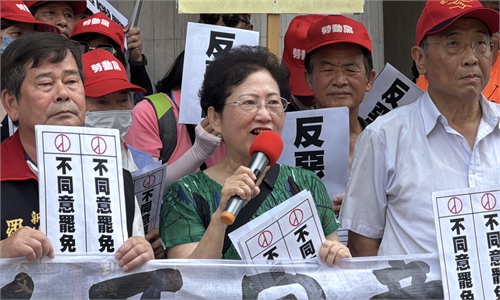
The impeachment vote carried strong symbolic weight at the anniversary. Although the motion failed, it underscored deepening political divisions on the island and gave voice to growing dissatisfaction with the DPP authorities, Wang Wu-lang, secretary-general of Taiwan's Labor Party, told the Global Times on Tuesday.
Wang noted that for the past two years, the DPP authorities continue to anchor their political line in "Taiwan independence" separatism. On economic and industrial policy, the DPP has rushed to "decouple with the mainland" while pushing parts of the semiconductor supply chain to the US and opening the island's market to the US in an unprincipled way. These moves have also weakened confidence among traditional industries and ordinary people, fueling discontent among the public, Wang said.
Many Taiwan regional media outlets covered Tuesday's impeachment vote. Before the vote on Tuesday, a UDN editorial noted that over the past two years, Lai has persisted in a stubborn and misguided approach, leading to division and social confrontation. The impeachment motion was not about winning or losing a vote in the moment, but about establishing right and wrong for history, the editorial said.
Public backlash
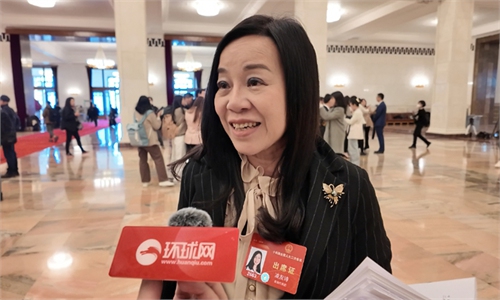
The 56 votes in favor of impeachment on Tuesday, together with recent polls showing high disapproval and weak confidence in Lai's future governance, underscore Lai's failure in governance over the past two years. The public dissatisfaction is also closely linked to the Lai authorities' separatist line, Zhu Guilan, an assistant professor at Tsinghua University's Institute of Taiwan Studies, told the Global Times.
On cross-Straits relations, the Lai authorities have denied the 1992 Consensus and promoted the claim that "the two sides of the Taiwan Straits are not subordinate to each other," leading to a suspension of cross-Straits consultations and a freeze in people-to-people exchanges. The fact that more than half of the public is dissatisfied with Lai's cross-Straits policy clearly shows that the mainstream voice on the island is for peace, exchanges and development, Zhu said.
A TVBS poll released on May 14 showed that 38 percent of respondents were satisfied with Lai's governance performance over his two years in office, while 45 percent were dissatisfied and 17 percent expressed no opinion. On Lai's future governance performance, the poll showed that 51 percent of respondents said they had no confidence.
Zhu noted that as the Lai authorities face rising public dissatisfaction and Washington signals that it does not support "Taiwan independence," they may continue to hype the so-called mainland threat to divert public attention. Such political manipulation, however, will only further intensify cross-Straits tensions and harm the interests of compatriots on both sides.
On May 15, during an interview aboard his return flight from China to the US, President Trump stated that he was "not looking to have somebody [in Taiwan] to go independent." This remark quickly sent shockwaves through public opinion on the island. Lai awkwardly responded on May 17, throwing out the fallacy that "defending the status quo of the 'Republic of China' is not an issue of 'Taiwan independence.'"
Lai's evasion, ambiguous and weak clarification on the topic fully demonstrated Lai has gone into a dead end and harbors deep inner fears; meanwhile, he desperately attempted to embolden himself with such play of words, exposing his stubborn stance as a die-hard advocate of "Taiwan independence," analysts said, adding that no matter how Lai tries to defend his words, clinging firmly to the separatist path will eventually make him spurned by people across the Straits and condemned by history forever.
Hou Yu-ih, Mayor of New Taipei City, stated bluntly that if there is no "Taiwan independence," the DPP should remove its pro-independence party platform. Former People's Party Chairman Ko Wen-je posted on social media that Lai Ching-te keeps coining new political terms, yet the DPP is fully aware that its pro-independence party platform is impractical in the international community and can only resort to deliberate concept shifting.
In response to Lai's words, Chinese Foreign Ministry spokesperson Guo Jiakun said on Monday that Lai Ching-te's latest act is just self-defeating, which once again lays bare his separatist stance and intent to advance "Taiwan independence."
"There is but one China in the world. Taiwan is never a country, not in the past, and never in the future," Guo noted.
RELATED ARTICLES