A lesson from Spanish pistachios coming to China
By Published: May 20, 2026 09:53 PM

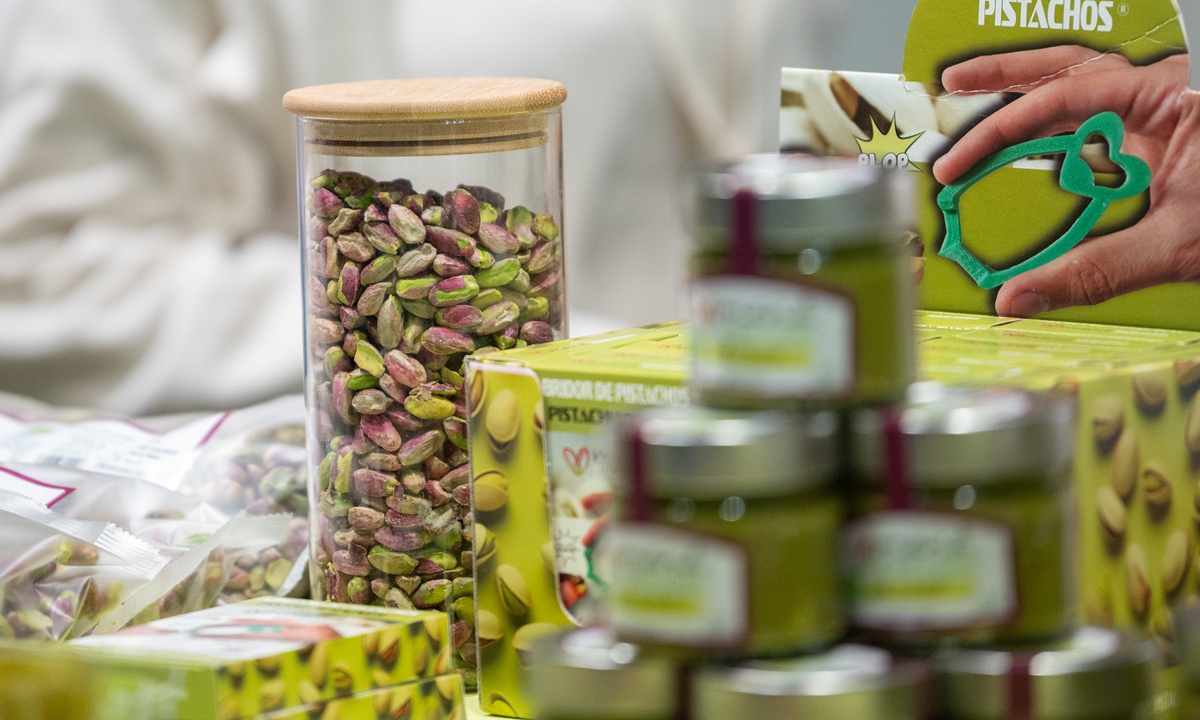
Organic pistachio products are displayed at a consumer fair in Spain on November 6, 2025. Photo: VCG
"Mom, can I have Spanish pistachios every day?"My eight‑year‑old son looked up at me with eyes full of calculation. He was holding a pistachio shell in one hand, one of those "Product of USA" nuts I had picked up from a supermarket here in Beijing.
One year ago, I returned from a reporting trip to Spain with a bag of goodies, among them a small packet of Spanish pistachios. He went straight for the pistachios and devoured them. "Yummy," he declared, pronouncing his judgment as if he were a food critic. I didn't give it another thought. I simply figured he must really like the taste of pistachios, so once his Spanish stash ran out, I replenished it with nuts from elsewhere. But children have long memories - especially when food is involved.
When I told him the news - that as of April 30, Spanish pistachios and dried figs are allowed into China, provided they meet all relevant inspection, quarantine and hygiene requirements - his first question wasn't about the complicated processes; it was about the pantry.
As a journalist who follows international affairs, I recognized immediately that this announcement was one of the concrete outcomes of Spanish Prime Minister Pedro Sánchez's visit to China in the middle of last month. Agreements get signed, and then the follow‑ups happen fast.
Of course, I wouldn't actually let my son eat pistachios every day. But his innocent question made me realize something: A dry intergovernmental negotiation and a customs notice can be translated into a real‑life moment - a child sitting at the dinner table, eagerly waiting for nuts from a country on the other side of the world.
That little pistachio, when it finally travels from Spanish orchards to a Beijing supermarket, will have borne witness to trade agreements, quarantine standards, diplomatic back‑and‑forth, container shipping schedules - and, underneath all of that, the evolving trade relationship between China and Spain over the past five decades, or even longer.
China and Spain established diplomatic ties in 1973, over five decades ago. Since then, annual bilateral trade has risen to over 43 billion euros ($46.7 billion), and Spain's exports to China have expanded from wine and pork to olive oil and ham, all of which are on the dinner tables of ordinary Chinese families.
Up until this point, Spanish fruit shipments to China include citrus, peaches, plums, table grapes, persimmons, and pistachios and dried figs are newcomers on the list. Spain ranks fifth among the world's leading producers of pistachios. The Mediterranean climate gives the fruit a unique advantage, making it plump and crisp.
This advantage aligns perfectly with Chinese consumers' increasing demand for product quality, reflecting what is often referred to as China's domestic consumption upgrading. More fundamentally, the import of Spanish pistachios serves as a vivid example of China's high‑quality opening‑up in the agricultural sector.
Spain has chosen a path that enhances its ability to develop what is needed in the current world. Spain has long sought wider access to the Chinese market. While certain voices calling for "de-risking China" have emerged within some EU member states, Madrid sees a window to step up. By deepening economic and trade ties with Beijing, Spain is not only securing a vital outlet for its agricultural sector but also demonstrating a pragmatic form of de-risking: Diversifying its own export markets reduces over‑reliance on any single trade partner; when it comes to market opportunities, engagement remains the operative word.
Spanish philosopher Ortega y Gasset once famously said that Spaniards are the Chinese of the Western World. Both China and Spain were pioneers in the rise of the first modern wave of globalization. The Manila Galleon (1565-1815), also known in Spanish as the "Nao de China," was its most visible symbol - these legendary ships transported Chinese silk and porcelain to Spain in exchange for silver. Four centuries ago, Chinese silk shawls told a story on the shoulders of Spanish women. Today, Spanish pistachios are ready to tell their own story - on the dinner tables of Chinese children. Time changes many things, but the will to connect remains strong.
I didn't explain all these complexities to my son later that day. I just told him, "When the pistachios come, I will buy them for you."
The author is director of the Opinion Department of the Global Times. The article is originally published on Spanish media outlet El Llobregat. wangwenwen@globaltimes.com.cn
RELATED ARTICLES