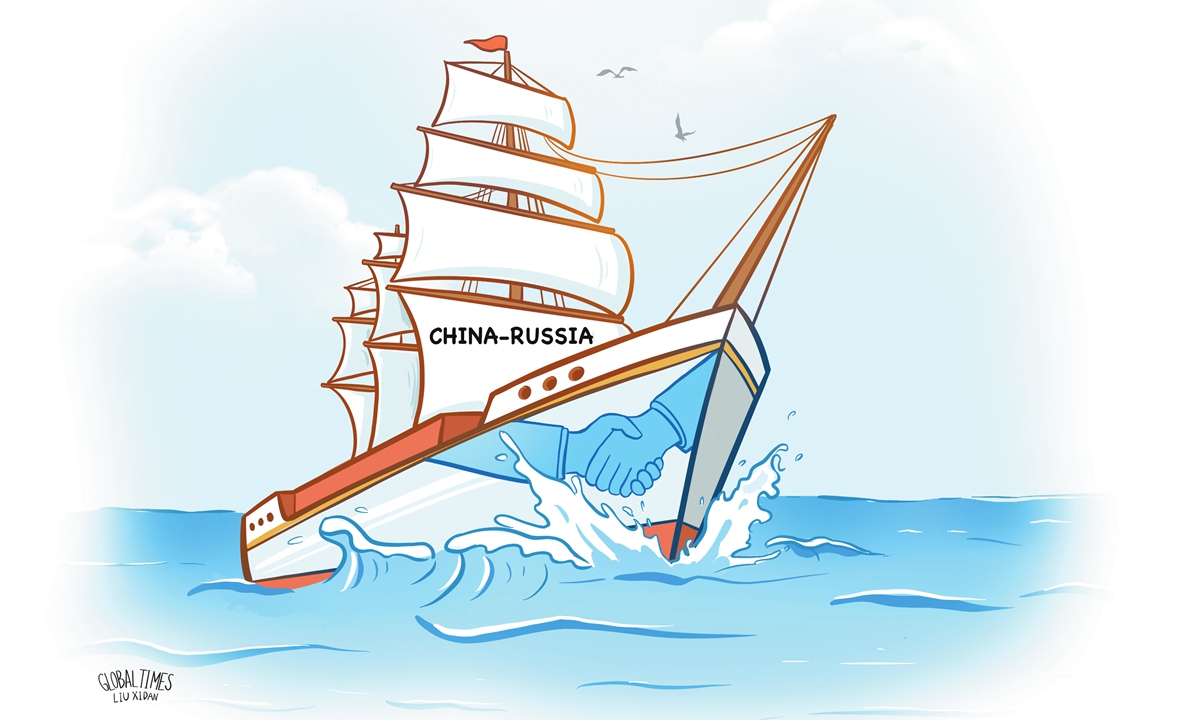
Illustration: Liu Xidan/GT
Russian President Vladimir Putin's current visit to China comes as the two countries mark the 25th anniversary of the signing of the China-Russia Treaty of Good-Neighborliness and Friendly Cooperation, a milestone in bilateral ties. The leaders of Russia and China have met more than 40 times since 2013, across different forums, and each encounter has deepened cooperation and added new substance to the relationship.Today's global political and economic landscape is accompanied by sharp, unpredictable shifts. Russia and China need to define a joint course of action to cushion negative effects, strengthen the resilience of their political and economic systems, and improve cooperation at each and every level. That is why expectations for talks between the two leaders are running high around the world.
This substantive visit could take China-Russia relations to a new level and bring greater stability and constructive momentum to global affairs.
The Russian delegation includes five deputy prime ministers, eight ministers and the central bank governor as well as heads of state corporations and major businesses, underscoring the careful preparation of the talks and the packed business agenda.
President Putin recently confirmed that Moscow and Beijing are at an advanced stage in negotiating a major new agreement for the oil and gas sector, Reuters reported earlier this month. In today's geopolitical climate, it is crucial for both countries to secure long-term energy and transport stability.
Industrial cooperation, especially in high technology, is also vital for Russia and China. The emphasis is expected to be on sustainable, multilateral models for developing, producing and marketing high-tech goods, which will require creating stronger clusters, adopting common standards and legal rules.
Practical cooperation on military and security issues also remains important, including joint exercises, air and naval patrols, and drills for crisis response, natural disasters and industrial accidents. Russia and China are also successfully cooperating in space.
The close Russia-China partnership is not bloc-based and is not directed against any third party, but it is often portrayed so in the West. Moscow and Beijing are independent and self-sufficient power centers, committed to building a fairer and more equal world order centered on the UN system. The two countries traditionally seek to coordinate efforts aimed at the peaceful diplomatic settlement of conflicts, preventing crises from escalating, and stopping them from entering an uncontrollable phase. China shares Russia's approach to "indivisible security," under which even a small shift in stability in favor of one state or group of states is unacceptable in any region.
Moscow and Beijing recognize the importance of not only expanding trade and economic ties, but also improving their quality, moving toward a complementary model, and rejecting protectionism and unfair competition.
Both countries aim to make multilateral and non-discriminatory partnership formats around the Shanghai Cooperation Organisation and the BRICS (Brazil, Russia, India, China, South Africa) work more effectively, with the involvement of other interested institutions such as the Association of Southeast Asian Nations, the South Asian Association for Regional Cooperation, the African Union.
The bilateral agenda also includes support for regional development, especially in Russia's Far East and China's Northeast provinces. There is also significant room for humanitarian cooperation, including culture and tourism. The mutual 30-day trial visa-free policy between the two countries has already boosted exchanges, though more needs to be done to help Russian and Chinese people better understand each other's countries, traditions and ways of life, as well as to strengthen mutual trust, including among small and medium-sized businesses.
Improving transport connectivity also carries high expectations, with expanded passenger and freight routes, simpler procedures, lower transport costs, and modernized border and logistics infrastructure.
At present, Russia and China stand as an example of equal and respectful relations between major powers working to preserve global peace and security - and here, actions speak louder than words.
The author is a professor at the Department of International Relations, Far Eastern Federal University (Vladivostok). opinion@globaltimes.com.cn
RELATED ARTICLES