IN-DEPTH / IN-DEPTH
$5,000 donation blooms into 50,000 trees: Witnesses invite American donor to China to see fruits of his kindness
Let us plant trees together, Dear Mr. Sakolsky
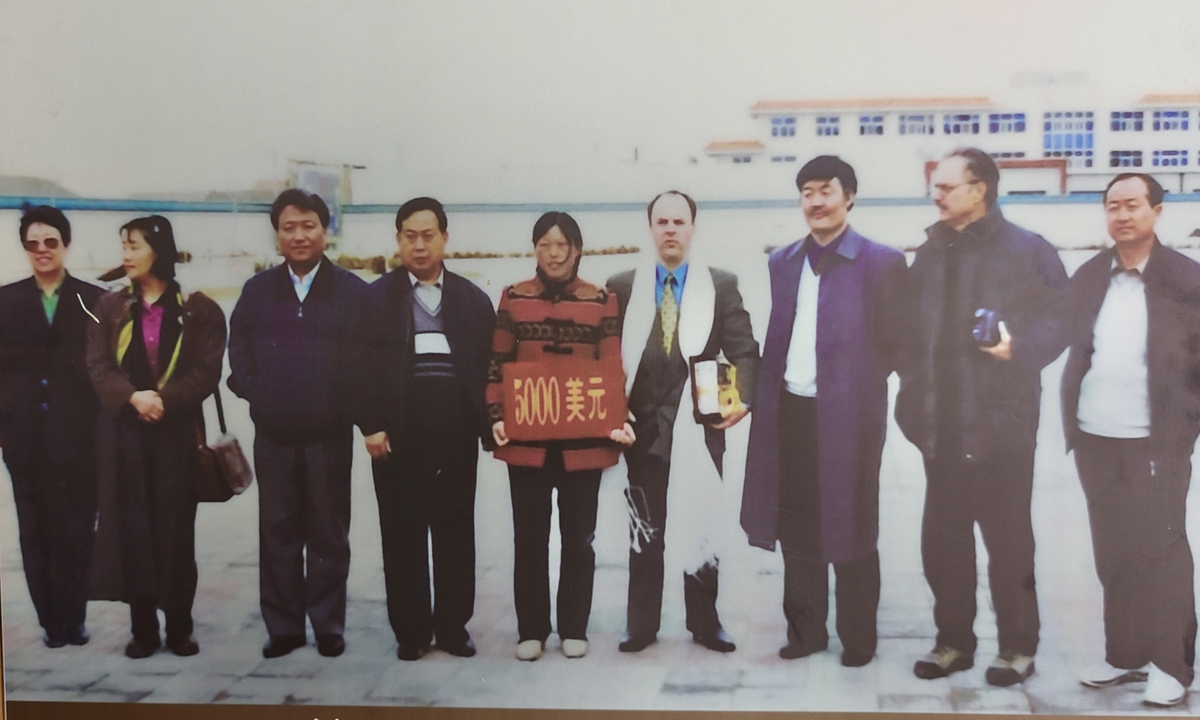
A group photo from the 1999 donation ceremony, where Ronald Sakolsky presents $5,000 for afforestation efforts, is preserved by Bai Fan. Photo: Courtesy of Luoyang No.2 Foreign Language School
"I had never seen so much money. He gave me that sum, and I bought so many good saplings with it... I have always thought of him. I wanted to tell him that I did it. I didn't waste his money."
Yin Yuzhen, a national model for desert reclamation in China, fought to hold back tears during an interview with the Global Times on Tuesday.
For nearly three decades, Yin searched for the American, who gave her $5,000 in 1999 to plant trees in the Mu Us Desert in Ordos, North China's Inner Mongolia Autonomous Region. On May 18, 2026, she finally found him.
Their reunion took place via video call, capping a swift under-48-hour search spurred by Yin's public appeal on Chinese social media. As he chatted with Yin once more, former US exchange teacher Ronald Sakolsky from Pennsylvania learned his donation had blossomed into vast lush forests, and exclaimed it was truly amazing, Inner Mongolia Radio and Television Station (IMRTS) reported.
In 1999, Sakolsky made the donation to support Yin's desert greening efforts. Back then, that amount of money could have bought Yin a 400-square-meter apartment or a lifetime of fine clothes. Today, that $5,000 has blossomed into more than 50,000 trees, transforming a stretch of northern China's barren wilderness into a greenbelt that now shelters wildlife and holds back the encroaching dunes.
The story has captivated millions of netizens. Underneath a news report of their video call, one user commented on Xiaohongshu (RedNote): "Chinese people remember every debt of gratitude. You give me a drop of water, I return a sea. You plant a single tree, I give back a spring."
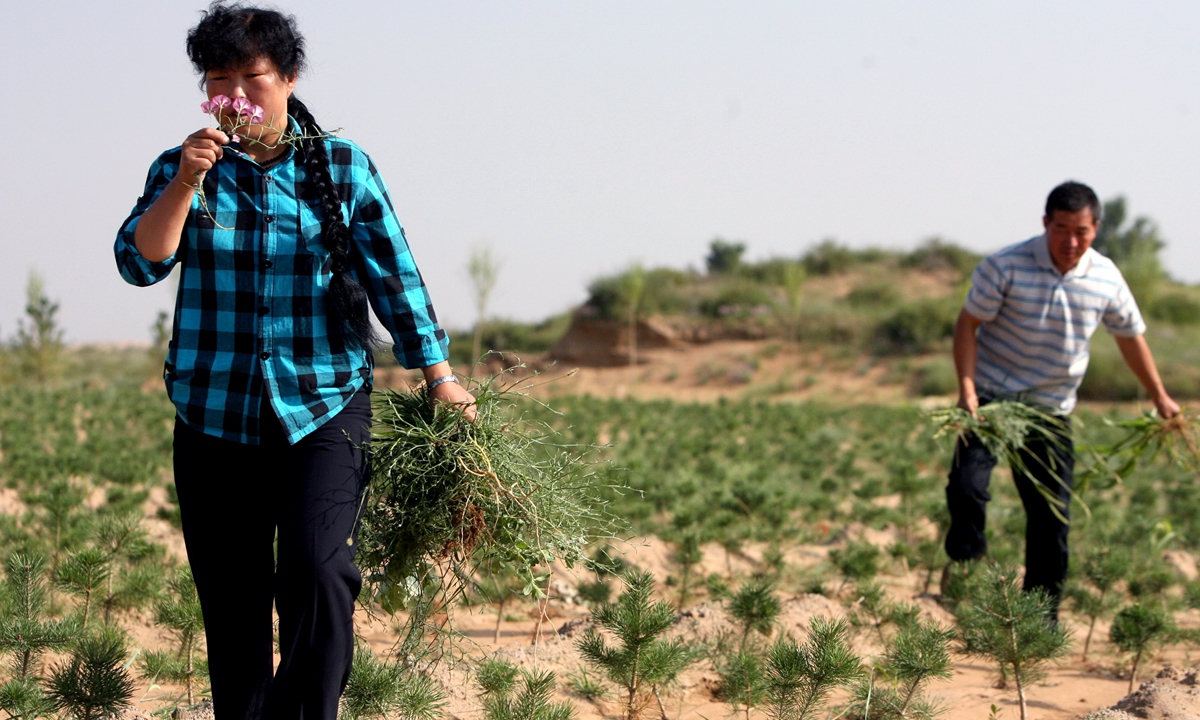
Yin Yuzhen, a national model for desert reclamation in China, stands in the desert holding up pulled weeds. Photo: VCG
'He has never been forgotten'
On May 16, local media in Inner Mongolia released a video recorded to help Yin to find Mr. Sakolsky. In the footage, standing amid the lush greenery of the Mu Us Desert, she called out: "Hello, Mr Sakolsky. If you can see this video, I especially invite you to come back to China to see the forest that grew from your donation."
Flash back to 1999. The Mu Us Desert was a different world then.
"I couldn't believe what I saw when I first went there," recalled Bai Fan, vice principal of Luoyang No.2 Foreign Language School in North China's Henan Province. At the time, Bai was the vice principal of Luoyang Foreign Language School, overseeing international affairs. Sakolsky was an exchange teacher there through a China-US program, and Bai's "neighbor right across the hall."
Bai told the Global Times that Sakolsky had seen a report about Yin and her husband on CCTV's English channel. Deeply moved by the perseverance of these ordinary farmers, Sakolsky said he couldn't imagine anyone enduring such hard work in such a harsh environment. He decided to do something. He emailed multiple foundations in the US, telling Yin's story, and eventually secured a $5,000 grant.
Accompanied by Bai, Sakolsky traveled to the heart of the Mu Us Desert to witness the donation ceremony and meet the "hero of the desert." Bai still remembers the "land of despair" they saw.
"The saplings were only as thick as a finger. Water had to be carried from far away, and Yin watered them with a ladle, scoop by scoop," Bai told the Global Times. "Mr Sakolsky kept saying 'Impossible.' His expression was incredibly serious. He even worried whether the money could truly change the desert."
They lost contact after that visit. But Yin never forgot the timely help. She kept her promise through decades of relentless work.
"I wrote to him for a few years, but then the connection was lost, and I even forgot the spelling of his name," Yin said. "When I later went out to give lectures, I would show people his photo, asking if they could find him. No one could."
"At an Earth Day event on April 22, I asked if anyone knew Sakolsky. They said that with today's internet connection, finding someone would be easy. I kept thinking about it," Yin said.
Sure enough, once the video was released, a wave of warmth surged across the internet. Bai revealed that a friend in Luoyang reached out to him, asking, "Weren't you the one who took a foreigner to Inner Mongolia to donate money?" Only then did Bai realize people across the nation were on the lookout for his old friend. He dug out dusty old emails and tried sending a message to Sakolsky's old address.
"The next day, he replied!" Bai's said. "His first word was 'Wow!'" Bai recalled. "During our conversation, I could hear his voice shaking." "He was so excited. He has never been forgotten. He never thought, after 27 years, anyone would still remember his small act of kindness."
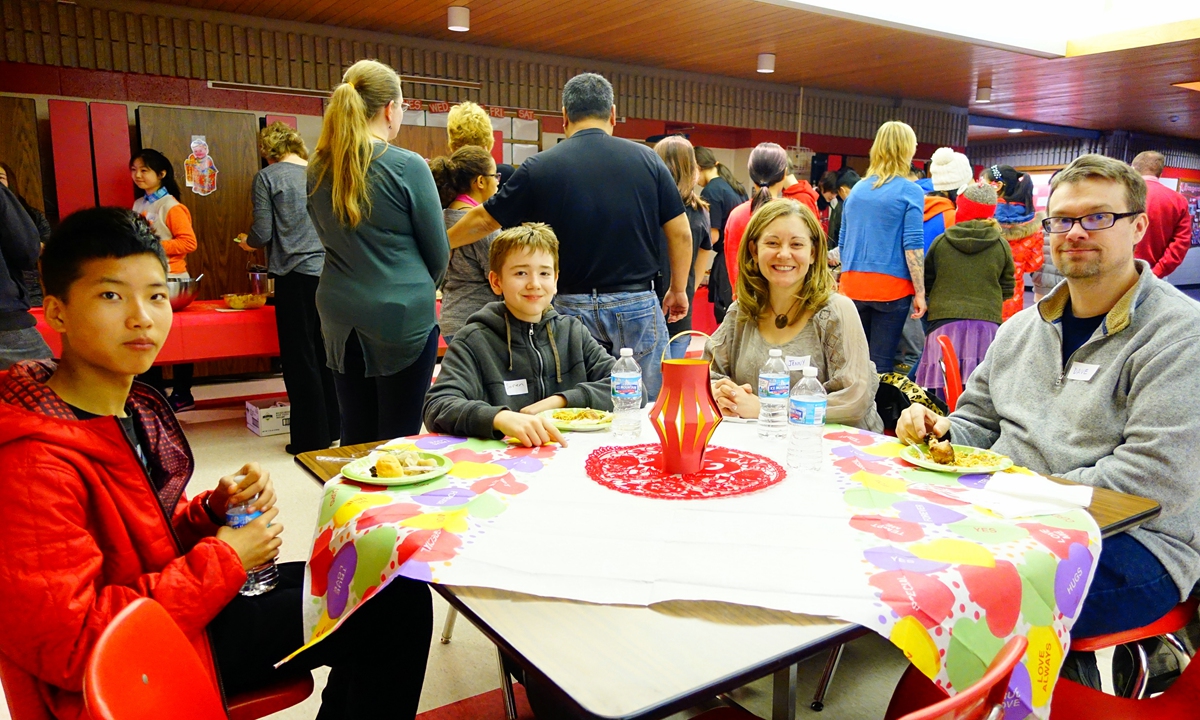
A student from Luoyang No.2 Foreign Language School joins host families and peers at a school event during his exchange program in the US. Photo: Courtesy of Luoyang No.2 Foreign Language School
'I want to find you to plant a tree'
Bai told Global Times that a large vintage photo taken in 1999 featuring himself, Sakolsky and Yin in the Mu Us Desert hangs on his office wall. "This photo has hung here for over 20 years. I could never to take it down," he said.
To Bai, Sakolsky is an American who genuinely loves China. In 1997, Sakolsky volunteered for the exchange program. "He was passionate about Chinese culture and scenery. During his stay in Luoyang, he visited the Longmen Grottoes and White Horse Temple, collecting boxes of folk cultural materials to take home."
After returning to the US, Sakolsky continued to share his passion. In 2009, Bai visited the US and stayed a week at Sakolsky's home in Pittsburgh. He was shocked to find that Sakolsky's classroom had become a "Chinese Culture Exhibition Hall," filled with Chinese memorabilia. Every new school year, Sakolsky would show these items to students, telling stories of his time in China, the kindness of the people and the beauty of Luoyang, passing his love for China to generations of students.
However, many of these mementos were later destroyed in a school mold contamination incident. "He was devastated. He wrote to me through others, asking if we could send more things," Bai said. Bai later mailed a replica of the Terracotta Warriors. "He used to keep it at school, and after retiring, he took it home. He treasures it like a gem."
Far away in Inner Mongolia, this sincere cross-border kindness has taken firm root and borne abundant fruits in the vast desert. The saplings Sakolsky once feared wouldn't survive have flourished under Yin's 40-year watch. The once barren Mu Us Desert now boasts an 85 percent control rate, with forest coverage rising to 32.92 percent. Over 8.39 million mu (559,000 hectares) of sandy land have turned green, and wildlife like rabbits and foxes have returned.
On May 18, Yin looked at Sakolsky through the screen and extended a direct invitation: "When can you come visit? I really want to see you."
Sakolsky replied in Chinese: "I want to find you to plant a tree."
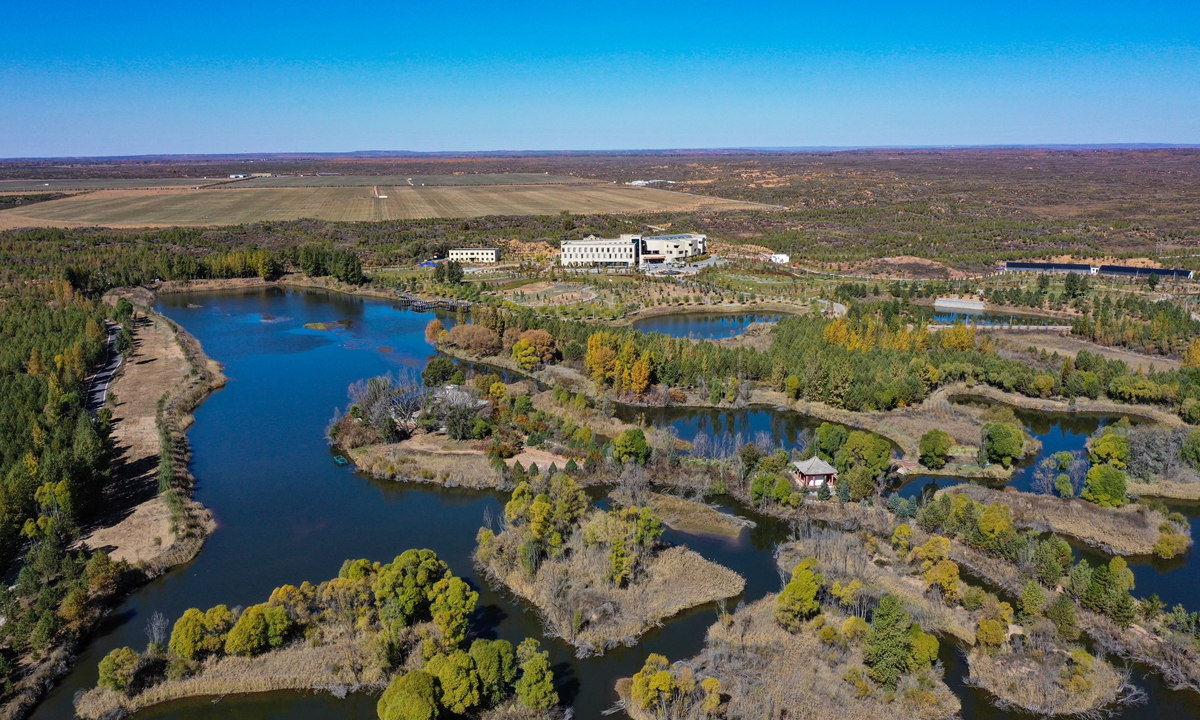
An aerial view of the part of the Mu Us Desert, which has been transformed into an oasis Photo: VCG
Kindnesses always remembered by Chinese
At the donation ceremony in 1999, Sakolsky spoke a few words in English. Bai still remembers them vividly: "We humans have one common home, and that is the Earth. We should cherish our home."
His words won warm applause amid the endless sand dunes, and still resonate strongly, even after 27 years.
Before the video call, Yin had learned a few simple English sentences specially for this occasion. On May 18, she said to Sakolsky: "You are [my] brother."
She told the Global Times that "Sakolsky is my first American elder brother. I have many other kind brothers and sisters who have helped me with afforestation, and I am deeply grateful for their contributions to nature and all humanity."
In 2015, Donald Ashton Jones, a young American, was moved by Yin's story and came to China to recognize her as his "sister." Over the past decade, he has returned to the Mu Us Desert every two years, planting over 2,000 Scots pines by hand. Siu Fong, a 76-year-old Chinese-American, traveled from California after retirement to plant four saplings in the desert, local media IMRTS reported.
Numerous international friends have reached out to assist China, just like Mr. Sakolsky. As reported by IMRTS, Yin collects currencies from different countries. She preserves banknotes from every nation whose people offer donations to her desert greening cause.
Xue Lian, principal of Luoyang No.2 Foreign Language School, was also a beneficiary of the China-US teacher exchange program. In 2008, she taught in Wisconsin for a year. In an interview with the Global Times, Xue shared that she had observed a shift in perception: "When I arrived, most American students' impressions of China were stuck in Bruce Lee movies. They were most curious about whether we really lived on campus and if our families owned cars."
During her overseas teaching tenure, Xue guided American students to access authentic information and videos to learn about real China, covering campus daily life, ordinary family scenes and the country's rapid technological advancement. She strove to present a genuine China to her American colleagues and students, firmly believing that personal experience beats hearsay.
This spirit of reciprocity continues to evolve with a new generation of students. Xue noted that, today, Chinese children view the world differently. "Our students talk about environmental protection, science and technology, and a community with a shared future for mankind. They have a strong sense of identity and a desire to communicate."
"This confidence gives 'repaying' a broader dimension," Xue said. "And in the future, we will do even more to answer the world's kindness."
RELATED ARTICLES