Korean Air to adjust flights to China after merger with Asiana Airlines amid rising tourism boom
By Published: May 21, 2026 10:23 PM

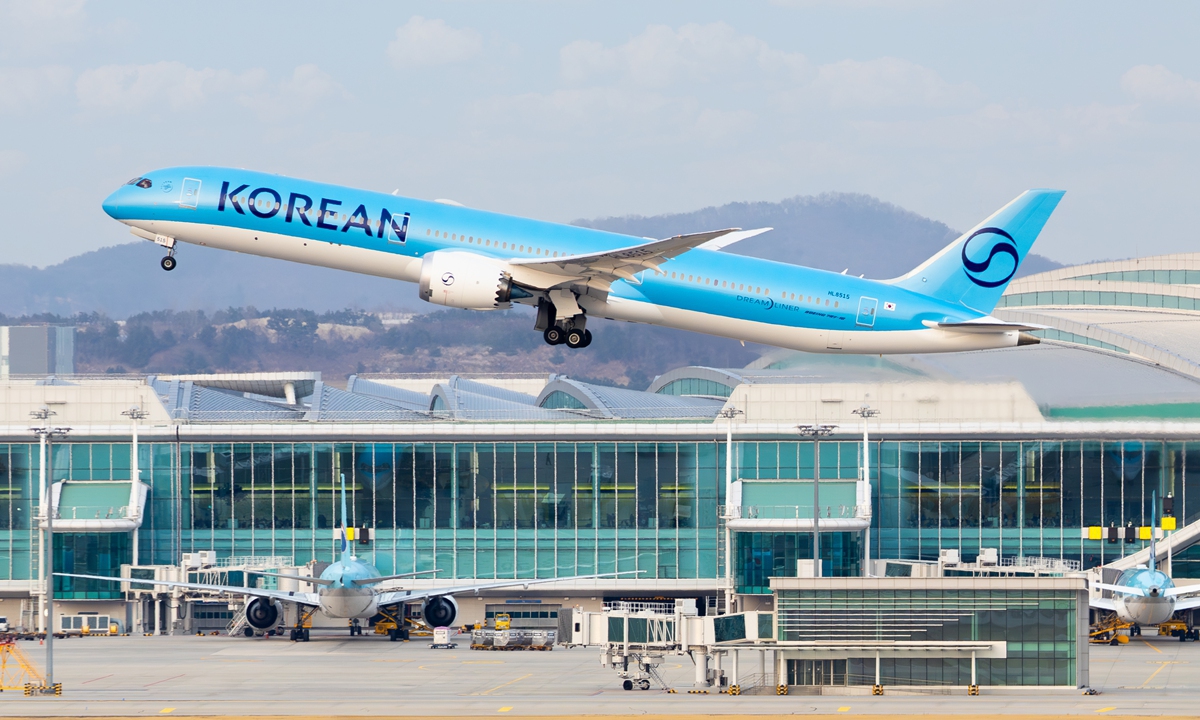
Photo: Courtesy of Korean Air
Korean Air told the Global Times on Thursday that it will adjust flights to China after its merger with Asiana Airlines, and the decision will be made based on market demand. Meanwhile, industry data showed that travel demand between China and South Korea are surging.
Korean Air is set to complete its integration as a flag carrier by December 17, following a five-year period of consolidation with Asiana Airlines. Once the integration is complete, Asiana Airlines will gradually exit the market, breaking the "duopoly" pattern dominated by the two major airlines in South Korea and replacing it with a "super aviation group."
After the merger, the airline plans to expand operations as much as possible based on existing traffic rights from both airlines and market demand, or further increase flight frequencies, the company told the Global Times on Thursday.
Regarding flights to China, the company said that it will adjust services depending on market demand.
From January to April, the average passenger load factor on Korean Air's routes to China was 88 percent, an increase of 11 percentage points year-on-year, according to data the company shared with the Global Times.
The rising load factor came amid a two-way travel boom. Since the beginning of this year, the number of flights between South Korea and China has grown rapidly.
Data from industry information provider Flight Master showed that during the 20th week of 2026 (May 11-17), the number of flights from the Chinese mainland to South Korea reached 1,147, with a recovery rate of 103 percent compared with 2019, ranking first for nine consecutive weeks. In the first week of 2026, flights from the Chinese mainland to South Korea surpassed 1,000.
Notably, in terms of round-trip flight volume on South Korea-China routes, Korean Air has surpassed China Eastern Airlines to become the top carrier. Besides China Eastern, domestic Chinese airlines with the densest presence on South Korea-China routes include China Southern Airlines and Spring Airlines.
Starting on Saturday, Qingdao Airlines will increase flight frequencies on the Qingdao-Seoul route, operating every Tuesday, Thursday, and Saturday. After the increase, the average daily number of passenger flights from Qingdao, East China's Shandong Province to South Korea has reached 18, including 16 daily flights to Seoul.
The rising travel demand benefits from a warm diplomatic climate between the two countries, underscoring people-to-people exchanges.
The Yonhap News Agency reported on Thursday that in April, South Korea received 2.03 million foreign tourists, up 19 percent year-on-year. By origin, the Chinese mainland topped the list with 570,000 tourists, followed by Japan with 300,000, according to the report.
According to the online travel platform Qunar, during the recent May Day holidays, users checked into hotels in more than 3,000 cities worldwide, with South Korea ranking as the second most popular outbound destination.
RELATED ARTICLES