Blinken claims US would ‘lose’ one-on-one competition with China; analyst says the proposition serves as a political excuse and bloc confrontation mentality will only backfire on US allies
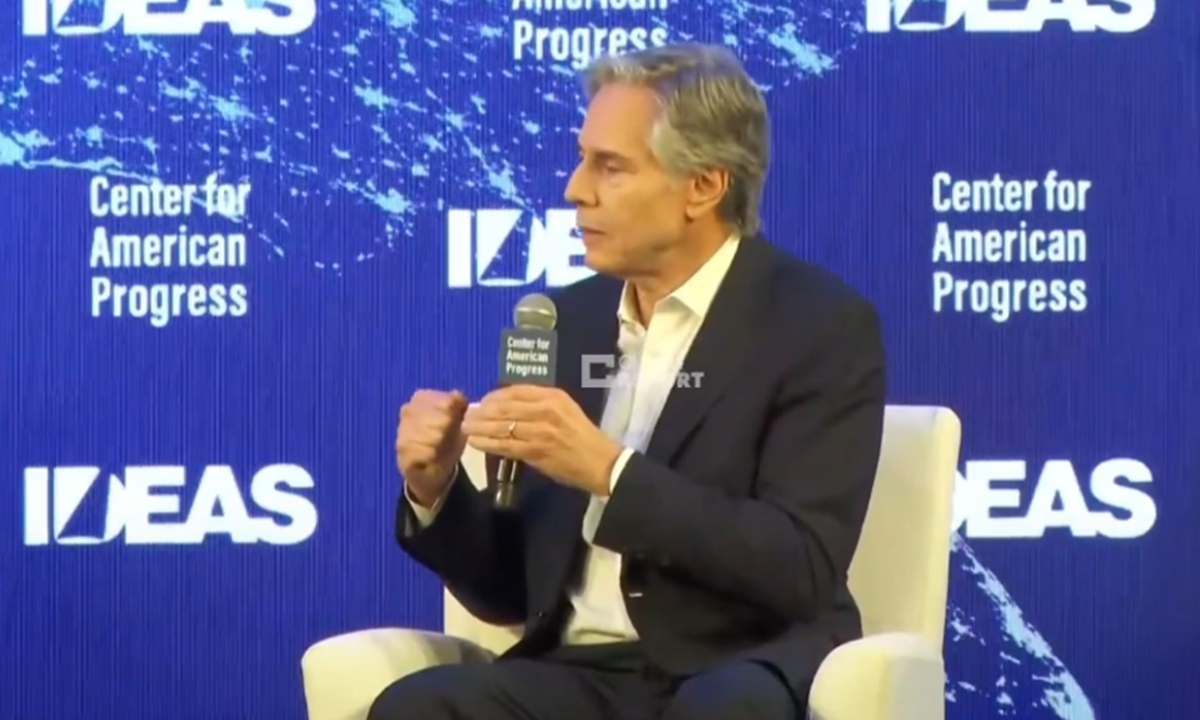
Former US secretary of state Antony Blinken speaks at the Center for American Progress (CAP) annual 2026 IDEAS Conference on May 19, 2026. Photo: Screenshot from website
Former US secretary of state Antony Blinken's claim that the US would lose if it "competed one-on-one" with China has sparked debate on social media X, after he cited China's market size, manufacturing capacity, academic output and patents to argue that Washington must work with allies and partners to make it "harder" for China to "ignore."The remarks, made at the Center for American Progress (CAP) annual 2026 IDEAS Conference and was reported by Clash Report, quickly sparked discussion on social media, with many netizens opposing Blinken's views, though a smaller number of commenters expressed support for them.
Their opinions were divided, with some accusing the US of using its alliance system to exploit partners or blaming past US policies for hollowing out American manufacturing, while others questioned why Europe should follow Washington in confronting China.
Li Haidong, a professor at China Foreign Affairs University, told the Global Times on Thursday that the idea of one-on-one competition itself is a false proposition, arguing that China and the US should pursue mutual benefit and win-win cooperation rather than confrontation. He said claims that the US would "lose" in direct competition with China serve as a political excuse for some US politicians to rally allies to contain China and engage in bloc confrontation.
Some netizens expressed similar views. User @Masonch31178202 wrote, "China is also very important trading partner with EU, Aus, Canada and Korea. It's not winner takes all." Another user, @JKH_Smith, argued that "the problem isn't the number of allies....."
"The broader trend across the international community over the past decade or so has been a shift away from the West's long-dominant model of values-based and bloc diplomacy toward a realist approach centered on national interests, sovereign autonomy and pragmatic self-interest. This trend is increasingly challenging the alliance system long built by the US, as countries are no longer willing to align purely on the basis of ideology," Li told the Global Times.
Li described Antony Blinken as a representative figure of the US political establishment, saying, while acknowledging China's growing strength, Blinken's remarks also carried a strong Cold War and bloc-confrontation mentality.
The expert traced the issue back to its historical roots, noting that for a long period after the end of the Cold War, the US relied on ideological narratives to rally allies, drawing some countries into a US-led values camp. "But now countries around the world are returning to the most basic logic of realism: Europe needs energy security and industrial interests, while some other countries also care about their economies and markets," he said.
According to Li, more and more countries are pursuing strategic autonomy, hedging strategies and balanced diplomacy rather than acting as US followers. "The idea of making the US 'harder for China to ignore' essentially means pressuring countries to choose sides," he said.
Some netizens argued that alliances would not necessarily bring benefits. User @RohitKarir wrote: "First, think about what the US does to countries it aligns with, with friends, with alliance partners, and with fellow democratic countries. Yours is an America-first, my money first, and my interests first policy, and then you want us to help you out in your hot and cold wars? "
Another user referred to India — one of the countries mentioned by Blinken — saying, "Don't count India in." One American netizen commented that the US treats its so-called allies as "vassals."
User @AvMuhammadOsman used the single word "Pathetic!" to describe Blinken's call for countries to align with the US, adding that "Sovereign nations aren't US vassals." Citing Europe as an example, the user argued that "Europe's current sickness is largely made in Washington."
"The world is exhausted by unfair US tariffs, bullying, threats to destabilize economies, and attacks on independent foreign policies. They crave peace & progress which China delivers. China wins through real partnerships, infrastructure, and production, not coercion. China respects others sovereignty, China prefers mutual cooperation over containment," the netizen wrote.
Notably, in some of the comments, "stability" emerged as one of the most frequently used words when describing China. User @CheburekiMan wrote, "China got to where it is by sowing stability and not starting wars all over the planet. The US is the opposite, sows chaos and misery whenever a sovereign nation rises up to claim its fair share of global power."
These views echoed the expert's analysis. Li said China's political, economic, policy and diplomatic stability closely aligns with the core logic of today's realist diplomacy, and has helped drive the recent wave of high-level visits to China.
From an economic perspective, he said that international relations are ultimately driven by interests. "No matter how many allies the US tries to rally, any attempt to contain China would disrupt global division of labor and supply chains, drive up inflation worldwide, and ultimately force US allies to bear the costs as well."
RELATED ARTICLES