Spanish art works highlight sustainability, promote cultural exchanges at Beijing Fair
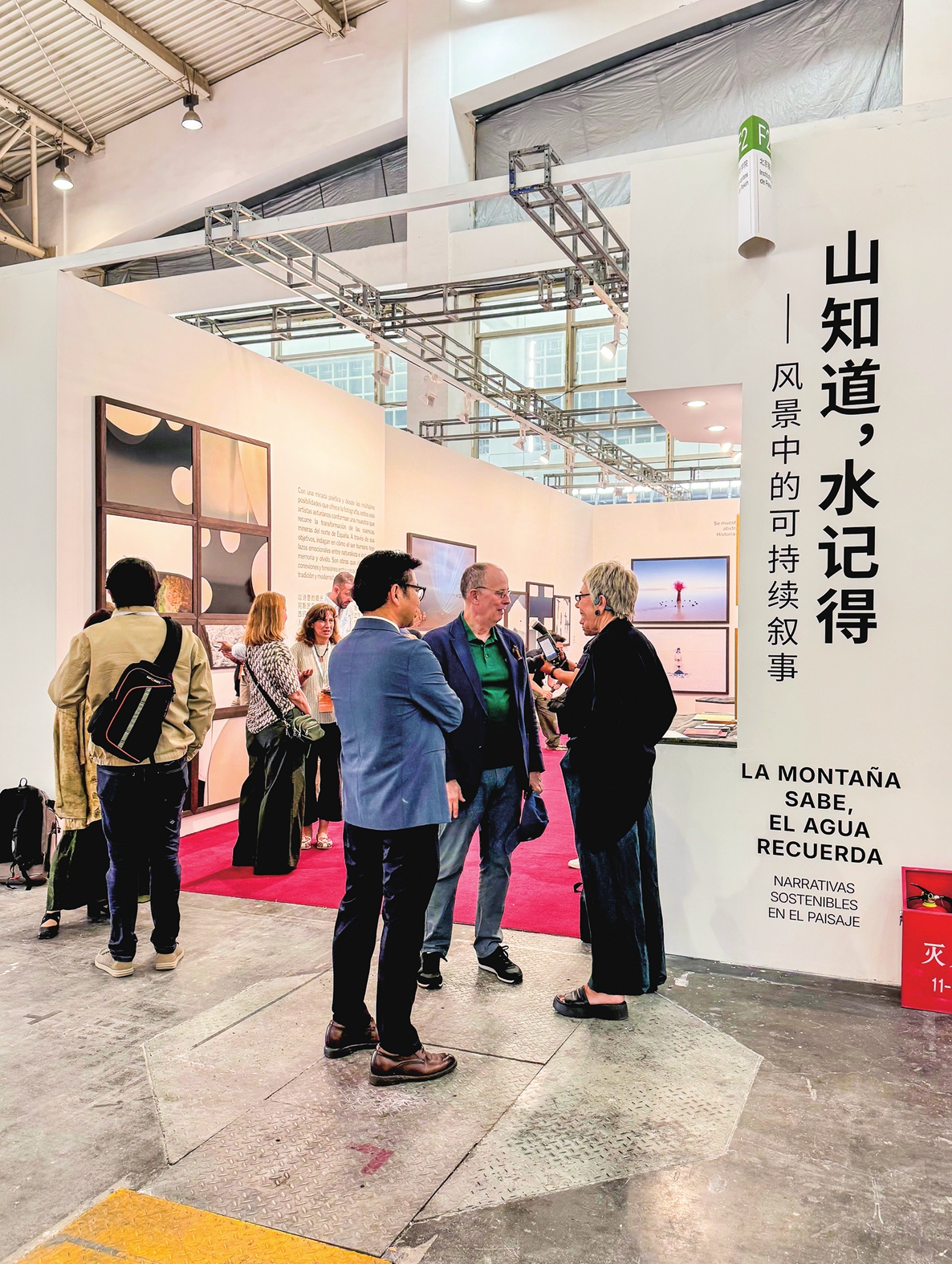
Visitors explore works at the booth of the Cervantes Institute in Beijing on May 21, 2026. Photo: Dong Feng/GT
Under the theme of "Land Trace," the 2026 Beijing Dangdai Art Fair is held at the National Agricultural Exhibition Center from Thursday to Sunday. The Cervantes Institute in Beijing, a Spanish public institution that focuses on the teaching of the Spanish language and the visibility of Spanish and Latin American culture, participates in the art fair for the first time. Inma González Puy, director of the Cervantes Institute in Beijing, told the Global Times that the institute's participation further solidifies the organization's commitment to promoting dialogue between Chinese and Latin American cultures and showcases the artistic voice of northern Spain.The curatorial theme "Land Trace" represents both the trajectory of historical evolution and markings of shifting landscapes. It signifies the walking paths through urban streets and alleys while symbolizing the profound connections between people.
The Cervantes Institute in Beijing's participation in the art fair marks a further deepening of the dialogue between Chinese and Spanish cultures, Director González Puy told the Global Times.
Meanwhile, the institute's presence provides the Chinese public with a new window to understand Spanish contemporary art from an innovative, interdisciplinary perspective closely connected to major contemporary global issues, she said.
The booth of the Cervantes Institute in Beijing's is titled La montaña sabe, el agua recuerda: narrativas sostenibles en el paisaje (The mountain knows, the water remembers: sustainable narratives in the landscape), featuring works of six Asturian artists, presented in various forms, explore the profound connection between people and the land.
Curated by Laila Bermúdez and Ramón Isidoro, the exhibition shows from industrial heritage to natural regeneration, the works together weave a narrative about memory, sustainability, and landscape change, prompting people to reflect on the ever-changing environment.
Asturias is the ancient heart of northern Spain. Bermúdez told the Global Times that it's situated along the Atlantic Ocean in the north, with a mountainous setting and vast greenery. Asturias has unique culture and history, Bermúdez added.
Asturias was a mining area, Bermúdez said, however, since the 1920s, many mining businesses vanished. After deindustrialization, many mines in the area were abandoned.
Consequently, the photographs taken in this area present this area with a more poetic perspective, Bermúdez said.
Bermúdez expects the works could break the language barrier and connect with Chinese visitors. She has also explored other works at the art fair. In her view, the shared image language in China and Spain is highlighted at art fair here.
"Chinese artists' works could be more concrete to be understood," she said.
Against the backdrop of increasing global concerns over climate change and sustainable development, these artistic practices also guide the public to rethink resource recycling, material regeneration, low-carbon lifestyles, and the balance between tradition and modernity, González Puy added.
At the same time, such artistic practices can also promote sustainable cultural exchange between China, Spain, and Latin America and the Caribbean. These regions face similar challenges in urban development, ecological protection, and cultural transformation. Art can serve as a tool for international dialogue that transcends geographical and cultural differences, fostering deeper understanding and cooperation through shared focus on sustainable development, historical memory, and the future, González Puy said.
This year's art fair will expand to more than 20 countries, 45 cities and 130 exhibitors. The fair's footprints have been intertwined with the evolution of its host city and the art ecosystem.
RELATED ARTICLES