Director highlights fruitful results in two-way book translation
Director hails fruitful results in book translation
Editor's Note:
Although China and the Latin America and the Caribbean (LAC) region are geographically distant, the bond of our friendship stretches back through centuries. As the official or dominant language in most of the LAC region, Spanish serves as the primary language for more than 450 million people in the world. Recently, a slew of translated works - spanning both Chinese and Spanish literature - has emerged. Experts, diplomats, and government officials talked with Global Times reporter Dong Feng to share their observations focusing on this new wave of literary exchange.
Director González Puy said high-quality translators and domestic publishers have actively involved, and the introduction of Spanish works has evolved from thin pamphlets in the early days to substantial and comprehensive publications.
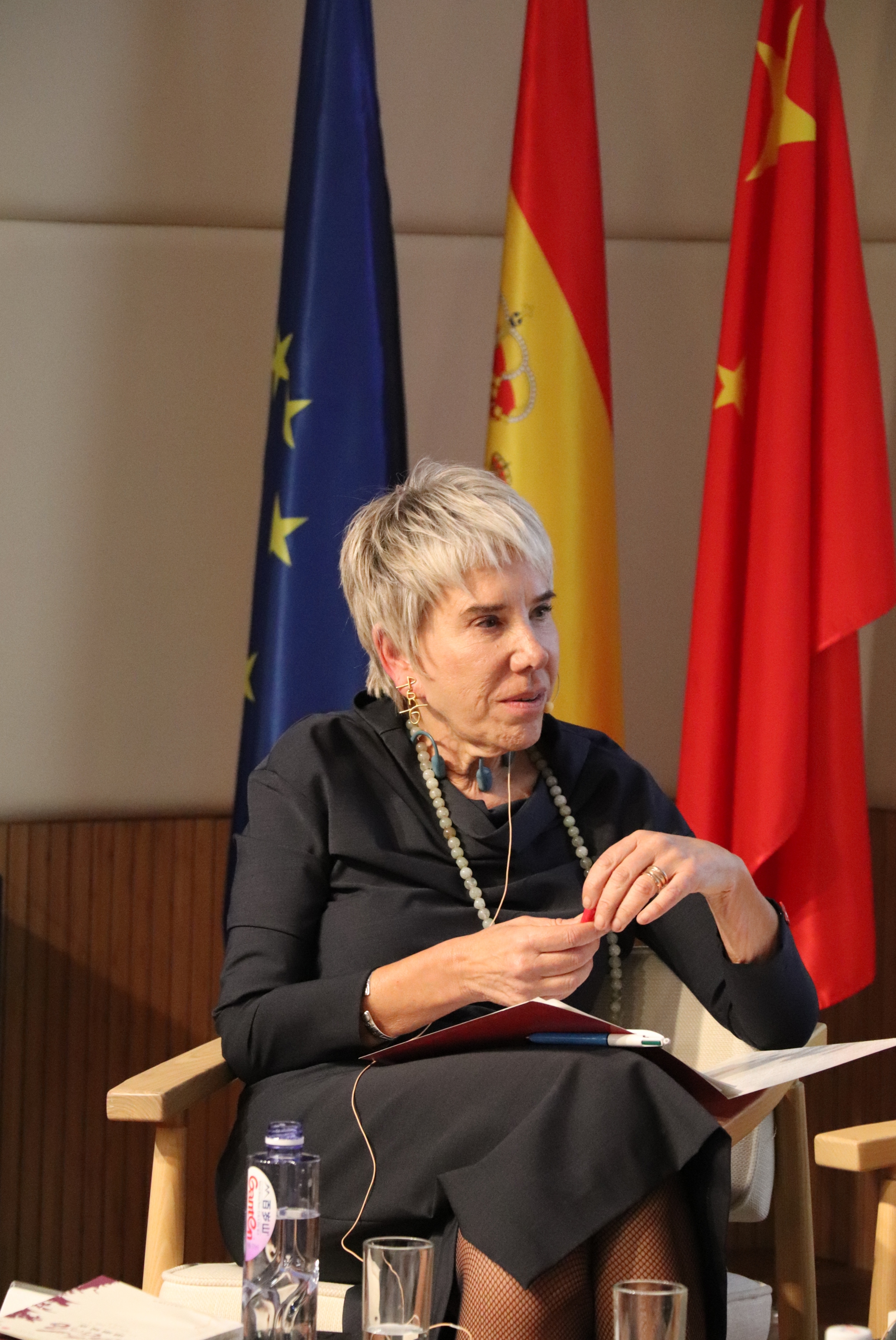
She chaired a panel discussion at a new book launch event at the Cervantes Institute in Beijing on April 24. Hosting almost 100 people, the event launched the Catalogue of Spanish Literature translated into Chinese, which is its third edition.
González Puy told the Global Times that the Spanish literature translated into Chinese has increased by 300 percent in less than 15 years.
From her point of view, literature remains the bridge that unlocks the unlimited potential for intercultural understanding and dialogue. In the age of AI, the world of translation continues to demonstrate that it is thriving.
She said that it is remarkable that there is continuous optimization of the translation and dissemination structure of Spanish literature, which shows a trend toward the emergence of younger, more feminine, and more contemporary writers. "The proportion of works by Latin American writers, emerging writers born in the late 1970s and 1980s, and female writers has increased significantly, changing the previous pattern that was dominated by classical literature," said González Puy.
The Spanish government has also established a special fund to support Chinese translators in introducing Spanish literature. At the same time, through channels such as the Confucius Institute, it has promoted the translation of works by renowned Chinese contemporary writers such as Mo Yan, Yu Hua, and Liu Zhenyun into the Spanish-speaking world. Argentine writers and their booksellers have also actively built bridges between Chinese and Spanish literature, achieving a two-way exchange of culture, González Puy noted.
Sharing her observation to the reality of the digital age and the development of AI technology, González Puy said that AI is only a translation tool and cannot replace the humanistic and artistic aspects of literary translation. "The value of professional translators remains irreplaceable, and the cultural and practical value of learning Spanish continues to stand out," she said.
During the panel discussion, the panelists said that the new publication from the Cervantes Institute in Beijing includes works by Spanish and Latin American authors published in China up to August 2025. Compared to the previous edition published in 2011, the total number of translated works has increased by 300 percent.
The catalogue's author Lucila Carzoglio, editor and translator Wang Tian'ai, editor Zhao Chao, and writer Guillermo Bravo jointed director González Puy and traced the history of publishing Hispanic authors in China.
The new book Catalogue of Spanish Literature translated into Chinese, aims to showcase a map of authors, translators and publishers that serves as a tool to understand what is being read in China today.
2026 marks the 20th founding anniversary of the Cervantes Institute in Beijing.
As an important platform for promoting Spanish culture in China, the Cervantes Institute not only focuses on Spain, but also covers more than 20 Spanish-speaking countries in Latin America and Africa, reaching a global language and cultural sphere with almost 600 million users and a native speaker population second only to Chinese, González Puy said.
She added that the Cervantes Institute will continue to customize programs to meet the needs of young people, introduce more young writers and contemporary artists, deepen dialogue between China and the Spanish-speaking countries in literature, art, science and technology, further strengthen the Spanish language cultural brand, and promote exchanges and mutual learning among Chinese and Spanish-speaking civilizations.
Although China and the Latin America and the Caribbean (LAC) region are geographically distant, the bond of our friendship stretches back through centuries. As the official or dominant language in most of the LAC region, Spanish serves as the primary language for more than 450 million people in the world. Recently, a slew of translated works - spanning both Chinese and Spanish literature - has emerged. Experts, diplomats, and government officials talked with Global Times reporter Dong Feng to share their observations focusing on this new wave of literary exchange.
Inma González Puy, director of the Cervantes Institute in Beijing, chairs a panel discussion in Beijing on April 24, 2026. Photo: Courtesy of the Cervantes Institute in Beijing
In a recent exclusive interview, Inma González Puy, director of the Cervantes Institute in Beijing, told the Global Times that Spanish literature has seen a significant surge in popularity in China, with the scale of translations and publications doubling in volume. Meanwhile, cooperation in the translation of Chinese and Spanish literature is progressing steadily.Director González Puy said high-quality translators and domestic publishers have actively involved, and the introduction of Spanish works has evolved from thin pamphlets in the early days to substantial and comprehensive publications.
She chaired a panel discussion at a new book launch event at the Cervantes Institute in Beijing on April 24. Hosting almost 100 people, the event launched the Catalogue of Spanish Literature translated into Chinese, which is its third edition.
González Puy told the Global Times that the Spanish literature translated into Chinese has increased by 300 percent in less than 15 years.
From her point of view, literature remains the bridge that unlocks the unlimited potential for intercultural understanding and dialogue. In the age of AI, the world of translation continues to demonstrate that it is thriving.
She said that it is remarkable that there is continuous optimization of the translation and dissemination structure of Spanish literature, which shows a trend toward the emergence of younger, more feminine, and more contemporary writers. "The proportion of works by Latin American writers, emerging writers born in the late 1970s and 1980s, and female writers has increased significantly, changing the previous pattern that was dominated by classical literature," said González Puy.
The Spanish government has also established a special fund to support Chinese translators in introducing Spanish literature. At the same time, through channels such as the Confucius Institute, it has promoted the translation of works by renowned Chinese contemporary writers such as Mo Yan, Yu Hua, and Liu Zhenyun into the Spanish-speaking world. Argentine writers and their booksellers have also actively built bridges between Chinese and Spanish literature, achieving a two-way exchange of culture, González Puy noted.
Sharing her observation to the reality of the digital age and the development of AI technology, González Puy said that AI is only a translation tool and cannot replace the humanistic and artistic aspects of literary translation. "The value of professional translators remains irreplaceable, and the cultural and practical value of learning Spanish continues to stand out," she said.
During the panel discussion, the panelists said that the new publication from the Cervantes Institute in Beijing includes works by Spanish and Latin American authors published in China up to August 2025. Compared to the previous edition published in 2011, the total number of translated works has increased by 300 percent.
The catalogue's author Lucila Carzoglio, editor and translator Wang Tian'ai, editor Zhao Chao, and writer Guillermo Bravo jointed director González Puy and traced the history of publishing Hispanic authors in China.
The new book Catalogue of Spanish Literature translated into Chinese, aims to showcase a map of authors, translators and publishers that serves as a tool to understand what is being read in China today.
2026 marks the 20th founding anniversary of the Cervantes Institute in Beijing.
As an important platform for promoting Spanish culture in China, the Cervantes Institute not only focuses on Spain, but also covers more than 20 Spanish-speaking countries in Latin America and Africa, reaching a global language and cultural sphere with almost 600 million users and a native speaker population second only to Chinese, González Puy said.
She added that the Cervantes Institute will continue to customize programs to meet the needs of young people, introduce more young writers and contemporary artists, deepen dialogue between China and the Spanish-speaking countries in literature, art, science and technology, further strengthen the Spanish language cultural brand, and promote exchanges and mutual learning among Chinese and Spanish-speaking civilizations.
RELATED ARTICLES