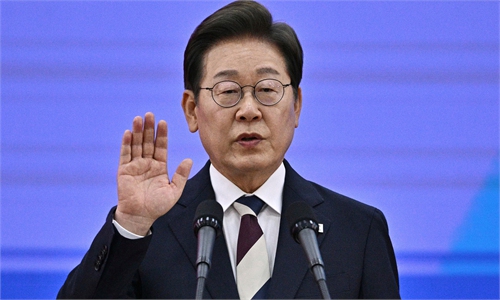
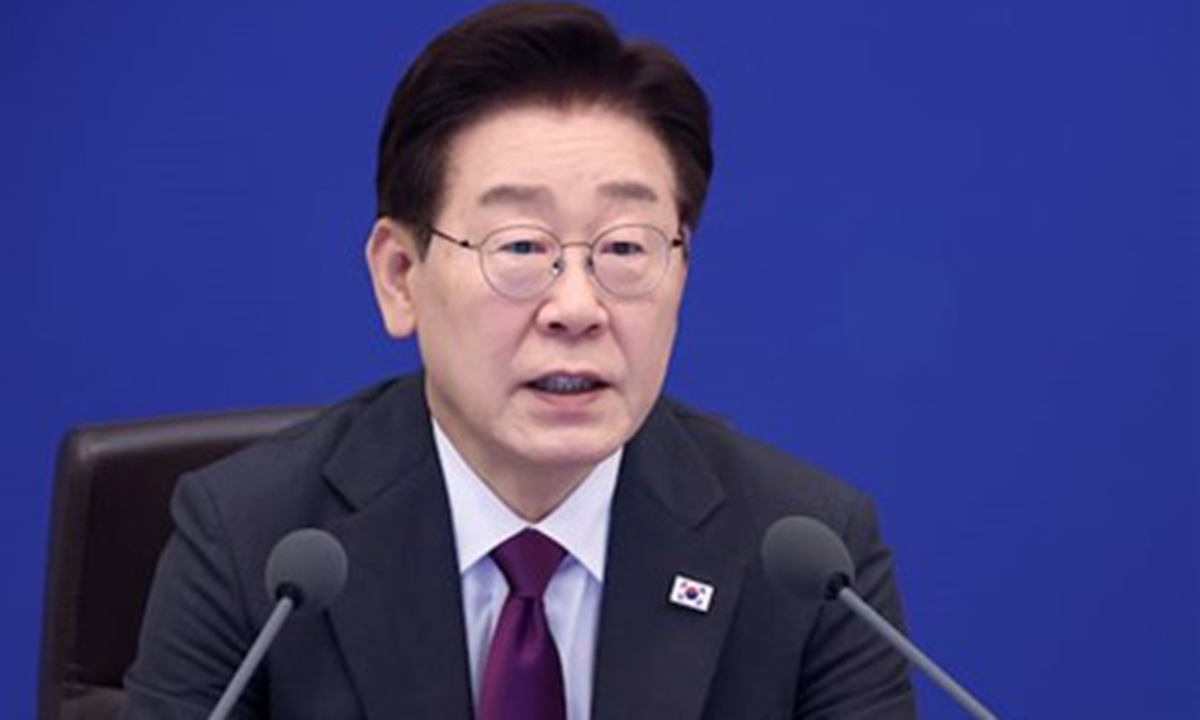
South Korean President Lee Jae-myung speaks at a senior secretaries' meeting held at Cheong Wa Dae on May 21, 2026. Photo: Chosun Daily
Chinese Ambassador to South Korea Dai Bing on Friday reposted South Korean President Lee Jae-myung's post on X, expressing appreciation for Lee's remarks denouncing a fake report about Chinese nationals buying apartments in droves in Seoul. The ambassador also urged people in South Korea to reject false information and inflammatory rhetoric to help strengthen mutual trust between the Chinese and South Korean people.
South Korean President Lee Jae-myung denounced a media report claiming that Chinese nationals had made a surprise purchase of 944 apartments in Seoul's Gangnam District as "clearly false," calling for strict accountability, according to South Korean media.
In a post on his X account, Lee wrote that Seoul Economic TV aired a fake video report titled "Chinese Nationals Suddenly Buy 944 Apartments in Gangnam, Seoul. Snapping Up Multi-Homeowners' Listings," which has now been deleted.
"Upon verification, it turns out to be an outright false report, with only 5 purchases by Chinese nationals of collective buildings in Gangnam between January and April. It's suspected to be a deliberately fabricated fake news article intended to be used as material for anti-China agitation. Even a media outlet, and an economic one at that - how on earth does stirring up Sinophobia help the country and its people? They should be held strictly accountable, don't you think?" read the post.
On Friday, Chinese Ambassador to South Korea Dai Bing reposted Lee's post on X, writing in both Korean and Chinese that he highly appreciates Lee's remarks and hopes all sectors in South Korea will discern right from wrong, "consciously resisting the practices of fake information, discrimination, and incitement, so as to enhance the mutual objective understanding, trust, and friendly sentiments between the Chinese and Korean people."
Ambassador Dai later wrote in Chinese and Korean on X that, for some time, a small number of South Korean media outlets have fabricated and spread fake news about China to attract attention or serve ulterior political motives. He said such outlets have magnified individual cases into a broader narrative, disguised prejudice as fact, deliberately tarnished the image of China and Chinese nationals in South Korea, and interfered with the improvement and development of China-South Korea relations.
"Some media have publicly apologized under pressure, but others remain keen on publishing inaccurate reports and commentaries on China-related issues," Dai wrote. "Freedom of speech is not freedom to spread rumors. We hope the relevant media will adhere to journalistic ethics, conduct China-related reporting based on facts, do more things that are conducive to enhancing mutual understanding, trust, and friendly sentiments between the Chinese and Korean people, and stop fooling their readers," the ambassador wrote.
On Thursday evening, Seoul Economic TV issued an apology on its website over its previous report on Chinese apartment buyers, saying it "deeply apologize[s] to viewers who felt discomfort and concern."
"The content was produced to report on foreign buying trends in the real estate market, but its title and wording were framed in a way that could create a negative perception of a specific nationality. We sincerely apologize for causing offense and confusion to many people," read the statement.
The outlet claimed it had no intention of inciting hatred toward or disparaging any particular country or people, but acknowledged that the production team had shown poor judgment by being overly focused on views and attention, and that its internal review system had failed to adequately screen the content.
Compared with his predecessors, Lee has taken a more forceful and frequent stance against anti-China rhetoric in South Korea. This contrast also underscores how anti-China sentiment in the country surged to an unprecedented level under the previous Yoon Suk-yeol administration, far exceeding that of previous periods and inflicting serious damage on the development of China-South Korea relations, Zhan Debin, director and professor of the Center for Korean Peninsula Studies at the Shanghai University of International Business and Economics, told the Global Times on Friday.
Lee has placed importance on South Korea's relations with China. Since taking office, he has stepped up efforts to combat disinformation, pushing back against false China-related reports and anti-China rhetoric by some conservative media outlets, which are driven by ulterior motives. Anti-China words and deeds do nothing to benefit either country or bilateral relations, while claims such as "China's interference in South Korean elections" are baseless and absurd, said Zhan.
According to the Chosun Daily, a media outlet previously reported that Chinese nationals had concentrated their purchases on properties sold by multiple-home owners in Gangnam, Songpa, and Yongsan just before the reinstatement of the heavy transfer tax on multiple-home owners.
The Ministry of Land, Infrastructure and Transport later refuted the report, stating it was untrue. According to the ministry, among 592 foreign buyers who applied for ownership transfer registration for collective buildings in Seoul from January to April this year, 218 were Chinese nationals, and only five Chinese nationals purchased collective buildings in Gangnam District, per Chosun Daily.
South Korean media The Financial News also reported on Thursday that the previous day, during a State Council of South Korea meeting that also served as an Emergency Economic Review Meeting, Lee had already ordered relevant ministries to respond firmly to similar reports on real estate policy, calling them "clear manipulation and distortion."
At the time, Lee criticized the article claiming that Chinese nationals had bought up units dumped by multi-home owners, asking, "Why write such a false article?" and saying it was done intentionally to fuel anti-Chinese sentiment, according to the report.
Also, in September 2025, Lee also condemned recent rallies and demonstrations targeting tourists from China, describing them as "not freedom of expression, but disturbance," Yonhap News Agency reported.
Presiding over a Cabinet meeting at the presidential office in Yongsan, Lee referred to a series of reported protests held in Seoul's Myeong-dong area, where groups insulted foreign visitors. "If someone cursed me as an ugly Korean and pointed fingers at me, I would never visit (that tourist spot) again. They were doing such things in Myeong-dong," Lee said, criticizing the behavior as deliberately aimed at worsening bilateral ties, Yonhap reported.
Zhan noted that Lee's public stance has given support to those in South Korea who favor an objective understanding of China and oppose fake news, strengthening their confidence to speak out. It may also help push government agencies to pursue accountability in accordance with the law and curb attempts by some media outlets to spread China-related rumors under the disguise of so-called "freedom of speech."
Some South Korean media outlets, including Yonhap News and South Korea's Korea Economic Daily, also covered the developments. For example, a Chosun Daily report on Friday highlighted Ambassador Dai Bing's expression of high appreciation for President Lee's criticism of fake news that fuels anti-China sentiment, while also reviewing the issue in detail. A JoongAng Ilbo report gave detailed coverage of Ambassador Dai's related posts on Friday.
Some South Korean netizens left comments under related news reports, with many calling for punishment for those who spread fake news. Netizen @Guijeong-y9t wrote, "Media outlets that publish such false reports are dividing public opinion. They must be held accountable and shut down." Another netizen, @Bae Young-hee-d1i, wrote, "Fake news should be punished severely. Far-right channels and media outlets that cross the line with fake news should face strict punishment."
While netizen @hyeshin_7 wrote that "fake news is a very serious problem. And for an economic media outlet to spread fake news that incites anti-China sentiment is even more outrageous. Even though it has now been deleted, it still makes me angry. Still, it is a great relief that the president is able to cross-check and monitor such issues in this way."
Zhan also said greater efforts are needed to oppose fake news aimed at fueling anti-China sentiment. South Korea needs to break the toxic atmosphere in which any objective voice on China is easily labeled "pro-China," so that scholars, media professionals and others can speak more frankly, help foster a healthier public opinion environment and contribute to the development of bilateral ties, he said.