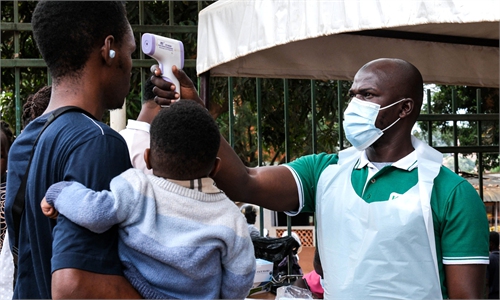
Chinese companies, nationals step up prevention amid spreading Ebola in some African countries
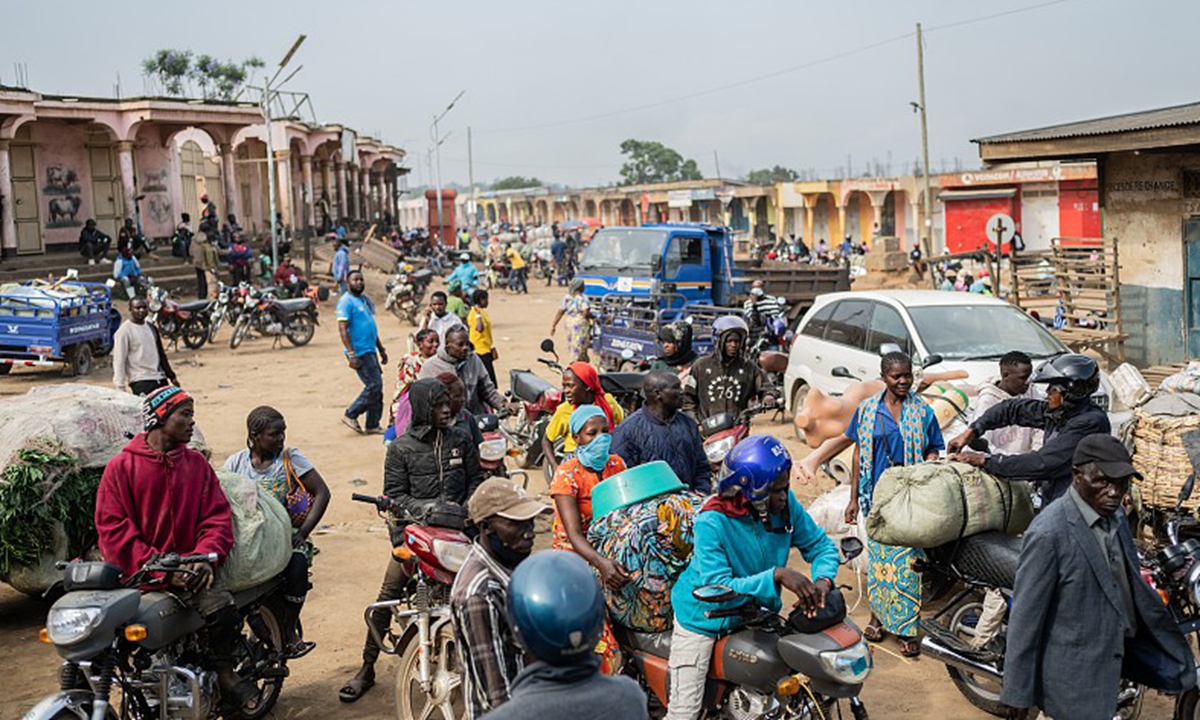
Motorcycle taxi riders and their passengers wait at the entrance to the central market while sanitation workers disinfect the area, as Ituri province continues to combat an Ebola outbreak in Bunia, Congo, on May 23, 2026. Photo: VCG
As the ongoing Ebola outbreak continues to spread across the Democratic Republic of the Congo (DRC) and into Uganda, Chinese nationals and companies in affected areas have reinforced safety protocols such as pre-entry temperature screening, mask wearing and curbing non-essential travel.The government of the DRC has temporarily suspended all passenger flights to and from Bunia, capital of the northeastern Ituri Province that is the epicenter of the ongoing Ebola outbreak, the Xinhua News Agency reported on Sunday, citing the DRC's Ministry of Transport.
The UN World Health Organization (WHO) on Friday raised the national risk assessment for DRC to "very high," although the global risk remains "low," according to UN News. So far, 82 cases and seven deaths have been confirmed in the DRC, but the WHO says the real scale of the outbreak is likely far larger, with nearly 750 suspected cases and 177 suspected deaths reported, per UN News.
To control the risks, the Chinese Center for Disease Control and Prevention (China CDC) announced on Saturday via its official WeChat account that individuals entering or returning to China from epidemic-risk countries and regions such as the DRC and Uganda should undergo 21 days of self-health monitoring, commencing from the date of entry.
The outbreak has also heightened vigilance in Chinese companies in the DRC. Sun Yilong, a Chinese employee working for a Chinese company in Bunia said that due to the severity of the local epidemic, they have already taken preventive measures and are making every possible effort to ensure maximum protection.
Sun told the Global Times on Sunday that employees are required to wash their hands and wear masks before entering, and security personnel will check employees' temperature at the gate, barring entry to anyone with a reading above 37 C.
"We are also required to refrain from non-essential outings," Sun said, adding that employees are required to wear disposable gloves when handling cash or passing objects to minimize physical contact.
Some regions that have yet to report confirmed cases are also concerned about the risk of the outbreak spreading and have stepped up protective efforts.
A Chinese medical worker surnamed Chen employed at a Chinese firm in Lomami Province told the Global Times that local efforts are currently focused on strengthening protection awareness, with posters on identifying Ebola symptoms and prevention measures being put up in areas where company employees gather.
The outbreak has spread to other African countries, with Ituri-neighboring Uganda logging confirmed infections. According to Xinhua's Sunday report, Uganda's health ministry announced three new Ebola cases on Saturday, bringing the total number of confirmed infections to five.
A Chinese national working in Uganda who requested anonymity told the Global Times that "my client reminded me to stay away from the markets, and I will do my best to take protective measures and sanitize as much as possible," he said.
The WHO's representative in DRC, Dr Anne Ancia, told reporters in Geneva that "We have significant uncertainty about the number of infections and how far the virus has spread," UN News reported on May 19.
The Economist warned this outbreak "is shaping up to be the worst Ebola epidemic since at least 2018, when more than 2,000 people died in eastern Congo."
According to the Africa CDC, Ebola is a severe and often fatal illness. It spreads through direct contact with the bodily fluids of infected persons, contaminated materials, or persons who have died from the disease.
Yang Zhanqiu, a professor of pathogen biology at Wuhan University, believes that whether the current outbreak will surpass previous ones in scale remains to be seen. Yang told the Global Times that if the outbreak is confined to one or two African countries, it would be relatively manageable. However, if multiple countries experience simultaneous outbreaks, the scale of the epidemic could make prevention more difficult due to challenges such as cross-border coordination and poor local healthcare infrastructure.
The WHO said it had deployed 22 international staff to the field and released $3.9 million from its contingency fund, while a continental incident management team was being established with the Africa Centers for Disease Control and Prevention, UN News reported on Friday.
RELATED ARTICLES