WHO declares Ebola outbreak in DR Congo and Uganda a public health emergency of international concern
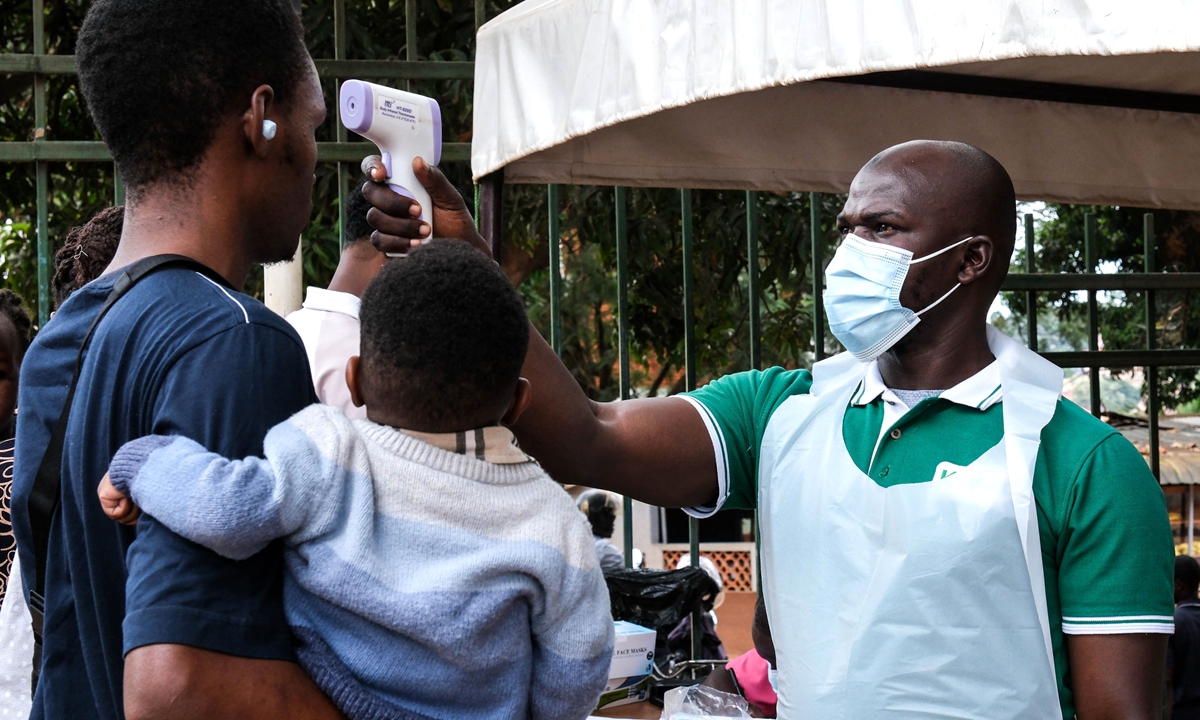
A health official uses a thermometer to measure people's temperatures in front of Kibuli Muslim Hospital in Kampala, Uganda, on Saturday, May 16, 2026. Photo: VCG
The World Health Organization (WHO) declared on Sunday that the Ebola disease caused by the Bundibugyo virus in the Democratic Republic of the Congo and Uganda constitutes a public health emergency of international concern (PHEIC), but does not meet the criteria of a pandemic emergency, according to an official statement posted on the WHO website.
As of Saturday, eight laboratory-confirmed cases, 246 suspected cases, and 80 suspected deaths have been reported in Ituri Province of the Democratic Republic of the Congo (DR Congo) across at least three health zones, including Bunia, Rwampara and Mongbwalu, per the statement.
In addition, two laboratory confirmed cases with no apparent link to each other have been reported in Kampala, Uganda, within 24 hours of each other, on Friday and Saturday, suggesting that the outbreak has spread beyond the DR Congo into the neighboring country. Another laboratory confirmed case was also reported on Saturday in Kinshasa, DR Congo.
WHO Director-General Tedros Adhanom Ghebreyesus warned that there are "significant uncertainties to the true number of infected persons and geographic spread" of the Ebola disease outbreak, noting that unlike for Ebola-zaire strains, there are currently no approved Bundibugyo virus-specific therapeutics or vaccines. As such, this event is considered extraordinary, according to the WHO statement.
Global Times reporters tried to contact Chinese nationals in the region through social media platforms. Some did not respond, while others said they were not in the affected eastern region and were unfamiliar with the outbreak situation.
The Chinese Embassy in the DR Congo issued a reminder on Friday, warning Chinese nationals in Ituri Province and nearby areas about Ebola risks. The embassy advised Chinese citizens not to travel to key outbreak areas, including Bunia and Mambasa in Ituri Province, as well as nearby areas with extremely high security risks.
"The key is to isolate infected patients after symptoms appear to prevent further transmission. Once the chain of transmission is cut off, the outbreak can be brought under control," Zeng Guang, former chief epidemiologist with the Chinese Center for Disease Control and Prevention (CCDCP), told the Global Times on Sunday.
In response to a Global Times inquiry regarding latest updates and comments on the outbreak situation, the WHO referred the newspaper to the statement released on Sunday, without further elaboration.
The Africa CDC previously said in a press release on Friday that it was concerned about the risk of further spread due to the urban context of Bunia and Rwampara, intense population movement, mining-related mobility in Mongwalu, and insecurity in affected areas, among others.
In response, the Africa CDC on Friday convened an urgent high-level coordination meeting that focused on immediate response priorities, cross-border coordination, laboratory support and other related topics with multiple related health organizations and pharmaceutical companies all around the world including the WHO, disease control centers from both China and the US, and the Public Health Agency of Canada, according to the press release.
Media around the world has been paying close attention to the outbreak. Reuters reported on Sunday that the outbreak is the 17th in the country since Ebola was first identified there in 1976, which could be much larger, given the high positivity rate of the initial samples and increasing number of suspected cases being reported, citing the WHO.
The BBC on the same day said in a report that countries bordering DR Congo are considered high risk for further spread due to population mobility, trade and travel.
Zeng noted that one reason Ebola outbreaks repeatedly occur in parts of Africa is that the virus exists in tropical rainforest ecosystems, where hot and humid conditions are conducive to its circulation among wildlife hosts, increasing the risk of transmission to humans.
Reuters also reported that the DR Congo's dense tropical forests are a natural reservoir for the Ebola virus.
The WHO stated that for all other states parties other than those with land borders adjoining States Parties with documented Bundibugyo virus disease, no country should close its borders or place any restrictions on travel and trade.
According to the Africa CDC, Ebola is a severe and often fatal illness. It spreads through direct contact with the bodily fluids of infected persons, contaminated materials, or persons who have died from the disease.
RELATED ARTICLES