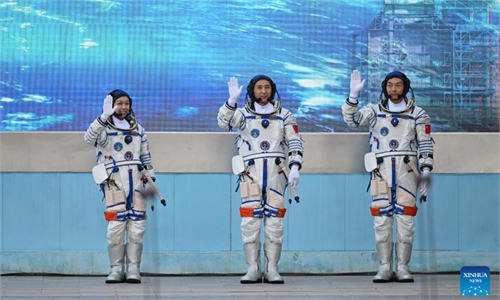
China successfully launches Shenzhou-23 manned spacecraft to Chinese space station
Line-up includes first taikonaut from Hong Kong; one crew member to make history with year-long stay
By in Beijing and Fan Wei in Jiuquan Published: May 24, 2026 10:59 PM Updated: May 24, 2026 11:39 PM
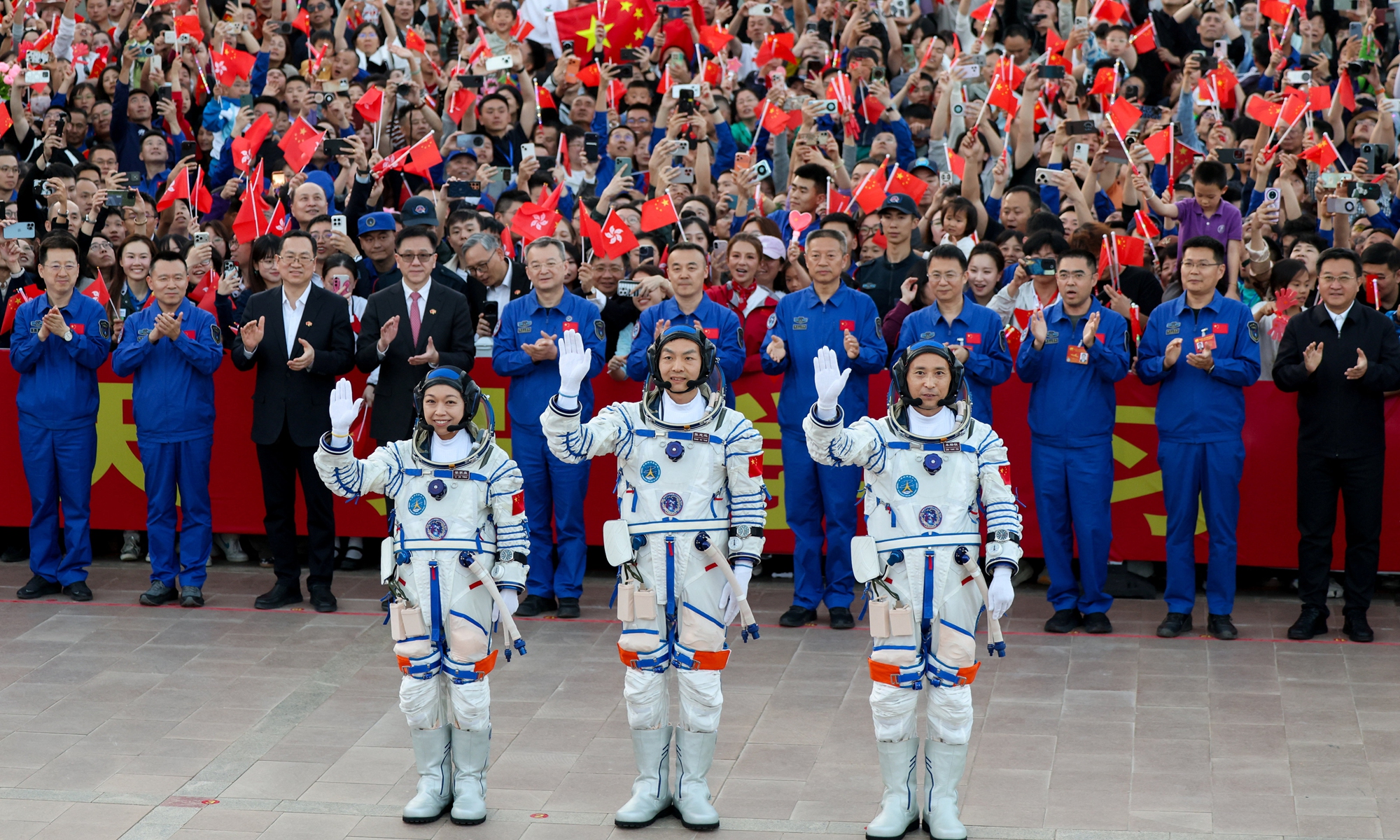
Chinese astronauts Zhu Yangzhu (center), Zhang Zhiyuan (right) and Lai Ka-ying, for the Shenzhou-23 crewed spaceflight mission, meet the press at the Jiuquan Satellite Launch Center in Northwest China, on May 23, 2026. Photo: VCG
The Gobi Desert in Northwest China still carried a chill under the moonlight in May, but on Sunday night it was once again illuminated by the passion surrounding China's aerospace program.
Carrying the Shenzhou-23 crewed spacecraft, China's Long March-2F Y23 launch vehicle took off from the Jiuquan Satellite Launch Center at 11:08 pm on Sunday.
After a flight of 10 minutes, the China Manned Space Agency (CMSA) announced that the rocket has successfully sent the spacecraft into a preset orbit, marking the complete success of the country's first manned spaceflight mission in 2026. The crew of three taikonauts, led by Zhu Yangzhu, has smoothly embarked on their journey to the orbiting China Space Station.
The line-up of the Shenzhou-23 crew itself has set many firsts in the history of China's manned space program, the Global Times has learned from the Astronaut Center of China (CAC).
The CMSA unveiled Saturday that Zhu, Zhang Zhiyuan and Lai Ka-ying would carry out the Shenzhou-23 crewed mission, and Zhu will be the commander. The three taikonauts are respectively a flight engineer, a spacecraft pilot and a payload specialist. Zhang and Lai come from the third and fourth batches of astronauts respectively, and will embark on their first spaceflight missions.
The CAC highlighted that this will be the first crew led by a taikonaut from China's third batch of astronauts. One crew member will also work and live aboard the China Space Station for an unprecedented full year. In addition, payload specialist Lai will become the first taikonaut from the Hong Kong Special Administrative Region (HKSAR), as well as the first member of China's fourth batch of astronauts, to carry out a manned spaceflight mission.
Zhu, who had previously participated in China's Shenzhou-16 space mission, will make history as China's first flight engineer to serve as commander of a Shenzhou-23 mission. Facing the potential physiological and psychological challenges of a year-long orbital stay, Zhu remained calm and composed. He described the 365-day mission in space as a "Space Long March," saying there was no need to dwell too much on the distant future. Instead, one should focus on doing everything in the present to the highest standard - performing each experiment with precision, carrying out every operation by the book, and taking good care of his own and his teammates' physical and mental well-being, Zhu told the Global Times at the meet-and-greet ceremony in Jiuquan on Saturday.
Zhang, who was previously a first-class pilot in a unit of the People's Liberation Army Air Force, was selected as a spaceflight pilot in China's third batch of astronauts in September 2020. At the Shenzhou-23 crew meet-and-greet with the media held on Saturday, he said that the journey from having a dream to realizing it is a long march paved with faith and perseverance.
Lai, before being selected, worked in the Hong Kong Police Force. Lai at the same event on Saturday expressed deep gratitude for the opportunity. "As an ordinary person from Hong Kong, being able to join the astronaut team and be selected for this mission is an opportunity I never dared to dream of. My heart is full of gratitude and honor," she said, the Xinhua News Agency reported.
"Every astronaut around me is outstanding," Lai noted. "I feel truly fortunate to have learned, trained and become friends with them. Their companionship, encouragement and shared progress have meant so much to me."
According to an official release on the HKSAR government website on Sunday, HKSAR Chief Executive John Lee held a video conversation with the city's first astronaut and congratulated her on being included in the crew for the Shenzhou-23 mission.
Lee said that Lai's participation in the mission shows national recognition and also the country's trust in and support for Hong Kong. He urged Lai to rest well, stay in good condition and relax her mind, and wished her a successful mission.
The Global Times has also learned from the spacecraft developer that the vehicle will attempt to make a 3.5-hour rapid rendezvous and docking with the China Space Station, and if successful, it will mark a historic first for China's crewed space program.
In the past, the Shenzhou spacecraft could only carry about 50 kilograms of payload when returning to Earth, meaning scientific samples had to go through a strict selection process. This time, the Shenzhou-23 spacecraft's return capacity has increased to over 100 kilograms, and its payload volume has expanded to three times its previous capacity.
In addition, to enhance the spacecraft's safety, the team has focused on optimizing details of the products. For example, they have added redundant backups to certain "single-point" locations that previously had no backup.
Also, to meet the working and living needs of a female astronaut returning to the Chinese space station after a one-year absence, the Shenzhou-23 spacecraft has also specially carried some living facilities tailored for female astronauts.
RELATED ARTICLES