Hong Kong residents share their thoughts after witnessing the first astronaut from the SAR's journey to space
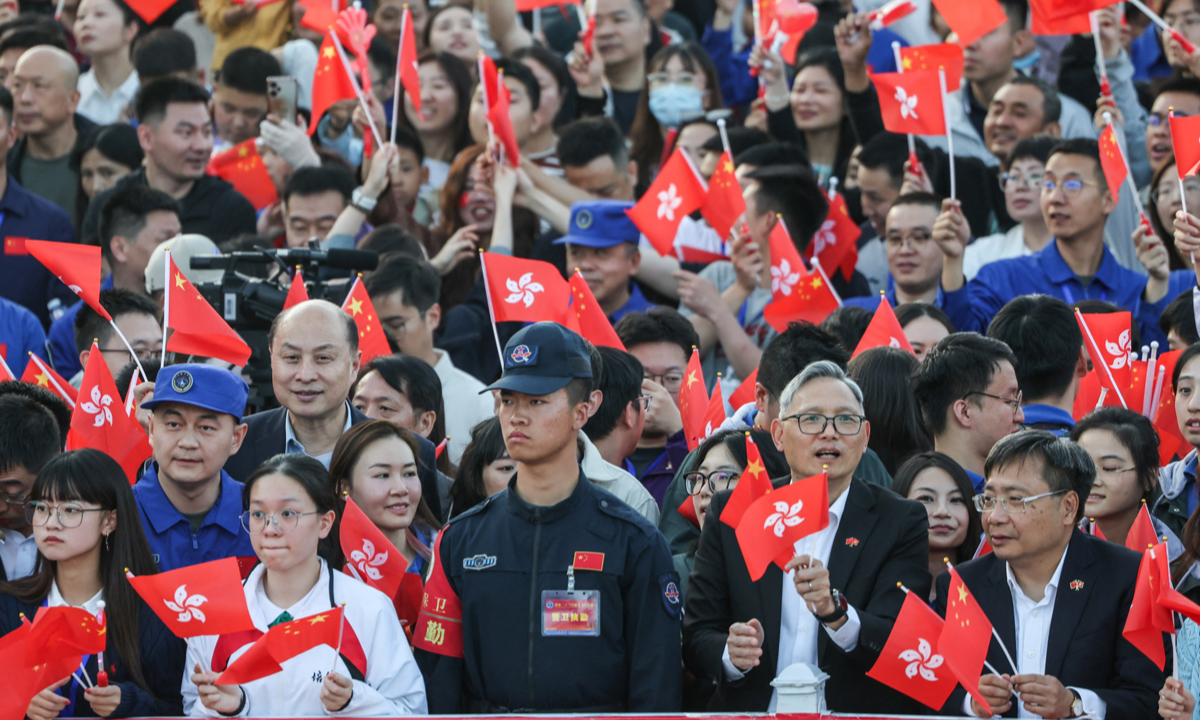
Spectators wave the national flag and the Hong Kong Special Administrative Region flag at the send-off ceremony for the three Chinese astronauts of the Shenzhou-23 crewed space mission at the Jiuquan Satellite Launch Center in northwest China on May 24, 2026. Photo: IC
Fifty-six years ago on April 28, four days after the successful launch of Dongfanghong-1, China's first man-made satellite, the spacecraft flew across the night sky over the Hong Kong and Macao special administrative regions (SARs). Crowds of Hong Kong residents flocked to the banks of Victoria Harbour, Victoria Peak, and numerous highlands across the New Territories with radios in hand. They eagerly watched the satellite streak across the firmament and listened to the melody of The East Is Red transmitted from space, brimming with pride over this satellite independently developed by Chinese people. This memorable scene was vividly recorded by Hong Kong's Ta Kung Pao in its April 29 issue that year.
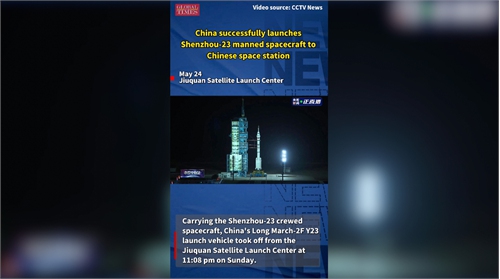
On Sunday, the Shenzhou-23 crewed spaceship, atop a Long March-2F carrier rocket, blasted off from the Jiuquan Satellite Launch Center in northwest China. Hong Kong compatriots who traveled long distances to witness the moment were filled with excitement as they watched the rocket's orange-red plume pierce the night sky. Meanwhile, countless local residents tuned in to the spectacular launch via televisions and mobile devices.
This scene bore a striking resemblance to that historic moment, except that this time, Hong Kong compatriots found themselves closer to the motherland, closer to space, and therefore closer to their dreams. Aboard the spaceship is Li Jiaying, or Lai Ka-ying in Cantonese, the first astronaut from China's HKSAR, as well as the nation's first female payload specialist. The vision of the HKSAR integrating into the overall national development and sharing the motherland's developmental achievements has gained profound and tangible significance the moment Li fulfilled her space dream.
'A full affirmation from the nation of the HKSAR's technological innovation development'
As a member of the HKSAR delegation, Undersecretary for Security Michael Cheuk Hau-yip witnessed the rocket liftoff at the Jiuquan Satellite Launch Center alongside local scholars, scientists and young people. He was deeply moved by the spectacular scene.
"On one hand, I truly felt the development and technological strength of our nation in aerospace. On the other hand, I feel proud of Li, who was once a police officer and is now, as a payload specialist from HKSAR, participating in a space mission for the first time and travelling aboard the Shenzhou-23 crewed spaceship to work on the space station," Cheuk told the Global Times. He believes this demonstrates the nation's recognition and trust in the HKSAR's level of science and technology, scientific research, and talent. "Thanks to the nation's generous support, we have been given this opportunity," Cheuk said.
Following Li's journey into space, the HKSAR has become one of the world's few regions that have an astronaut. Sun Dong, secretary for innovation, technology and industry of the HKSAR government, who also watched the launch on site, expressed great excitement. "This is an invaluable opportunity granted by the motherland, and we sincerely appreciate the profound care and strong support the country has extended to the HKSAR," Sun said.
In an interview with the Global Times, Sun said the HKSAR government has spared no effort to integrate into and serve the country's overall development strategy over the years. Local research teams have long participated in multiple national aerospace projects and yielded fruitful outcomes. "I believe this is also a full affirmation from the nation of the HKSAR's technological innovation development over the past few years," Sun added.
Aerospace has long served as a vital bond connecting the mainland and the HKSAR. Public records show that Hong Kong professionals have taken part in major national space programs over the past decade, including the Chang'e lunar missions and the Tianwen Mars missions. China Aerospace Science and Technology Corporation (CASC) has maintained frequent cooperation with research teams from The Hong Kong Polytechnic University (PolyU), enabling HKSAR expertise to fuel the country's journey into deep space.
The Global Times has learned that in previous lunar and Mars missions, a research team led by Professor Yung Kai-leung from the PolyU collaborated with the China Academy of Space Technology (CAST) under CASC. The joint team developed lightweight compact camera pan-tilt assemblies for the camera-pointing systems aboard the landers of Chang'e-3 and Chang'e-4. They also created the surface sampling manipulator sampler, close-range camera and primary surface sample encapsulation device deployed on Chang'e-5, as well as the Mars landing monitoring camera carried by Tianwen-1.
Another team headed by Professor Bo Wu from the PolyU assisted CAST in analyzing the topography and landforms of landing zones for Chang'e-3, Chang'e-4 and Tianwen-1. Their research provided crucial support for landing site selection and safety assessment. For the Tianwen-1 mission, the team specially developed an AI-based landform feature recognition method. In less than one and a half months, the technology completed 3D terrain modeling of the targeted landing area, identified and analyzed over 2 million rocks, more than 600,000 impact craters and numerous other landform features, offering vital reference for the final determination of the landing site.
Li's journey into space as China's first female payload specialist undoubtedly marks another historic milestone for the HKSAR.
"I believe Li's safe return from this space mission will deliver a strong boost to HKSAR's development. We will continue to forge ahead and contribute our part to national advancement during the 15th Five-Year Plan period (2026-30)," said Cheuk.
'Leverage the HKSAR's strengths to meet the country's development needs'
Looking back on history, Hong Kong compatriots have long lent firm support to the advancement of China's aerospace industry. Before and after the founding of the People's Republic of China, numerous distinguished overseas scholars engaged in cutting-edge research at foreign institutions chose resolutely to return home, braving untold hardships without hesitation. Public reports show that amid the special historical backdrop, Hong Kong served as the first stop for many of these returning scientists.
A great number of researchers crossed oceans and overcame numerous hardships before safely reaching the Chinese mainland via Hong Kong. Renowned trailblazers who made monumental contributions to China's aerospace development, including Qian Xuesen, Wang Xiji and Yang Jiachi —founding fathers of China's "Two Bombs, One Satellite" — were outstanding representatives among them.
Endowed with its unique geographical advantage of linking the Chinese motherland with the rest of the world, the HKSAR has long engaged in fruitful commercial cooperation with Chinese aerospace institutions, particularly in the field of communication satellites. APT Satellite Company Limited (APT Satellite) is a major user of Dongfanghong-series satellites developed by the CAST.
According to previously released reports, the AsiaSat 9 communications satellite, developed by CAST on the Dongfanghong-4 satellite platform, was successfully launched in October 2015. It marked China's first export of a complete satellite to established international operators, breaking the long-term monopoly held by European and American aerospace firms in the high-end market.
CAST has since designed and delivered other satellites such as AsiaSat 6C and AsiaSat 6D. Among them, AsiaSat 6D is China's inaugural satellite carrying a Ku-band high-throughput broadband satellite communication system, boasting dozens of times greater capacity than conventional communication satellites. Satellites developed by CASC play a pivotal role in the in-orbit fleet operated by APT Satellite, delivering cost-effective high-speed broadband communication services covering the HKSAR and extensive regions across Southeast Asia.
In recent years, the HKSAR government has actively encouraged, guided and supported local research bodies to take part in major national aerospace projects.
"To motivate more local research teams to join national scientific undertakings, the HKSAR government has previously launched dedicated calls for aerospace research proposals and funded multiple projects, some of which have already been incorporated into national scientific and technological missions," Sun said.
He added that under the InnoHK, the government has set up specialized research centers undertaking diverse aerospace tasks, including the development of lunar surface operation robots. These efforts provide solid technological backing for the country's future lunar exploration programs, Sun said.
"I am confident that the HKSAR government will keep scaling up investment to encourage local research teams to further participate in national aerospace initiatives, and leverage the HKSAR's strengths to meet the country's development needs," Sun said.
'This will bring great excitement to everyone'
Li has made history as the first astronaut hailing from the HKSAR, blasting off aboard the Shenzhou-23 crewed spaceship bound for the country's space station. Her journey has sparked widespread discussions across the city. The Global Times reporters witnessed numerous Hong Kong media outlets, including the Hong Kong Commercial Daily and Ming Pao, covering the landmark launch in diverse forms at the Jiuquan Satellite Launch Center.
According to the Hong Kong Commercial Daily, shopping malls across Hong Kong aired live footage of the liftoff, allowing locals to jointly behold this historic milestone. Many Hong Kong residents interviewed expressed their excitement and agreed that the emergence of the HKSAR's first astronaut carries great significance, hoping it marks the beginning of a journey that will inspire more children to pursue their space dreams.
"As a Hong Kong resident, I feel extremely privileged and thrilled to witness our fellow Hong Kong compatriots taking part in such a monumental aerospace mission right here," Anderson Ho Cheung SHUM, vice president of City University of Hong Kong and president of the Hong Kong Young Academy of Sciences, said in an interview with the Global Times. Watching the rocket soar skyward, he said that when he saw the rocket lift off, he realized that children in HKSAR can now not only watch rocket launches on television but also see someone from their city sitting atop the rocket. "I think this will bring great excitement to everyone, and it is also an affirmation of HKSAR," he added.
Previously, numerous chief designers of China's space program, including Qi Faren, the Chinese Academy of Engineering (CAE) academician, visited various universities, secondary schools, and primary schools in the HKSAR to engage with local youth. The insightful lectures delivered by these aerospace experts and academicians have inspired Hong Kong's young people to cultivate scientific dreams, further strengthened their sense of national identity, and enhanced their affection for the motherland, allowing the spirit of China's space endeavor to take root in the HKSAR.
Now, Li's space mission will undoubtedly further nurture the public's fascination with aerospace, especially among the younger generation in HKSAR.
"Hong Kong youth can feel they garner nationwide attention, which encourages them to strive to make the world a better place," Shum said. He said that Li's experience proves HKSAR residents, particularly young residents, can break through perceived limitations. "We need not be overly constrained by local boundaries when pursuing goals. We can set our sights higher, and with collective efforts and strong support from the motherland, those lofty dreams are well within reach," he added.
RELATED ARTICLES