Japanese right-wing figures renew denial of Nanjing Massacre amid constitutional revision push; Chinese experts warn of rising militarist rhetoric
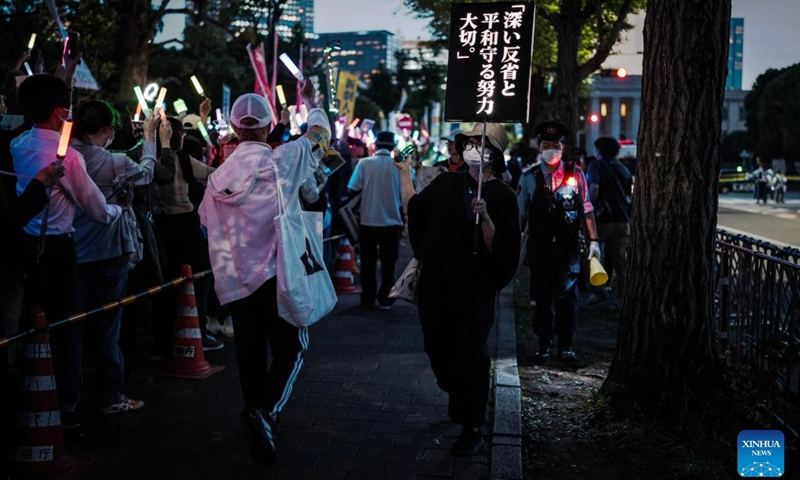
People holding slogans participate in a protest rally in front of the National Diet Building in Tokyo, Japan, May 19, 2026. Thousands of demonstrators gathered in front of Japan's National Diet Building in Tokyo on Tuesday evening to protest the government's attempts to undermine the country's pacifist constitution through constitutional revision and military expansion policies. (Photo: Xinhua)
Some Japanese right-wing lawmakers and scholars have once again attempted to question and deny the historical facts of the Nanjing Massacre, drawing sharp criticism from Chinese experts, who said such moves disregard established historical truth, cater to Japan's right-wing narrative and reflect the broader resurgence of neo-militarist tendencies in Japan's current political climate.
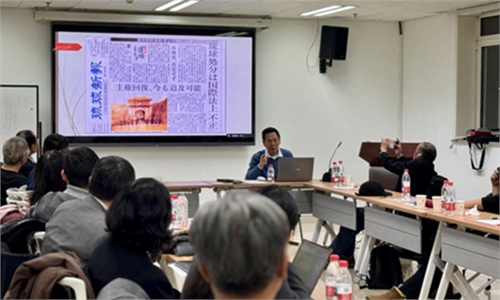
On Sunday, Japan's Sankei Shimbun reported a seminar held in Tokyo under the theme of "How to fight the historical war with China." According to the report, participants at the seminar claimed that although Japan's Foreign Ministry website currently states that "The Government of Japan believes that it cannot be denied that following the entrance of the Japanese Army into Nanjing in 1937, the killing of noncombatants, looting and other acts occurred." They rejected such wording, claiming that the Foreign Ministry's position is inconsistent with the descriptions found in the Japanese historical materials it cites.
They further claimed that the documents do not explicitly state that the former Japanese military carried out organized massacres of civilians.
Some anti-China Japanese lawmakers and right-wing groups have long adopted a denialist stance toward atrocities such as the Nanjing Massacre, repeatedly staging events to amplify such narratives. As Japan's political and social atmosphere continues to tilt further to the right, these views are becoming increasingly overt, Xiang Haoyu, a distinguished research fellow at the China Institute of International Studies, told the Global Times on Monday.
Marking the 80th anniversary of the beginning of the Tokyo Trials, the renewed attempt to challenge the historical verdict on Japan's war crime including Nanjing Massacre— a crime confirmed during the Tokyo Trials — demonstrates an attempt by Japanese right-wing forces to overturn established historical conclusions and challenge the postwar international order, Xiang said, adding that such attempts have been a consistent feature of Japan's right-wing political agenda.
At the seminar, several Japanese lawmakers openly questioned or denied the historical facts surrounding the Nanjing Massacre, including Masamune Wada of the Sanseito party, Shi Ping of the Japan Innovation Party, Liberal Democratic Party lawmakers Kei Takagi and Hiroshi Yamada. They also directed criticism toward China, claiming that "it is important to gradually correct the issue of historical understanding."
The purpose of such right-wing seminars is not to restore historical truth, but rather to whitewash the crimes committed by Japanese militarism and provide further evidence of militarist ideology resurfacing in Japan, Lü Chao, an expert at the Liaoning Academy of Social Sciences, told the Global Times on Monday.
"The focus of right-wing rhetoric on the Nanjing Massacre is to smear China while cultivating a victimhood narrative that Japan was wronged during the Tokyo Trials. This is intended to stir up hostility toward China and pave the way for revising the pacifist Constitution and reviving militarism," Lü said.
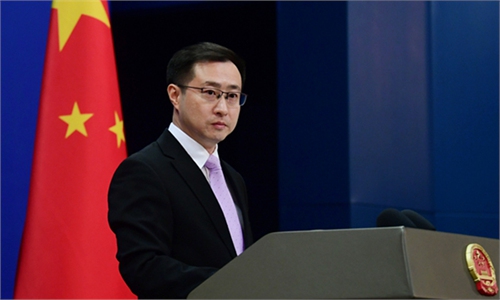
Previously, China's Foreign Ministry had also criticized Japan's attempts to fabricate historical narratives. At a regular press briefing in December 2025, Chinese Foreign Ministry spokesperson Guo Jiakun said that right-wing forces in Japan have concocted false narratives. They depicted Japan's war of aggression against Asian neighbors as "the liberation of Asia," downplayed the horrendous Nanjing Massacre as "the Nanjing incident," whitewashed the infamous Unit 731 as a "public health research unit," and dismissed forced labor and "comfort women" as "voluntary acts."
"After the war, Japan has described itself as a 'victim' of the war while avoiding mentioning that militarism is the source of the warfare," Guo said. "It claims to uphold the exclusively defense-oriented principle and the passive defense strategy, but has removed the ban on exercising the right to collective self-defense, kept relaxing restrictions on arms exports, and even attempted to revise its three non-nuclear principles."
The controversy has unfolded as Japan is also witnessing renewed call from Sanae Takaichi's administration over constitutional revision and military normalization. According to Japanese media outlet Jiji Press, Japanese Prime Minister Takaichi has renewed her call for Constitutional revision, by delivering a video message to a cross-party parliamentary league for the establishment of a new constitution last Wednesday, stating that "the Constitution is the foundation and core of the nation, and should be periodically updated in order to prevent its values from eroding."
At the same time, domestic concern within Japan over its political direction has also emerged. According to a May 18 report by Jiji Press, around 1,500 people joined a demonstration in Tokyo's Asagaya district carrying slogans such as "No to war" and "No to constitutional revision."
Jiji Press quoted a man in his 40s who participated in the protest as saying, "Looking at the way the current Takaichi administration is operating, I feel a dangerous possibility that Japan may move toward fascism. I joined because I want to resist that."
Meanwhile, Japanese media outlets have also published reports pushing back against attempts to deny the Nanjing Massacre. Mainichi Shimbun in a 2025 report cited a 2010 Japanese report produced as part of the joint China-Japan historical research project stated that "collective and individual massacres of prisoners of war, defeated soldiers, plainclothes soldiers and some civilians occurred at the hands of the Japanese military, while rape, looting and arson were also widespread."
Researchers cautioned that "if historical facts are ignored, the same mistakes will be repeated again," according to Mainichi Shimbun.
Mainichi also quoted Tokushi Kasahara, honorary professor of Tsuru University and a researcher on the Nanjing Massacre, as saying that wars are still ongoing around the world while Japan's defense spending continues to rise.
"More young people today lack even basic knowledge about the Nanjing Massacre and how cruel and reckless Japan's war of aggression was," Kasahara said. "If people are swayed by disinformation and fail to face the facts and sincerely reflect on history, Japan may repeat the same mistake of war once again."
RELATED ARTICLES