Editor's Note:
Chinese President Xi Jinping has urged efforts to further review the development experience of the city of Yiwu in East China's Zhejiang Province, and put it to good use. Yiwu's small commodities have broken into a vast market and developed into a major industry, forming the Yiwu development experience, he said, adding that this represents a successful model for developing county economies in line with local conditions, according to the Xinhua News Agency. The Securities Times launched a series titled "Close-up observations on Yiwu's development experience," exploring the vibrant "world supermarket." Through on-the-ground perspectives and close-up observations, the series delves into the rich essence and enduring vitality of Yiwu's development experience.
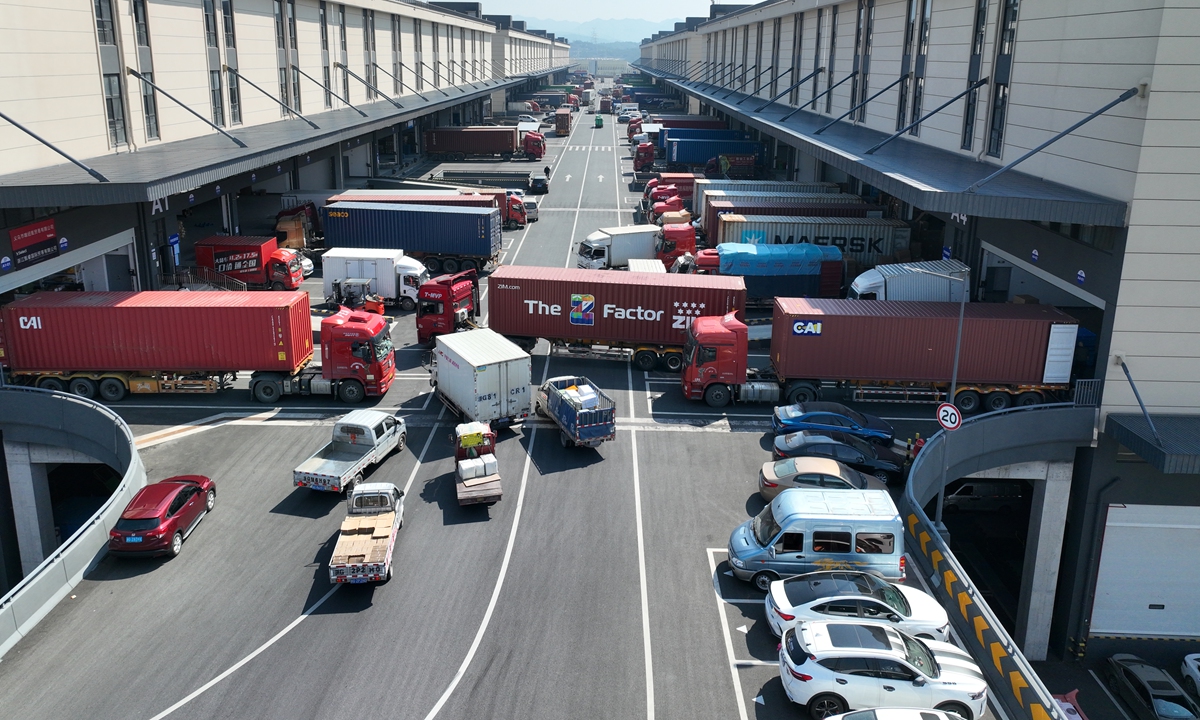
Containers are loaded with cargo at Zhejiang Zhijie Yuangang International Supply Chain Technology Co in Yiwu, East China's Zhejiang Province Photo: Courtesy of Zhejiang Zhijie Yuangang International Supply Chain Technology Co
Suxi Town, northeast of Yiwu, is a 20-minute drive from the Yiwu International Trade Market. A key logistics hub, it serves as Yiwu's gateway to global markets.
At night, the logistics parks are busy with lights, truck horns, forklifts, and coordination calls. Ready containers wait until morning to be shipped to Ningbo port and then exported worldwide.
Zhejiang Zhijie Yuangang International Supply Chain Technology Co is Yiwu's core platform for building an international supply chain. By consolidating small merchants into a "combined fleet," the platform helps cut logistics costs. In three years, its shipments reached 174,000 twenty-foot equivalent units (TEUs) last year—the most in Yiwu.
Saving costs
Li Chengfei, from East China's Anhui Province, quit his job in 2007 to work as a document clerk in Yiwu. In 2014, he founded Zhejiang Kaixun International Freight Forwarding Co, which now serves 200-300 local Chinese small and medium-sized enterprises (SMEs) and handled exports of about 11,000 containers in 2025.
In international trade, shipping companies dominate, dealing directly with Tier-1 forwarders. Though Zhejiang Kaixun handles 11,000 containers annually, its relatively small shipment volumes place it in the Tier‑4 or Tier‑5 category, forcing SMEs to rely on multiple agency layers to get containers loaded.
Small and medium-sized forwarders serving Yiwu merchants face challenges like consolidating small shipments, high warehousing and booking costs, and unreliable service. Another issue is that shipping companies may cancel bookings at the last minute due to tight capacity, delaying cargo. Small shipments are more likely to be rolled, especially during peak seasons.
Founded in 2022, Zhijie Yuangang has helped alleviate many of the difficulties Li previously faced.
"After joining Zhijie Yuangang, it feels like having VIP status—the difference is very noticeable," Li said. For example, in warehousing, unlike the frequent rent hikes he used to face, he now saves hundreds of thousands of yuan a year. In terms of booking, he enjoys "big client" treatment, with lower rates than before. Overseas, he can leverage Zhijie Yuangang's overseas warehouses to better serve his customers.
Over the years, Li has witnessed not only the booming export of Yiwu's small commodities but also the iterative upgrading of the local logistics industry.
When Li first arrived in Yiwu in 2007, the city's total import and export value was 12.92 billion yuan ($1.9 billion). By 2025, it had surpassed the 800-billion-yuan mark for the first time, reaching 836.5 billion yuan. Alongside this growth, the number of freight forwarding companies serving foreign trade exploded to over 4,000.
'Help first, benefit later'
"Successive Yiwu governments have repeatedly emphasized that state-owned enterprises and state-owned capital should act where they should and refrain from acting where they shouldn't, and not do things that 'big fish eat small fish,'" Yuan Meng, general manager of Zhejiang Zhijie Yuangang International Supply Chain Technology Co, told the Securities Times.
"Zhijie Yuangang is a platform-based state-owned enterprise established in response to the new situation in the Yiwu market. Through an operation model that separates 'heavy and light assets,' state-owned capital builds the platform, empowering Yiwu's trade ecosystem and helping small commodities go global," Yuan said.
The company aims to create a logistics service model better suited to the new trend in cross-border trade characterized by "small orders and mixed cargo." This model addresses pain points for small and micro-sized trading entities, such as "difficulty booking shipping space" and "high shipping costs."
The challenges facing Yiwu's small and micro enterprises stem from the market's fragmented ecosystem. In 2025, Yiwu had over 1.2 million business entities. Exported containers are "large yet small, low yet high": huge total volume but modest volume per merchant, low cargo value but high booking costs.
"Logistics is a business of scale — no scale, no bargaining power or service guarantees," Yuan said. Zhijie Yuangang focused on setting standards, consolidating small shipments to boost Yiwu's bargaining power and cut costs. Merchants can now track cargo in real time from order to delivery, ending the era of "black box logistics."
Data showed that in 2023, Zhijie Yuangang 's market share reached 3 percent, making it the largest logistics platform in Yiwu by shipment volume. In 2024, its market share rose to 6 percent, with shipments nearing 100,000 TEUs, doubling year-on-year. In 2025, market share increased to 8 percent, with shipments reaching 174,000 TEUs.
"Small and medium-sized enterprises keep a close eye on their costs. They're willing to work with us not because Zhijie Yuangang has state-owned backing, but because the platform reduces costs and increases efficiency for them," Yuan said. For a platform company to grow and thrive, it must follow the principle of 'helping others first, then benefiting oneself'—helping clients reduce costs to achieve win-win outcomes.
Joint forces
For Yiwu's small and medium-sized merchants, shipping goods is only the "first half"—bigger challenges lie in last-mile services after the goods arrive at port.
Yiwu's cross-border e-commerce industry is booming, with over 300,000 business entities, becoming a new engine for foreign trade growth. However, last-mile services are a weakness that small and medium-sized sellers can "see but cannot reach." Common problems include high warehousing costs, unstable delivery channels, unclear handling of returns and exchanges, and dynamic management of overseas inventory. These issues stem from a lack of control over overseas resources.
Take the US as an example, as a major destination for Yiwu's small commodity exports, among Yiwu's over 4,000 forwarders, more than 1,000 participate in the US route, but only two have overseas warehouses in the US. The reason is that overseas warehouses require significant investment and high operating costs.
"If services do not extend to overseas warehousing and distribution, the costs small and medium-sized merchants pay on the overseas end are far higher than their domestic costs," Yuan said.
To address it, Zhijie Yuangang is accelerating the construction of self-operated and deeply cooperative warehousing networks in key global cross-border e-commerce markets through equity participation and holding arrangements. To date, Zhijie Yuangang provides access to over 430,000 square meters of overseas warehouse space across 39 countries and regions, including major trading regions such as Europe and the Americas.
Recently, a B2C seller in Yiwu specializing in furniture and fitness equipment used Zhijie Yuangang's US West warehouse to deliver a batch of fitness equipment to a customer in the western US in just two days. Compared with using Fulfillment by Amazon warehouses, delivery was faster and more cost-efficient, saving at least 15 percent in per-unit distribution costs.
Zhijie Yuangang's current success is not the result of a single company's efforts. In accelerating the build-out of overseas service capabilities, Portus Capital plays a vital role.
Portus Capital is an industrial fund established in Yiwu, focused on cross-border logistics, with a capital scale of 1 billion yuan.
"Internationalization isn't just exporting services—it requires integrating capital, resources, and heavy assets. The future is exporting entire ecosystems, including local fulfillment, distribution networks, and after-sales services," said Bai Xue, co-founder of Portus Capital. "By investing overseas, the fund secures key resources and builds core moats. Phase two needs digitalization, intelligence, and internationalization."
Yuan said Yiwu is a prime example of a county-level economy creating tailored comparative advantages—not an isolated case, but a model of win-win cooperation across the industrial chain. With state capital and broad market participation, Zhijie Yuangang has helped build a global logistics network, turning SMEs' "small boats" into a "combined fleet" capable of sailing global markets.
This was compiled and translated by the Global Times based on an article originally published on the Securities Times on May 25, 2026.
RELATED ARTICLES