Experts at Xiamen forum warn excessive securitization and politicization undermining global ocean governance
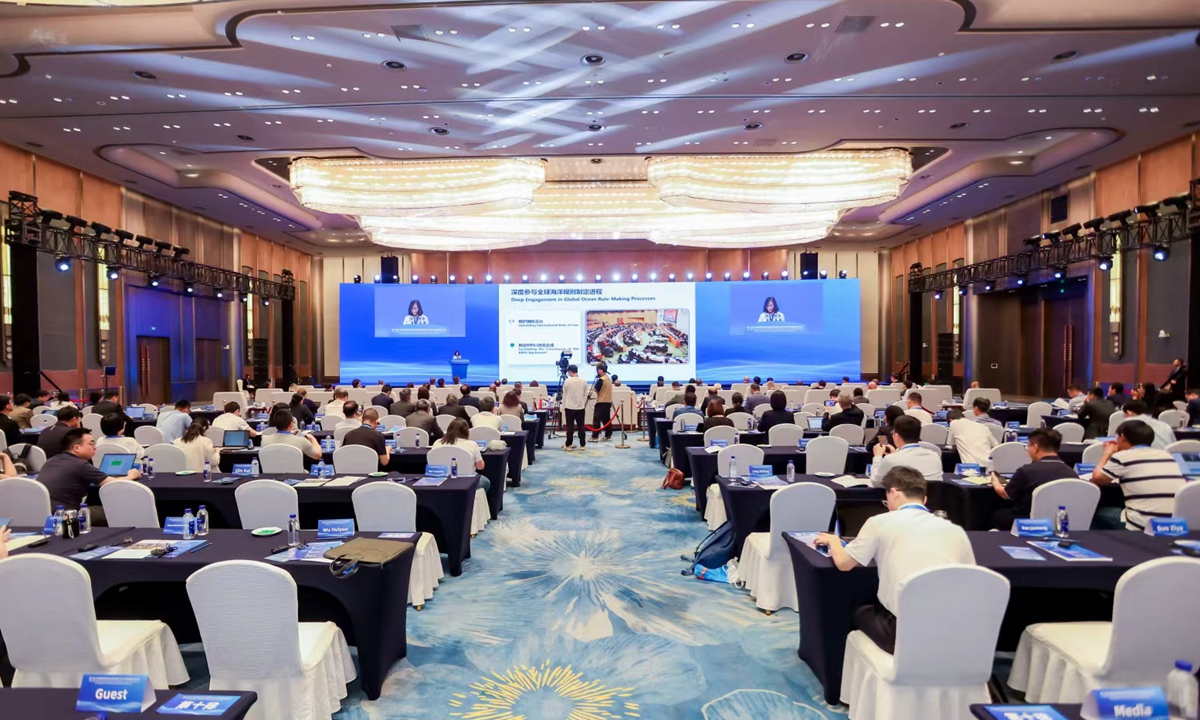
People attend the 8th International Symposium on Scientific and Legal Aspects of the Continental Shelf and the Area on May 25, 2026 in Xiamen, East China's Fujian Province. The symposium was held from May 25 to May 26, 2026. Photo: Courtesy of the symposium organizing committee
The 8th International Symposium on Scientific and Legal Aspects of the Continental Shelf and the Area was held on Monday and Tuesday in Xiamen, East China's Fujian Province. The event drew global experts amid rising challenges in ocean governance, with some warning that certain countries' excessive securitization and politicization of maritime issues are eroding trust and cooperation.
Hundreds of representatives, including delegates from institutions established under the UN Convention on the Law of the Sea (UNCLOS) as well as scholars from multiple countries, attended the symposium.
Addressing the forum, Aldino Manuel dos Santos de Campos, chair of the Commission on the Limits of the Continental Shelf (CLCS), pointed to what he described as one of the central dilemmas in global ocean governance: the contradiction between the "physical ocean" and the "political ocean." While the ocean operates as a single interconnected system, human beings have divided it into political and jurisdictional zones that nature itself does not recognize, he said.
Against this backdrop, concerns over unilateralism and geopolitical rivalry emerged as one of the central themes of the symposium. Wu Shicun, chair of the Huayang Center for Maritime Cooperation and Ocean Governance as well as a senior research fellow with China's National Institute for South China Sea Studies, warned that the excessive securitization and politicization of maritime issues are eroding trust and cooperation in global ocean governance, while international rules risk being "politicized, marginalized, instrumentalized and selectively applied."
Some countries are urging the CLCS to lower the threshold for reviewing disputed continental shelf submissions, which has further exacerbated maritime disputes. Meanwhile, intensified competition over resources, including oil, gas and critical minerals, may further complicate the situation, Wu told the Global Times.
Wu stressed that China's sovereignty and relevant rights and interests in the South China Sea should not be violated Japan's expanding security footprint in the South China Sea, particularly its growing participation in joint military exercises with the Philippines and the US, "deserves a high degree of vigilance."
One of the core reasons that the problems of the South China Sea remain difficult to resolve lies in overlapping maritime claims, exclusive economic zones (EEZs), continental shelf entitlements and historical rights asserted by different parties in the past. Some countries, including Japan and the Philippines, have misinterpreted these claims and attempted to illegally seize islands and seabed mineral resources in the South China Sea, Wu said.
At the same time, amid the growing prevalence of unilateralism, the implementation of multilateral maritime governance mechanisms for the high seas — such as the Biodiversity Beyond National Jurisdiction (BBNJ) Agreement and the long-delayed exploitation regulations under the International Seabed Authority — is facing mounting uncertainty, particularly as major powers increasingly bypass existing frameworks, Wu noted.
Similar concerns were echoed by Klaas Willaert, director of the Maritime Institute of Ghent University, who warned that recent US moves on unilateral deep-sea mining beyond national jurisdiction could undermine not only the seabed mining regime itself, but also "the law of the sea and the rules-based international order as a whole."
If other countries follow the US approach, it could become a "system-breaking event" that weakens collective commitment to multilateral governance frameworks, Willaert told the Global Times.
Willaert stressed that disagreements among states should still be resolved through multilateral negotiations rather than unilateral actions driven by strategic or economic interests. He further noted that weakening compliance in seabed mining governance could gradually spill over into other areas governed by UNCLOS, including fisheries management, biodiversity protection and marine environmental governance.
Stressing that legal frameworks alone are insufficient, Rommel Banlaoi, president of the Philippine Society for International Security Studies, said countries need to balance sovereignty concerns with multilateral cooperation and cooperative enforcement mechanisms. Banlaoi also identified marine environmental protection, scientific research, disaster response, international crime prevention and blue economy development as key areas for future maritime cooperation.
In 2019, China advocated building a "maritime community with a shared future." In 2025, China and ASEAN countries agreed to upgrade the Declaration on the Conduct of Parties in the South China Sea (DOC), while consultation on a Code of Conduct in the South China Sea (COC) has reached crunch time, the Xinhua News Agency reported.
Wu noted that these are all efforts aimed at maintaining regional stability and advancing the orderly development and sustainable use of marine resources, while safeguarding peace and tranquility in surrounding waters and fulfilling responsibilities to future generations.
The future of ocean governance will ultimately depend on whether countries are willing to uphold international agreements, coordinate governance frameworks and balance resource development with marine environmental protection, Wu added.
RELATED ARTICLES