Do Chinese firms’ overseas infrastructure projects create a ‘debt trap’?: Global Times editorial
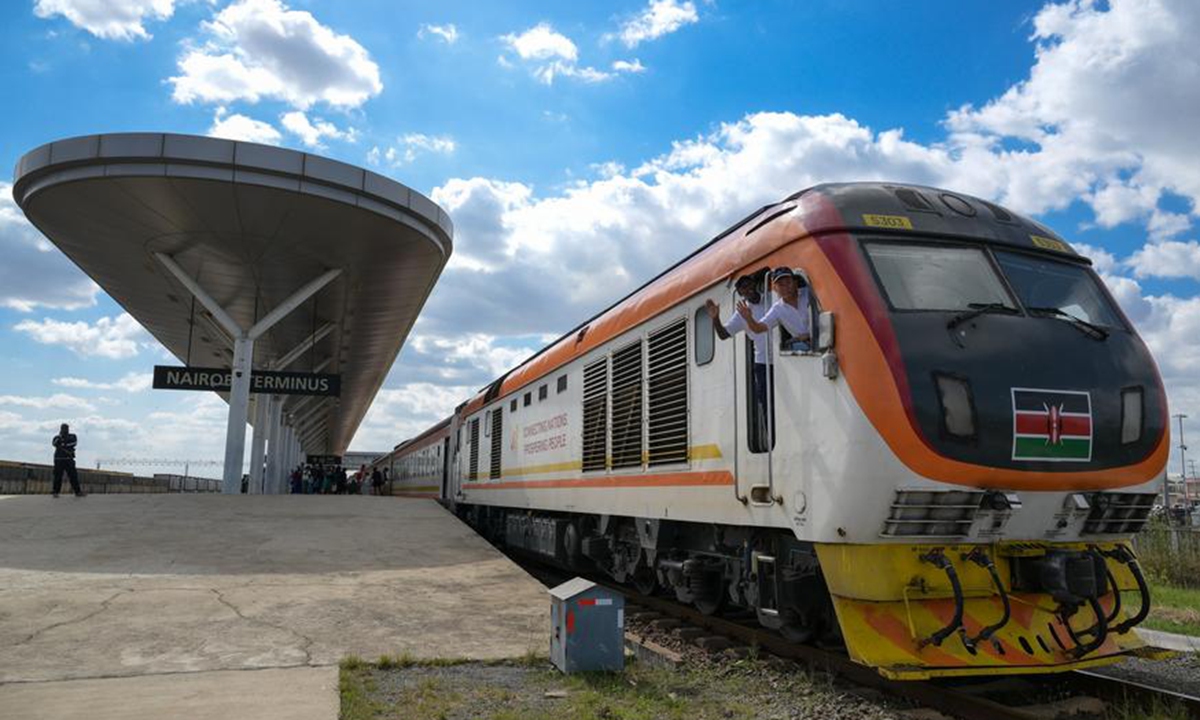
Train drivers Jiang Liping (R) and Bor wave aboard a train to Mombasa at Nairobi Terminus of the China-built Mombasa-Nairobi Standard Gauge Railway (SGR) in Nairobi, Kenya, on May 31, 2025. Photo: Xinhua
Editor's Note:
Currently, China's economy is steadily advancing along the path of high-quality development, even as domestic and international circumstances become increasingly complex. Some Western media, due to misunderstanding or bias, have repeatedly questioned or even distorted China's economic development. Accordingly, the Global Times launches the "Q&A on China's Economy" column to publish opinion pieces to present facts and clarify perceptions.
An outdated narrative lingers in Western public discourse: Chinese companies' participation in overseas infrastructure projects saddles developing countries with "unpayable debt" and even allows China to "control their strategic assets and economic lifelines." This flawed narrative stems from three key misunderstandings.
First, such narratives falsely frame all projects as "fully funded and constructed" by China, which is far from true. Overseas infrastructure projects employ diverse financing models, with Chinese companies involved in varied ways. Even for projects where China provides financing and loans, the debt structure is far from what some Western media outlets describe. In some overseas infrastructure projects involving Chinese firms, funding comes entirely from the host country's own fiscal resources or loans from multilateral financial institutions, with Chinese companies serving merely as general contractors.
For example, a Chinese firm recently joined hands with companies from the United Arab Emirates (UAE) and Turkey to successfully win a bid for a high-speed rail project in the UAE as part of a consortium; the project is funded by an Abu Dhabi state‑owned railway company. Another example involves a Chinese private enterprise that has been deeply engaged in wind power projects in Kazakhstan in recent years. Its financing relies primarily on the European Bank for Reconstruction and Development and the Development Bank of Kazakhstan, with funding denominated in US dollars, euros, or tenge. Clearly, Chinese companies secured these projects not through tied "loans-for-projects" deals, and they have nothing to do with the so-called "debt traps."
Second, they fail to understand that Chinese firms' core edge in winning global market share and reputation for overseas infrastructure lies in their solid technical prowess. By meeting international standards and overcoming engineering challenges with high cost-effectiveness, they have built strong brand credibility. As early as the 1970s, the government of Cote d'Ivoire proposed a plan to develop hydropower in the Sassandra River basin, but for various reasons, this plan was delayed and never implemented. Leveraging its advanced technology and extensive experience in hydropower development, PowerChina successively completed the Soubre Hydropower Station and the Gribo-Popoli Hydropower Station. These projects not only meet local electricity needs and drive the green transition but have also created thousands of jobs and cultivated a pool of reliable hydropower technical talent. China's strength in overseas infrastructure lies not only in delivering high‑standard, high‑tech solutions, but more importantly in its enduring philosophy of "teaching others to fish." This approach enables the sharing of technology and expertise with developing nations, bringing them hope for self-reliance and sustainable development.
Third, they overlook the inclusive nature of China's external financing services. China offers specialized investment and financing services to support overseas projects. For instance, the Silk Road Fund, established in 2014, has effectively facilitated the alignment of the Belt and Road Initiative (BRI) with the development strategies of various countries. This fund is open in nature and is not limited to developing countries. If there are distinctions in loans provided to developing countries, they typically manifest in longer repayment terms and lower interest rates tailored to their specific circumstances. For example, China provided a $944 million loan for the Bar-Boljare Highway project in Montenegro at an interest rate of just 2 percent, with a repayment term of up to 20 years. The former speaker of Montenegro's Parliament even said China has provided the most favorable and competent loans, and offered reputable infrastructure contractors.
To date, Chinese companies have utilized various funds to help African countries build and upgrade more than 10,000 km of railways, nearly 100,000 km of highways, nearly 1,000 bridges and 100 ports, as well as a large number of major power facilities, hospitals, and schools. In Kenya, the Mombasa-Nairobi Railway has created more than 74,000 jobs, with a local hiring rate exceeding 90 percent, transported a cumulative total of 40.396 million tons of cargo, and contributed over 2 percent to Kenya's GDP. In Indonesia, the Jakarta-Bandung High-Speed Railway has reduced travel time between Jakarta and Bandung from over three hours to just around 40 minutes, and has carried more than 12 million passengers in the two years since its opening. These tangible development achievements form the true foundation of the BRI.
China has never attached any political conditions to loan agreements, nor has it ever forced any country to borrow. Palitha Kohona, former Sri Lanka's ambassador to China, pointed out that 80 percent of Sri Lanka's foreign debt is owed to multilateral institutions such as the World Bank and Wall Street investors, and its debt to China only occupies 10 percent of the total. The security and ownership of Hambantota Port are 100 percent in the hands of the Sri Lankan side, and China's financing was provided entirely at the request of the Sri Lankan government. Similarly, of Ghana's total government external debt, Eurobonds and multilateral debt account for the vast majority, while official debt to China makes up only a small proportion.
It is undeniable that some developing countries do face debt difficulties, but attributing the root cause of the problem to Chinese loans clearly does not align with the facts. Faced with abundant data and hard facts, the so‑called "debt‑trap narrative" targeting Chinese overseas infrastructure projects collapses under its own weight. It is yet another product of Western efforts to build an information echo chamber pushing the "China threat" narrative - a sheer conspiracy theory. Chinese enterprises help developing nations build infrastructure by sharing technologies and standards, generating jobs and tax revenues, and laying foundations for long‑term growth. Facts will ultimately prevail over falsehoods, with a growing number of countries and peoples benefiting from Chinese‑led infrastructure cooperation serving as the most compelling witnesses.
RELATED ARTICLES