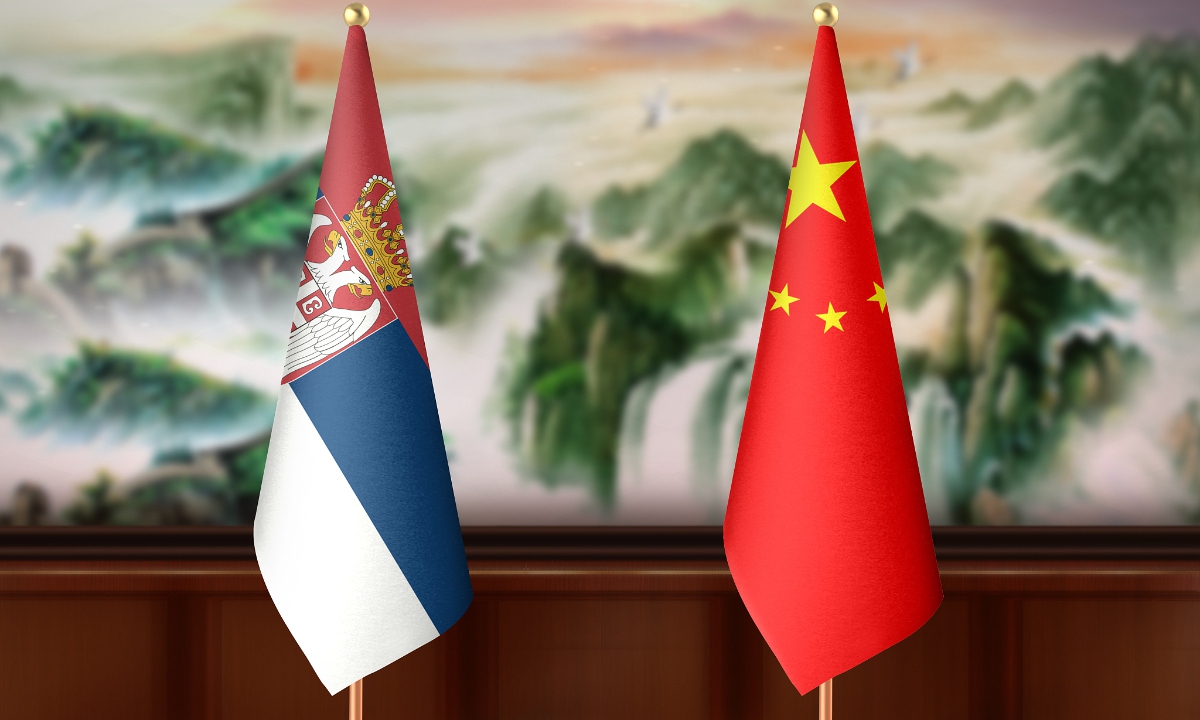
China Serbia Photo:VCG
President of Serbia Aleksandar Vucic arrived in Beijing on Sunday for a state visit to China from May 24 to 28.The friendship between China and Serbia is often referred to as "iron-clad." Since China and Serbia signed an agreement on the establishment of a strategic partnership in 2009, they have significantly strengthened their relationship. Both countries have achieved remarkable progress across various fields within the last 17 years.
If we say the year 2009 was significant because of the establishment of a strategic partnership, which set the stage for further cooperation, the signing of a new Comprehensive Strategic Partnership Agreement in 2016 marked further improvement in political and diplomatic relations.
In 2024, Serbia became the first European country to sign a joint document with China affirming its commitment to building a China-Serbia community with a shared future in the new era. In that way, both sides confirmed their commitment to further elevate their diplomatic relations, deepening their ties beyond usual agreements and memorandums.
It should be noted that China and Serbia share similar values and opinions on international relations and the challenges the world is facing. For both countries, United Nations principles, especially those regarding territorial integrity and national sovereignty, are undeniable, making them supportive partners. Serbia also shares values and beliefs that China promoted through its global initiatives, such as the Global Development Initiative, the Global Security Initiative, the Global Civilization Initiative and the Global Governance Initiative.
Since 2014, the Serbian and Chinese presidents have met frequently, on both bilateral and multilateral occasions. For a small Central and Eastern European (CEE) nation of six and a half million people, this represents a remarkable diplomatic achievement.
This political alignment between the two countries is closely mirrored in their military cooperation, which includes joint exercises and Serbia's acquisition of Chinese military equipment.
Additionally, Serbia became a member of the China-CEE Cooperation Framework in 2012 and joined the Belt and Road Initiative in 2016. Economic results achieved through these initiatives changed the Serbian economic landscape and development.
China became Serbia's No.1 foreign investor in 2024. Bilateral trade expanded dramatically from $1.5 billion in 2014 to $6 billion by 2023. Chinese state company Zijin Mining, with majority ownership in the Serbian copper mine situated in Bor, is Serbia's biggest exporter.
The Serbian government negotiated a Free Trade Agreement with China, effective on July 1, 2024. Under this agreement, Serbia can export thousands of products with zero or reduced tariffs. The government views this as an important opportunity to boost exports of domestic products, particularly food and alcoholic beverages. To support these efforts, the Serbian side promotes these products in China through export-import fairs.
China has invested $7.2 billion in Serbia through foreign direct investment and $15 billion through construction projects. The majority of Chinese private investment is placed in the automotive sector, positioning Serbia as a regional hub for the automotive industry. These manufacturing facilities are distributed across various regions, supporting more balanced domestic development.
The number of Chinese companies in Serbia is increasing each year, which has led to the establishment of the Chinese Chamber of Commerce in Serbia that currently has 64 members and reflects the scale and volume of Chinese investment in the country.
People-to-people, cultural and scientific cooperation has also undoubtedly progressed. Thanks to bilateral visits, joint cultural events and scientific conferences, mutual understanding between the Chinese and Serbian peoples has grown significantly deeper.
The visit by President Vucic to China closely follows the visits of US President Donald Trump and Russian President Vladimir Putin, both of which took place in times of heightened geopolitical uncertainties and tensions. In official statements, the Serbian government underlined the significance of President Vucic's visit, interpreting it as a testament to the highly developed, comprehensive relations that both sides have built over the past two decades.
Consequently, continuity, stability and mutual understanding remain the cornerstones of China-Serbia relations - a bond that is especially vital as the world rapidly changes, risks escalate and peaceful development is called into question.
The author is a senior research fellow and head of the Centre for China Studies, Institute of International Politics and Economics, Serbia. opinion@globaltimes.com.cn
RELATED ARTICLES