Chinese think tank releases first systematic report on non-US extra-regional military activities in Western Pacific, highlighting impacts on regional security
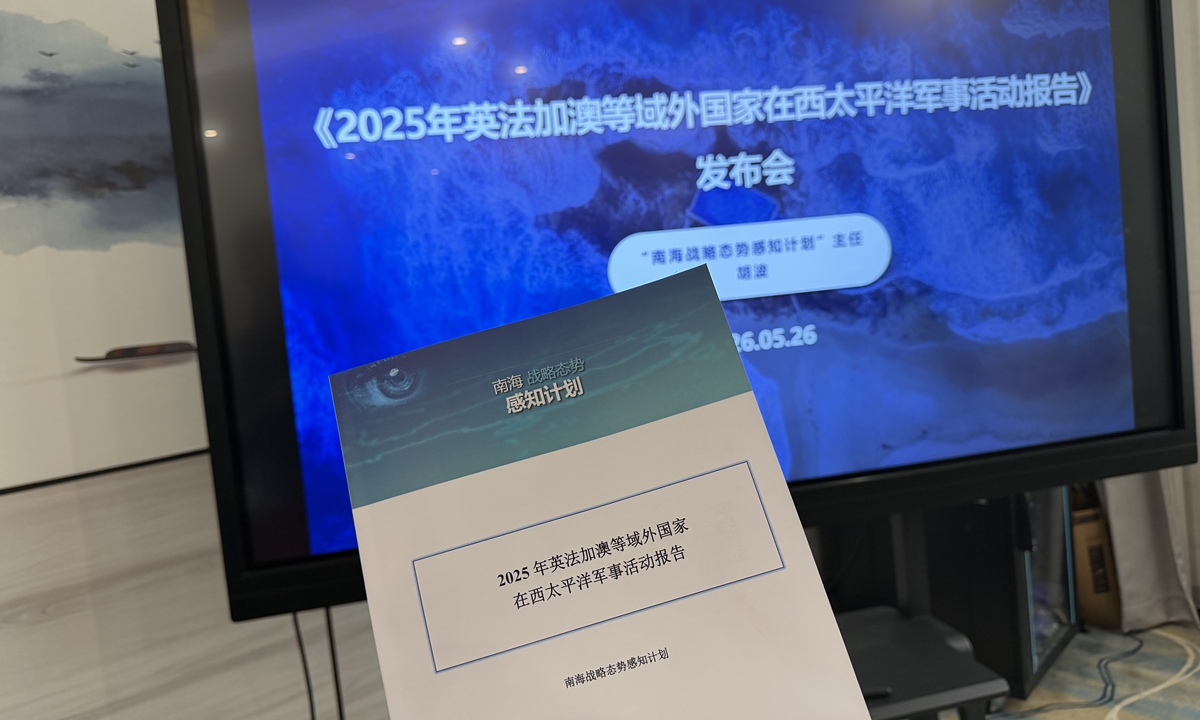
Think tank the South China Sea Strategic Situation Probing Initiative releases a report titled "Report on the Military Activities of Non-US Extra-Regional Countries in the Western Pacific in 2025" on May 26, 2026. Photo: Feng Fan/GT
The South China Sea Strategic Situation Probing Initiative (SCSPI) released its "Report on the Military Activities of Non-US Extra-Regional Countries in the Western Pacific in 2025" on Tuesday. Global Times reporters learned at the launch that this is the first time a Chinese think tank has systematically detailed the military activities of extra-regional countries, excluding the US, in the Western Pacific, including the South China Sea, East China Sea, Sea of Japan and the Philippine Sea.
The report aims to objectively present the impact of these activities on regional security and stability.
In 2025, according to incomplete statistics, approximately 200 warships from 18 extra-regional countries operated in the Western Pacific, totaling nearly 10,000 ship-days of naval presence. The US Navy accounted for 109 ships and 9,088 ship-days, while other countries, primarily from Europe, Oceania, and Canada, contributed 48 ships and 610 ship-days, averaging about 2 ships per day, said the report.
Meanwhile, in 2025, according to incomplete statistics, there were over 20,000 sorties of aircraft sent by extra-regional countries in the Western Pacific, including fighters, helicopters, transport aircraft, reconnaissance aircraft, tankers and bombers. Most were US sorties, while other extra-regional countries, such as Australia, Canada, and India, combined approximately 1,500 sorties, the report said.
Non-US sorties were mostly transport aircraft, helicopters, reconnaissance aircraft, airborne early warning aircraft and refueling aircraft, among which transport ones ranked top with nearly 900 flights (over 50 percent of the total). The report emphasized that due to the use of fake identification codes or transponders being turned off during missions, the actual number of sorties and the areas of activity are likely even greater.
In recent years, European countries like the UK, France and Germany, along with US allies such as Australia and Canada, have notably increased their military presence in the Western Pacific region, including the South China Sea, East China Sea, Sea of Japan, and the Philippine Sea. Among various underlying motives, the most prominent view is that against the backdrop of intensified US-China strategic competition, their deployments and activities in the region are meant to align with the US Indo-Pacific strategy and its competition with China, according to the report.
In response, Hu Bo, Director of the SCSPI, told the Global Times on Tuesday that based on analysis of open-source data, these extra-regional countries are primarily aiming to serve their foreign policy objectives and uphold the so-called "rules-based international order." Hu noted that different countries have their own strategic calculations and tactical arrangements, and in some cases, their actions have even shown a trend of diverging from US leadership and weakening the US' central role.
Hu's explanation is consistent with the report's findings. The military activities of extra-regional countries such as the UK, France, Canada and Australia in the Western Pacific differ fundamentally from those of the US military. Most of them have neither substantive geopolitical conflicts with China, nor capabilities to mount a significant military challenge in the region.
Hu stressed that the military activities of extra-regional countries should be viewed objectively. "We should neither exaggerate the so-called risks of multilateral coordinated pressure nor completely overlook the impact of their presence. Judging from actual deployment data, most extra-regional countries only conduct temporary military deployments in the Western Pacific. They lack long-term, high-intensity combat capability and can hardly form a substantial major military threat. We must analyze the situation rationally and prudently, avoiding both sensationalism and blind dismissal," Hu said.
The report projects that the trends of multilateralization and the institutionalization of extra-regional countries' military activities in the Western Pacific will continue to deepen in the future.
The report added that no matter how nuanced the rhetoric employed by these countries regarding their military operations in the Western Pacific, China is undoubtedly their primary target. Although there are indeed divergences in terms of maritime rules between China and these countries, these issues should be resolved through dialogue, discussion and coordination, rather than by military means.
Hu said that one of the most skillfully fabricated narratives by these extra-regional countries is that the Chinese People's Liberation Army (PLA) military aircraft have dangerously intercepted their own aircraft.
"But the South China Sea is vast. Where exactly did these incidents occur? These countries have provided no details. They often only tell the second half of the story, not the whole story," Hu said.
The PLA only takes action when foreign aircraft approach China's territorial airspace or come too close to China's exercise zones, which is consistent with international practice. In such situations, any country's military would take measures, often much more aggressive than China's, Hu added.
RELATED ARTICLES