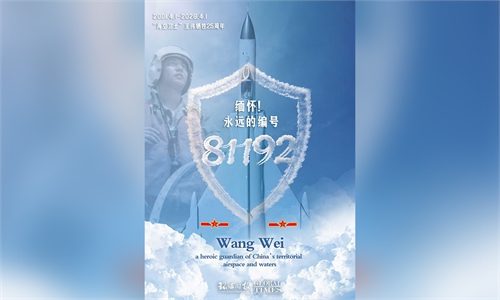
81192, a special number to remember: Heroic Chinese pilot commemorated 25 years after fatal collision over S.China Sea
By , Chen Xia in Hangzhou and Liang Rui, Shen Sheng in Beijing Published: Apr 01, 2026 10:20 AM

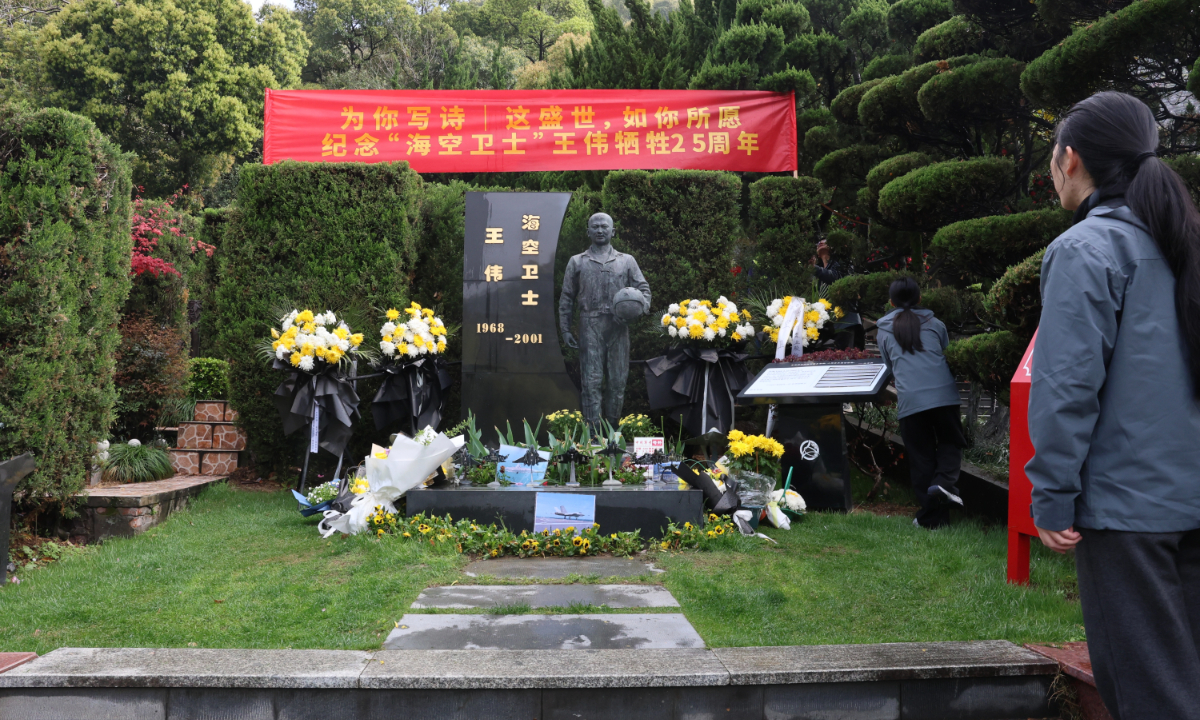
A memorial event marking the 25th anniversary of the sacrifice of heroic pilot Wang Wei is held at his cenotaph in Anxian Cemetery in Hangzhou, East China's Zhejiang Province, on April 1, 2026. Photo: Chen Xia/GT
On Wednesday morning, gentle sunlight bathed Anxian Cemetery in suburban Hangzhou, East China's Zhejiang Province, where heroic Chinese pilot Wang Wei's cenotaph rests amid ringed pines and cypresses. His statue and monument gleamed with renewed clarity in the sun. On the same day of twenty-five years ago, Wang, a Chinese pilot serving in the Navy Air Force, died in a mid-air collision by a US spy plane with Wang's fighter jet, coded 81192, over the South China Sea.In front of the monument, Global Times reporters saw bouquets and an assortment of tributes laid by visitors, including models of the J-20 and J-35 fighters, aircraft carriers and missiles. To pay tribute to the heroic pilot, Global Times reporters also brought copies of special pages by the Global Times that commemorated China's Victory Day military parade on September 3, 2025, marking the 80th anniversary of victory in the Chinese People's War of Resistance Against Japanese Aggression and the World Anti-Fascist War. The pages contained images and analysis of a slew of advanced weapons and military equipment that were showcased during the parade and highlighted the rapid rise of China's military strength.
This microcosm of China's advanced military hardware speaks a silent language by the Chinese people - one of reverence and reassurance to a hero who once guarded the skies of the motherland.
A quarter of a century later, his sacrifice is still remembered. His final words to his comrades - "81192, roger. I'm unable to return to the base. Please move ahead. Please move ahead" - still echo in the hearts of the Chinese people.
Guardian of sea and air
Wang, a member of the Communist Party of China, laid down his life to defend China's territorial airspace and waters on April 1, 2001. He was born in 1968 in Huzhou, Zhejiang Province. He was the first-class pilot and the squadron leader of an aviation regiment of the South China Sea Fleet of the PLA Navy, according to the China Military Online.
On April 1, 2001, a US military reconnaissance aircraft entered airspace over China's Exclusive Economic Zone. Wang piloted his fighter upon order to track and monitor it. During the flight, the American aircraft, defying repeated warnings, suddenly changed direction and collided with Wang's fighter jet. Failing to save the fighter jet, Wang had no choice but to parachute into the sea, China Military Online reported.
The country launched a massive search for Wang, mobilizing more than 100,000 military and civilian rescuers despite the harsh environment and complicated weather on the sea. They searched for 14 days and nights, but their efforts did not bring Wang back. He was confirmed dead at the age of 33.
"Writing poetry for you. This prosperous era is exactly as you wished." A memorial event marking the 25th anniversary of the sacrifice of Wang was held on Wednesday morning at his cenotaph in Anxian Cemetery. Several hundred people attended the event, including former comrade-in-arms of Wang and local residents.
At the event, Ge Hanchang, a former comrade-in-arms of Wang, paid his respects at the cenotaph and recited a poem, expressing his deep remembrance.
Ge brought a lamp with him. "In my heart, Wang Wei is a lamp that never goes out. His spirit lights the way forward for us. Today, we're using the lights of countless homes to keep you going," he told the Global Times. Recalling fond memories of his fallen comrade-in-arms, Ge said that Wang was talkative, had many hobbies and was deeply responsible toward his family.
Zhou, a resident of Hangzhou and mother of a high school girl, came to pay tribute on behalf of her daughter, a military enthusiast who has been busy with her studies since entering high school.
"Our daughter has always loved airplanes in the sky and military equipment on the ground since she was little," Zhou told the Global Times. "She hopes to pursue a career in technology-related fields in the future. Martyr Wang Wei is a hero who has inspired her."
On site, Global Times reporters noticed a display board with a QR code. By scanning the code, people can visit Wang's online "personal memorial hall," where they can leave messages of remembrance for the hero, according to cemetery staff.
Beyond the memorial activities at Wang's cenotaph in Anxian Cemetery, people across the country also commemorated the heroic pilot, with many taking to social media to express their respect and remembrance.
"That year, I was 19! That year, 81192, a heroic soul fell in the vast sky, and his loyal blood sprinkled over the seas. Twenty-five years later, our navy's mighty ships stand in ranks and our warplanes fill the skies. We are still waiting for your return," wrote a Xiaohongshu user.
"81192 - behind this number is the name of a hero: Wang Wei. On April 1, 2001, he sacrificed his life to defend national sovereignty in the airspace of the South China Sea. Twenty-five years later, we still remember his sacrifice, and his spirit will forever inspire future generations," another netizen wrote on Douyin.
Capability, confidence and commitment
A video published by CCTV News on Wednesday morning showed J-35, J-15T, and KJ-600 aircraft taking off from an aircraft carrier, with pilots heard saying: "81192, I have catapulted and am here to escort you. Please return to the base immediately. Please return to the base immediately."
"After so many years, on this day, hearing the calls for 81192 to return still brings tears to my eyes," read one of the most viewed comments under the CCTV News video on Sina Weibo.
This enduring remembrance has transformed 81192 into more than just an aircraft number, but a symbol that embodies the emotions of the Chinese nation and carries forward the spirit of patriotism, Zhang Junshe, a military affairs expert, told the Global Times on Wednesday.
According to Zhang, the J-8II jet flown by Wang was an indigenously developed fighter jet and remained a key asset in China's air defense system at the time of the collision incident.
In the years since, China's national defense modernization has advanced rapidly. Fifth-generation fighters such as the J-20 and J-35 have entered service, while three aircraft carriers have been commissioned. Naval and air force equipment is now increasingly systematized, strengthening integrated combat capabilities and improving joint operations and far-seas defense capacity, Zhang said.
"The confidence we have today comes from countless researchers who have secured core technologies in their own hands," Chinese military affairs expert Song Zhongping noted, recalling how China once lagged behind in air defense equipment and relied on others for key technologies. Today, advanced fighter jets, early warning systems, electronic warfare capabilities and satellite networks are all independently developed and under China's full control.
National dignity is not upheld by slogans, but by hard technology, he said. China now possesses a complete industrial system. In the past, what the country lacked was not just aircraft, but also a full aviation industry, advanced materials and precision manufacturing capabilities.
From fighter jets and aircraft carriers to chips and engines, the country's major equipment and technologies are now supported by a full industrial chain and a strong heavy industry foundation, Song said.
"Most importantly, China's growing strength is not meant for hegemony, but to ensure the country will no longer be bullied and to safeguard peaceful development," he stressed. China's growing strength increases the force for peace, and contributes to regional stability and fairness, said Song, adding that "China will always be a force for peace, stability and progress in the world."
The martyr's final words - "I'm unable to return to the base. Please move ahead" - seem to have received a confident reply today. On Sina Weibo, some netizens commemorated Wang Wei with a six-character Chinese hashtag: "Nation strong today, please return home."
RELATED ARTICLES