Chinese scientists precisely measure thermal conductivities of lunar soil particle, find natural advanced insulation material
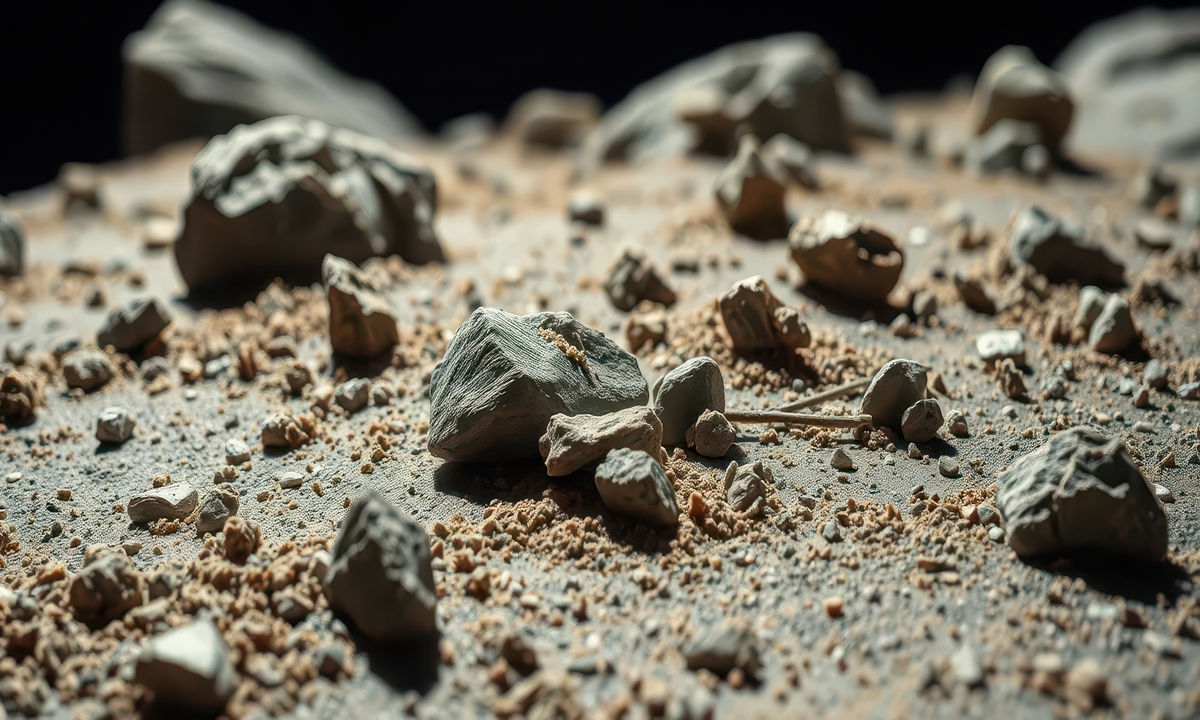
Lunar soil Photo: IC
Chinese scientists have, for the first time, precisely measured the thermal conductivities of a single lunar soil particle from the Chang'e-5 mission, discovering that lunar agglutinates in the soil provide insulation in a vacuum comparable to high-performance synthetic aerogels, marking the lowest thermal conductivity ever reported for a natural material, the Technology and Engineering Center for Space Utilization (CSU), Chinese Academy of Sciences, announced on Tuesday.
The finding, made by a joint research team of the CSU, Tsinghua University, and the Institute of Geochemistry, Chinese Academy of Sciences, sheds new light on the reason behind the extremely low thermal conductivity of lunar soil and the formation mechanism of the moon's extreme thermal environment, and offers a natural model for developing advanced insulation materials, the Global Times learned from the CSU on Tuesday.
Lunar soil particles can be classified into three types - agglutinates, rock fragments, and glass beads - based on their morphology. Agglutinates are the most complex, with highly irregular structures and blurred boundaries. The research team identified key features of different lunar soil particles, including internal pores, defect structures and mineral distribution.
Agglutinates are typical products of space weathering on the lunar surface. During rapid cooling, gases are trapped, forming a hierarchical pore structure ranging from the nanometer to micrometer scale, accompanied by numerous crystalline-amorphous and multiphase mineral interfaces, resulting in a highly complex internal structure.
Integrated structural characterizations and atomic-to-mesoscale simulations demonstrate that the space-weathering-forged multiscale voids and multiphase interfaces collaboratively suppress phonon transport within agglutinate particles, leading to their ultra-low thermal conductivities, according to the CSU.
Experimental results from the research team's precise measurements of the thermal transport properties of lunar soil particles show that different types of particles have significant differences in thermal conductivity. Agglutinates are the most thermally insulating component of lunar soil.
The experimental and theoretical framework established by this study lays an important foundation for future research on thermal transport mechanisms under conditions closer to the actual lunar surface, the Global Times learnt from the CSU.
The study also provides reliable material-property data for modeling the moon's thermal environment, designing landers and in-situ payloads, and guiding heat management in lunar resource utilization and construction.
RELATED ARTICLES