Chinese FM says it opposes forming exclusive groupings after Quad Foreign Ministers’ Meeting; bloc a patchwork of interests with divergences: Chinese expert
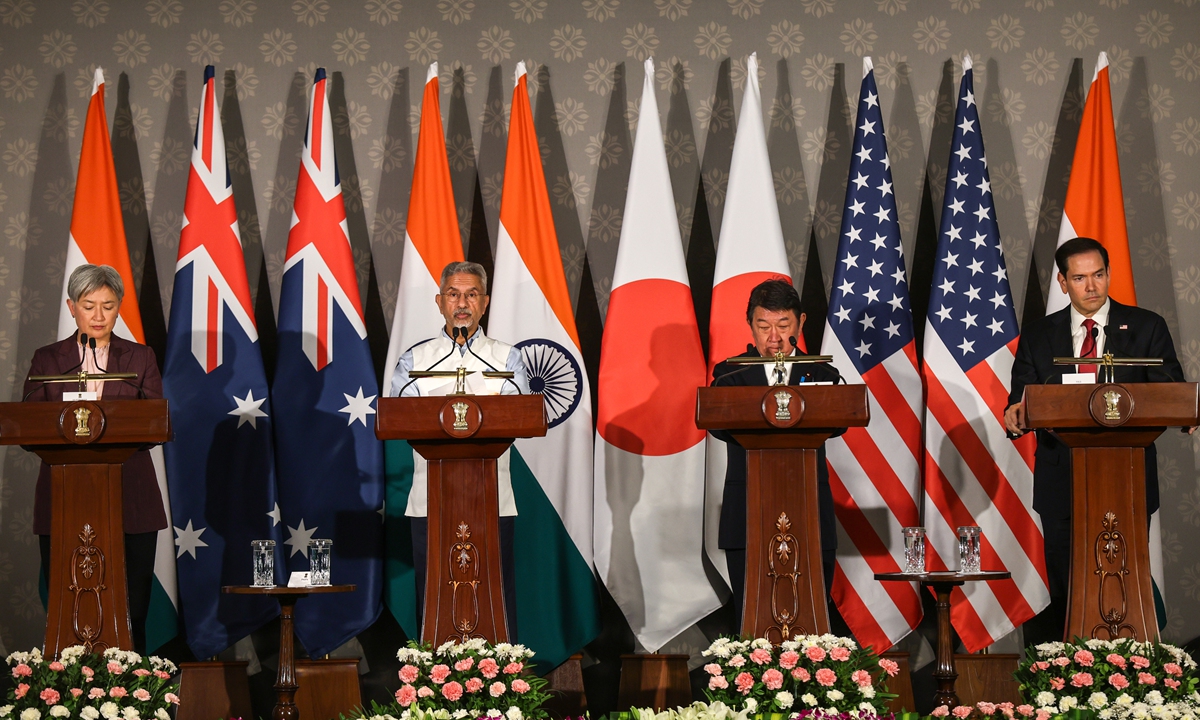
Australian Foreign Minister Penny Wong, Indian External Affairs Minister S. Jaishankar, Japanese Foreign Minister Toshimitsu Motegi, and US Secretary of State Marco Rubio, attend a joint press conference following the Quad Foreign Ministers' Meeting in New Delhi, India, on May 26, 2026. Photo: VCG
During the Quad Foreign Ministers' Meeting held in New Delhi, India, on Tuesday, the grouping expanded cooperation in critical minerals and energy while unveiling new measures to boost maritime surveillance and port infrastructure across the "Indo-Pacific," media reported. A Chinese Foreign Ministry spokesperson responded on the same day that China opposes forming exclusive groupings or engaging in bloc confrontation.
Foreign Ministry spokesperson Mao Ning made the remarks during Tuesday's regular press conference when asked to comment that the US, Japan, India and Australia have launched a maritime surveillance initiative for the so-called "Indo-Pacific" region, and also announced plans to partner with Fiji on port infrastructure. Mao said that China has stated its position on Quad on multiple occasions. Cooperation between countries should be conducive to regional peace, stability and prosperity, and not target any third party.
The Quad Foreign Ministers' meeting was chaired by Indian External Affairs Minister S. Jaishankar and attended by US Secretary of State Marco Rubio, Australian Foreign Minister Penny Wong and Japanese Foreign Minister Toshimitsu Motegi, Indian media outlet The Hindu reported.
In his media statement on Tuesday, Rubio claimed the Quad meeting decided to launch an Indo-Pacific Maritime Surveillance Cooperation Initiative. Rubio also announced expansion of the Indo-Pacific Maritime Domain Awareness Initiative among the Quad nations. He also claimed the Quad has decided to roll out a new initiative to boost port infrastructure in the Pacific Islands, according to The Hindu.
Rubio also announced the Quad Critical Minerals Framework, per The Hindu. This, he claims, will guide each of the countries to leverage economic policy tools and coordinate investment to strengthen critical mineral supply chains including in mining, processing and recycling.
This Quad cooperation was described by some media as having China in mind, with Reuters claiming that Quad countries share concerns about China. The Hindu report claimed the meeting came amid rising global concerns over the country.
Seemingly focusing on maritime surveillance, port construction, critical minerals and energy security, the Quad actually securitizes economic matters and turns development issues into bloc-based competition with clear strategic aims, Chen Hong, director of the Asia-Pacific Studies Center at East China Normal University, told the Global Times.
Echoing Chen, Li Haidong, a professor at the China Foreign Affairs University, told the Global Times that securitizing economic issues runs counter to the interests and aspirations of countries in the Asia-Pacific region.
Chen said that their so-called cooperation on critical minerals and energy security is not a purely market-oriented collaboration.
Despite rhetoric about a "free and open Indo-Pacific," the grouping's true aim is to reshape regional order through exclusive blocs, Chen added. Regional security cannot be achieved via surveillance, nor can energy security be realized by excluding China.
The brief meeting was the third such gathering of the group since September 2024. The four-nation group had lost some momentum last year after failing to hold a leaders' summit, amid tensions between US President Donald Trump and Indian Prime Minister Narendra Modi over Washington's tariffs and other matters, per Reuters.
Japanese media outlet Mainichi also noted that no leaders' meeting has taken place since the launch of the second administration of US President, who has placed less emphasis on multilateral diplomacy.
The meeting comes against the backdrop of uncertainty over the pace of high-level Quad engagement, including delays in convening a leaders' summit that had been expected earlier, The Economic Times reported on Tuesday.
Foreign ministers did not comment on the possibility of a summit later this year, but over the weekend, Rubio said that diplomats would work toward a meeting later this year, Reuters reported.
Chen said that Quad members have a patchwork of interests. All seek to leverage the bloc but are reluctant to bear excessive costs for it. Their repeated emphasis on unity only reflects persistent internal rifts that need constant mending.
However, if cooperation is turned into confrontation and development into containment, it will backfire and arouse vigilance among regional countries, Chen added.
RELATED ARTICLES