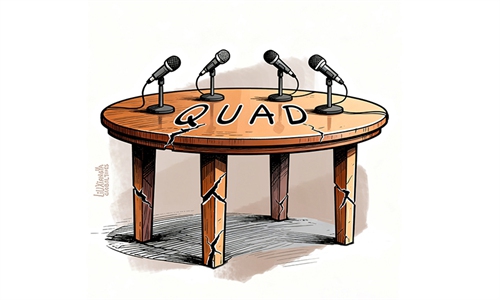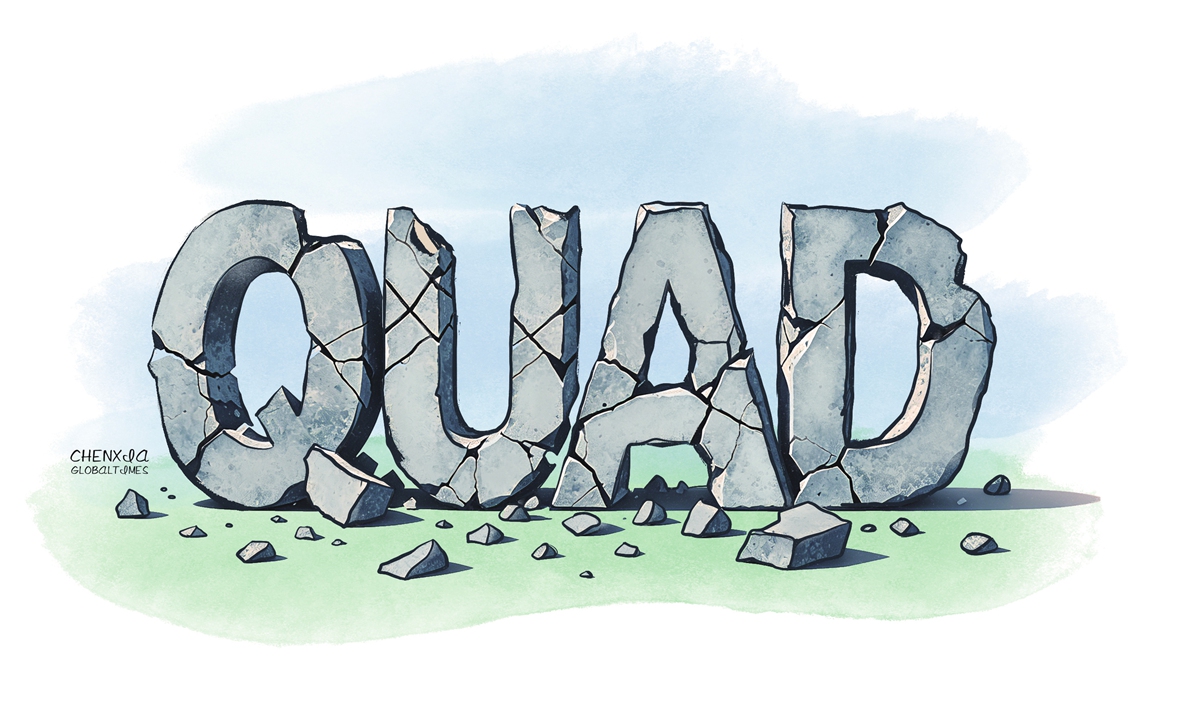
Illustration: Chen Xia/GT
On Tuesday, foreign ministers of the so-called Quad members - the US, Japan, Australia and India - met in India and announced new initiatives including the Indo-Pacific Maritime Surveillance Collaboration and Quad Critical Minerals Initiative Framework. Some media outlets used the occasion of the meeting to hype that "the Quad isn't dead." However, exclusive blocs such as the Quad are inherently at odds with the broader direction of regional peace, security and cooperation. In the long run, their weakening influence and diminishing cohesion remain the prevailing trend.Ever since its launch, the Quad has functioned as a disruptive bloc that stokes rifts and intensifies rivalry across the Asia-Pacific economic and security landscape, displaying the clear characteristics of an "exclusive clique."
After taking office in 2021, the Biden administration significantly strengthened the Quad's role and functions within its so-called Indo-Pacific Strategy. It established specialized working groups on military, technological, and economic cooperation and formalized regular leaders' summits among the four members. Yet Washington's efforts have not altered the fundamental reality that the mechanism remains plagued by internal divergences among its member states, nor have they eased the wariness and dissatisfaction felt by countries outside the group.
Each Quad member state has its own calculation, making the bloc lack a solid foundation for sustained and substantive cooperation. While the recent foreign ministers' meeting publicly touted cooperation among the members, it could not conceal the deep divisions over their respective national interests. Al Jazeera captured the subtle atmosphere at the meeting venue: as the four foreign ministers stood side by side preparing for the "family photograph," "their body language was stiff, with only the top Indian diplomat, S. Jaishankar, trying to smile." This awkwardness was no coincidence, but rather reflected the Quad's state of "sharing the same bed while dreaming different dreams." Judging by its development trajectory, this mechanism runs counter to the overarching trends of regional integration and economic globalization.
In today's world, where turmoil and upheaval are intertwined, the Asia-Pacific region has enjoyed long-term stability and prosperity compared to other parts of the world plagued by severe turmoil or armed conflict. This has made the region an engine of global economic development and an oasis of world peace. The growing economic interconnectedness and interdependence in the Asia-Pacific region, together with the indivisibility of security, form a solid guarantee and fundamental prerequisite for building a regional order that advances toward greater equality, orderliness, and inclusiveness that benefits all.
The actual track record of the Quad mechanism demonstrates that it precisely follows a harmful logic. Its practices have already caused - and will inevitably continue to cause - more friction among countries in the Asia-Pacific and generated greater regional crises. Faced with a lack of cohesion within the Quad and criticism and rejection from the vast majority of countries in the Asia-Pacific region, the four parties have ultimately chosen to prolong their own existence by manufacturing external crises and creating adversaries. Their exaggeration of concerns about China and their emphasis on so-called unity expose the reality of deepening internal rifts and irreconcilable contradictions.
The author is a professor of the Institute of International Relations, China Foreign Affairs University. opinion@globaltimes.com.cn
RELATED ARTICLES