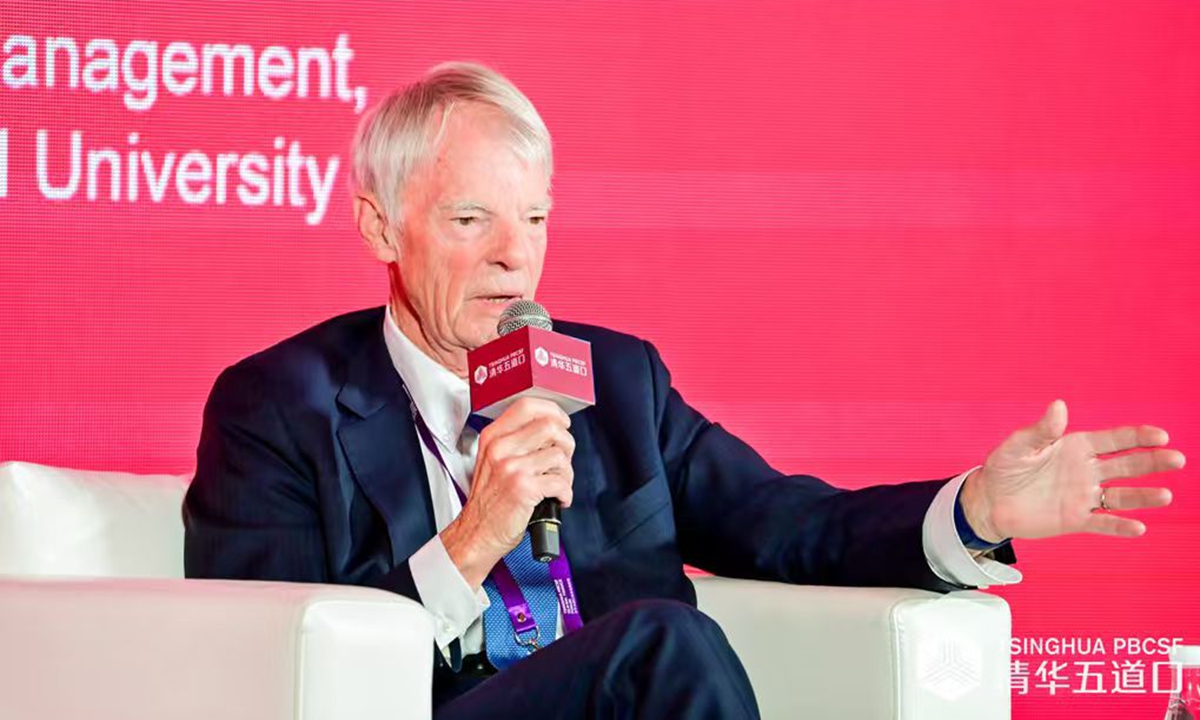
Michael Spence Photo: Courtesy of Tsinghua PBCSF
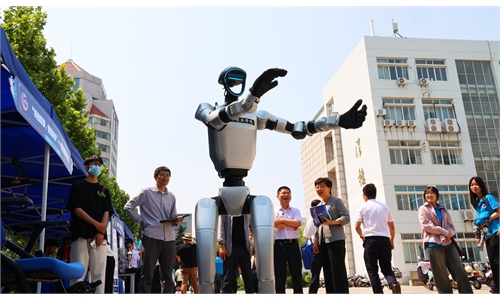
China accounts for 31 percent of global manufacturing and is significantly advanced in robotics. Robotics is moving forward pretty quickly. There is no doubt that China will rank among the world's leading robotic powers and will become a major player in the field.
Robotics is advancing at a tremendous speed, but there are challenges. Robotic systems still do not possess the kind of spatial intelligence that humans have. This is a really hard problem that some of the smartest people in the world are working on.
Within the framework of the 15th Five-Year Plan, China has a better set of plans and intentions to ensure that artificial intelligence (AI) is deployed and adopted across a wide range of the economy, both in manufacturing and services.
This is a significant event because the impact of AI depends not just on its potential, but on how widely and effectively it is used. In this regard, most Western countries are not doing enough. China is very focused on adoption, diffusion, deployment, and the application of AI in beneficial ways across the economy. That is a good thing.
The gaps that existed before between China and the US have largely gone away. Despite semiconductor restrictions imposed by the US government, China has found a way to innovate around the problem of training very large models in effective ways. There are differences in the ecosystem: China has developed a wider variety of open-source AI models than the US.
Looking at the global landscape, I hold an optimistic view that the US and other countries will recognize the importance of the diffusion challenge and act more proactively on that front, moving closer to where China's policy currently stands. As two leading AI powers, China and the US are expected to drive AI development in the years ahead, which will create enormous opportunities for the rest of the world.
For example, the two countries could probably cooperate on certain aspects of regulation on not using the technology for highly destructive purposes. Moreover, maintaining dialogue and communication is also going to be part of the overall cooperation.
Beyond the algorithms and the geopolitics, the real story is the underlying economic engines. Beyond the headlines, the trajectory of global growth still hinges on fundamental economic performance.
As for China's economic outlook, the positive side is that China has invested successfully and heavily in science and technology that drives long-run growth. That is evident to anyone who spends time in China. Although China's economy faces short-term challenges due to structural imbalances, its economic outlook in the long run looks pretty good.
China's contribution to the global economy will continue to be very large, though what it is as a fraction depends entirely on how much other countries' economies will grow.
Crucially, this technological and economic momentum is fueling a transformation in China's capital markets. The opportunities in China's capital markets are enormous. China intends to further open them up, and that will create opportunities. Domestically, capital markets are really important in financing various things, including technology. So, both domestically and for foreigners, the opening-up and the continuing development of the capital markets is really a big deal. That is part of the future.
This article is based on an interview with Nobel Laureate Michael Spence by the Global Times at the Tsinghua PBCSF Global Finance Forum 2026.
RELATED ARTICLES