AI to empower global economic cooperation, as China sharpens its tech edge: Joe Weinman
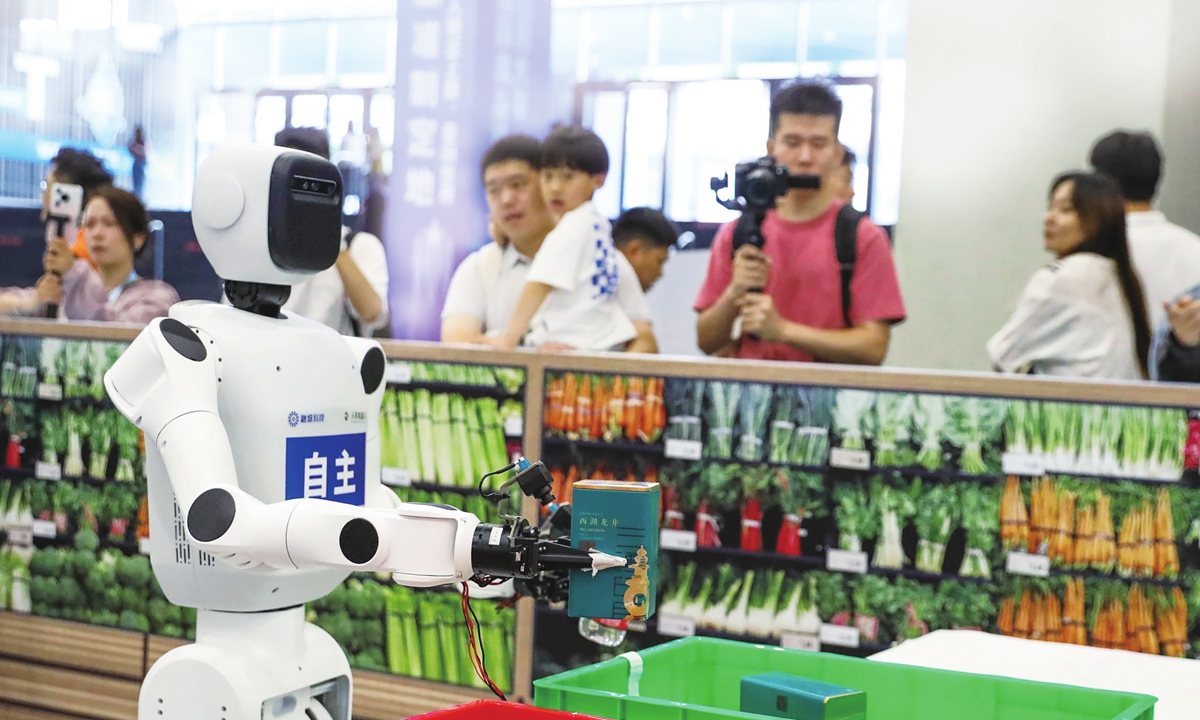
A robot demonstrates shelf-stocking skills at an embodied robotics competition in Hangzhou, East China's Zhejiang Province, on May 15, 2026. Photo: VCG
Editor's Note:
As artificial intelligence (AI) rapidly reshapes industries and daily life, China has drawn global attention for its advances in areas such as embodied AI and smart manufacturing. In an interview with the Global Times (GT), digital strategy expert and "father of Cloudonomics" Joe Weinman (Weinman) said that China is cultivating a distinct advantage in AI applications and innovation, while AI's continuous evolution will further facilitate global business and trade.
GT: Where do you see the global AI industry will evolve next? What role do you think China's AI industry will play in global digital economy cooperation?
Weinman: It's pretty clear that AI - if it's not already everywhere - is rapidly becoming pervasive across almost every industry and aspect of daily life, and increasingly integrated into everyday products and services.
People may think of AI mainly in terms of humanoid robots or chatbots, but AI is increasingly embedded in many technologies that people no longer consciously think of as AI, just as we no longer think about electricity when we use modern devices.
What people see today - large-language models, AI agents, and massive AI data centers - is just a snapshot in time. Many of today's technical bottlenecks will eventually be solved, making AI even more widespread and accessible. That, in turn, will accelerate the development of related technologies.
China is especially interesting because of its leadership in areas like embodied AI, whether it be humanoid robots or autonomous driving, for example. Moreover, China has distinct advantages, such as cost advantages, and a system-wide approach to solving problems, such as linking smart electric vehicles (EVs) to roadside infrastructure and traffic management systems.
Moreover, hundreds of new technologies are emerging that can improve chip production and efficiency. A significant amount of this scientific research is being conducted in China, whether it be photonic or ternary computing chips or synthetic diamonds to improve chip manufacturing.
GT: China's AI is now empowering a wide range of sectors, including manufacturing, e-commerce, and foreign trade. In your view, what unique advantages does China have in AI development?
Weinman: China and the US obviously are the two leading global economies in the AI sector. They each lead in different ways and that lead changes over time. One of the major developments is that the US has taken the lead in large-language models, particularly frontier models that represent the current state of the art. China, in some areas, has been playing catch-up to a certain extent.
Then came the "DeepSeek moment," when DeepSeek demonstrated that similar capabilities could be achieved at roughly 10 percent of the cost, using far less expensive chips.
This shows that technological advantages can be fleeting. From one moment to the next, it is often difficult to predict who will be ahead in most industries.
As I mentioned earlier, China has an advantage in areas of embodied AI, including self-driving cars and humanoid robots.
Moreover, it is important not to look only at raw tech capability, but also at the virtuous cycle surrounding it. By being able to manufacture products at lower cost while integrating AI into those products, China can accelerate wider adoption. This could include applications such as smart TVs, self-driving vehicles, industrial robots, or humanoid robots.
The more these technologies are deployed, the more real-world data can be collected. In turn, that data helps train AI models more effectively, creating a virtuous cycle of continuous improvement and wider adoption.
We are entering an era of significant technological complexity that requires much greater coordination across different systems. If a country is considering how AI can support its economy, it must think about a wide range of factors: access to chips, data centers, energy generation, energy storage, and energy transmission technologies. These are all interconnected parts of a highly complex system.
China is very good at investing in various areas, including educating its workforce and bringing in talent from around the world. Large companies are also good at asking: what is our business, and how do we work across a broad set of areas and do the things required to solve problems together?
For example, to name some US and Chinese examples out of many, Huawei, Google, Nvidia, Baidu and Tencent design a broad suite of services based on leading-edge technologies, whether it is "extreme co-design" of computer systems or building super-apps that include chat and payments or working up and down the stack from agents and search engines to cloud services and AI-focused chips.
There are also many entrepreneurs. I just met with several Chinese entrepreneurs during this visit to China who are coming up with creative approaches to solve business problems based on leading-edge technologies. I think the future is bright.

Joe Weinman Photo: Courtesy of Joe Weinman
GT: As economic and supply chain integration across Asia continues to deepen, how could China's AI-driven industrial transformation benefit regional economic cooperation?
Weinman: There is already a business model that illustrates this potential well: a virtual clothing manufacturer that coordinated production through a network of suppliers.
The way it worked was through a highly dynamic supply chain. When an order came in, it would determine the optimal sourcing for each component: where to get buttons, perhaps Thailand; where to source fabric, perhaps Japan; and where to do the sewing, perhaps China or Vietnam. Systems at the time essentially optimized these decisions dynamically.
It was also able to manage supply chain risk. If one supplier, such as a button manufacturer, went out of business, it could quickly switch to another supplier. In this business model, AI agents dynamically solve complex supply chain problems. For example, if buttons are cheaper in Thailand or higher quality in Vietnam, an agent - rather than a human operator - can decide to switch suppliers accordingly.
This leads to a more dynamic and flexible set of supply chain relationships. With dynamic supply chain optimization, companies can respond quickly to shifting demand. And so being able to have a reasonably tight physical arrangement with that optimization of a competitive business, tying the supply chain together, really means that there are enhancements for regional trade networks and enhancements of overall economic efficiency.
GT: There are increasing reports about China's "token exports." How do you view this emerging phenomenon?
Weinman: Whenever a commodity becomes relevant to trade, similar market dynamics can emerge. The idea that lower-cost processing could take place elsewhere is certainly possible, but it is also a complex question.
Users don't get functionality from tokens themselves. They get functionality from systems and services such as a commercial AI agent, a customer support AI agent, and so on.
Companies have always been able to optimize or arbitrage computing power in remote locations. Because AI is fundamentally based on computing power, it may make sense in some cases to move data elsewhere - for example, to China - for processing to take advantage of lower costs. That is certainly one possibility.
But in other cases, it may make more sense to process data locally. One reason is something called "data gravity," meaning that if there is a lot of data it can be costly and time-consuming to move, which could offset any cost savings or remote AI availability, in other words, token exports.
The real question is: what is the right balance among cost, convenience, speed or overall value?
GT: As AI applications develop rapidly, how will it reshape regional and global patterns of digital economy cooperation?
Weinman: Technology has always enabled commerce by making it easier, faster, and more efficient.
Given the growing importance of AI, any technology that can help businesses improve sales and operations will naturally be adopted. For ordinary business owners, regardless of the goods or services they offer, their main concerns are simple: how to sell more, more quickly, at lower costs. If AI tools can help achieve those goals, businesses will leverage them.
In this sense, enabling technologies in targeted areas can help grease the wheels of commerce and generate net benefits for the broader economy. It is clearly more advantageous than relying on older technologies. It is similar to the difference between a company that now has a website and one that still relies on handing out flyers in mailboxes. As the world moves to AI, businesses are rapidly adopting AI and using it to create new patterns of cooperation.
RELATED ARTICLES