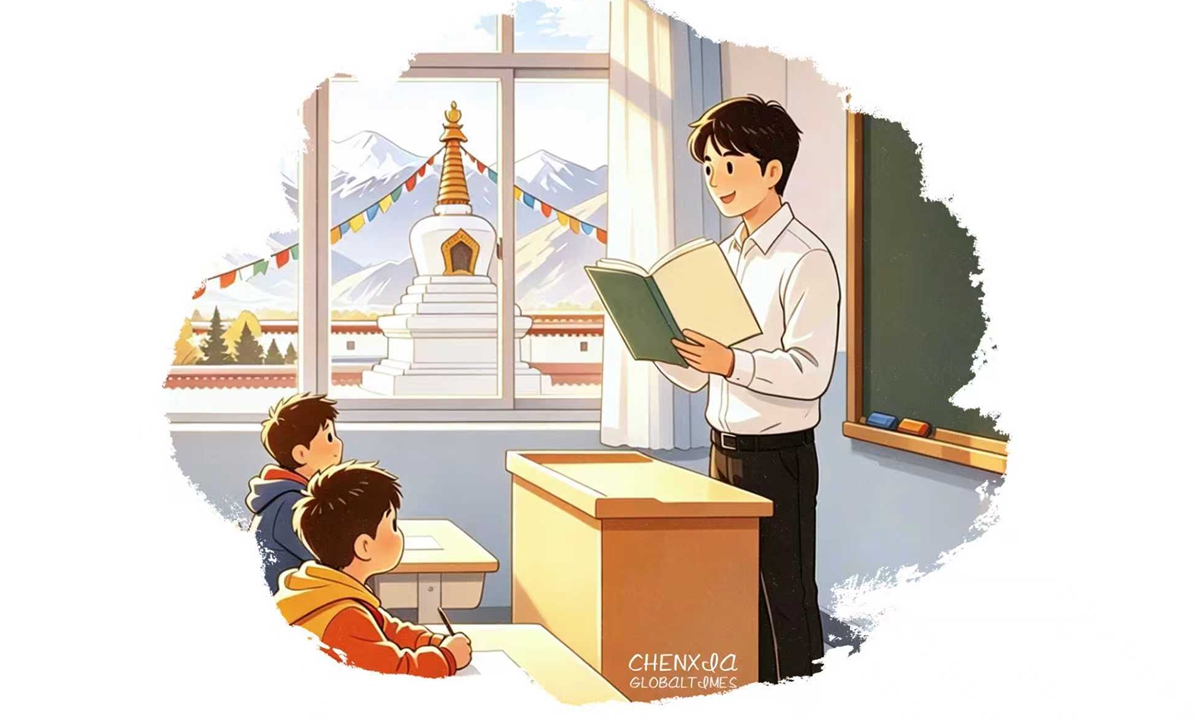
Illustration: Chen Xia/GT
Editor's Note:National support for Xizang's development has yielded remarkable achievements. Over the decades, numerous volunteers from across the country have come to Xizang, making indispensable contributions to the autonomous region's growth. Their efforts focus on various fields such as education, healthcare and infrastructure. Despite harsh conditions, these volunteers persevere in their roles, writing chapters of endeavor on the snowy plateau. Each diary they pen serves as a vivid testament to the building of the Chinese national community. Against this backdrop, the Global Times launches the "My Xizang Diary" series, presenting firsthand reflections from these dedicated volunteers. This is the fifth piece of the series.
In July 2025, as a member of the 27th graduate voluntary teaching corps from Beihang University, I traveled from Beijing to Shannan Vocational and Technical School in Shannan city in Southwest China's Xizang Autonomous Region, where I taught biology, geography and chemistry courses to local students.
My decision to join the program began with a touching story. At Beihang University's 2022 opening ceremony for new students, a freshman named Parasati Kinnes, from Northwest China's Xinjiang Uygur Autonomous Region, shared how a volunteer teacher from Beihang University had introduced him to aerospace science when he was a child. This inspired him to work hard and stay focused, eventually helping him gain admission to Beihang.
The story made me realize that a single word of encouragement or a moment of companionship can truly light up a student's hope about the future and even change the course of his life. That is why I signed up and went to Xizang.
At the school, we volunteer teachers were encouraged to move beyond traditional tutoring and place greater emphasis on helping local students build broader horizons, confidence and imagination for the future, including by introducing AI-related classroom activities.
Beyond the classroom, I also organized a letter-exchange activity that paired local students in Shannan with Beihang University students in Beijing. As the letter-exchange program unfolded, letters crossing mountains and rivers traveled back and forth between the plateau and the university.
Once during a class break, a student suddenly ran up to me and said, "I want to get into Beihang University one day. I want to go to Beijing and see the Forbidden City." At that very moment, her words brought me back to Parasati's speech at the university opening ceremony. I do not know whether the student will become the next Parasati, but in that instant, I truly felt the invisible yet powerful force behind education. Perhaps years later, one of these students will also stand at a university ceremony and tell the story of how a volunteer teacher once changed his or her vision of the future.
During my time in Xizang, I gradually came to understand why educational aid has long been such an important part of the Chinese government's governance strategy for Xizang. From pairing-up educational aid programs to graduate voluntary teaching corps, the meaning and scope of educational assistance in the region have continued to expand. It has not only improved local school conditions and raised the quality of education, but more importantly, it has helped illuminate local students' hopes and expectations for the future.
Through classes, mentorship and daily interactions, the volunteer teachers inspire local students to see a broader world beyond the snow-capped mountains. Education is helping these students break the intergenerational cycle of poverty and enabling them to reshape their own destiny. As the saying goes: "Educators are not for the past, nor for the present, but for the future."
Over the 75 years since Xizang's peaceful liberation, the region has built a modern education system encompassing preschools, primary and secondary schools, vocational and technical schools, as well as institutions of higher learning and special education institutions. The vocational and technical schools have also become key recipients of support, which is exactly why I came to Shannan Vocational and Technical School.
With the continuous support of national policies and assistance from people across the nation, education in Xizang has transitioned from a privilege enjoyed by a few to a fundamental right accessible to all. In urban and rural areas alike, students in Xizang are now able to enjoy increasingly equitable educational opportunities.
Educational aid to Xizang is not only an important livelihood project but also a vital front for promoting ethnic unity. As volunteer teachers, we are also envoys facilitating interaction, exchange and integration among different ethnic groups. Through daily interactions and letter exchanges, we have built a regular communication bridge between local ethnic minority students and Han students from other parts of China. Ethnic unity becomes concrete and real in these small, everyday moments.
Over the past two decades, the program of postgraduates voluntary teaching corps has recruited more than 37,000 young postgraduate students from over 200 universities nationwide to provide volunteer teaching support at more than 700 schools in counties and rural areas across central and western China.
Generation after generation of postgraduate volunteers have dedicated their youth where the country needs them most. I feel truly honored to be one of them, integrating my personal growth into the cause of the country's undertakings of promoting regional development and ethnic unity.
The author is a postgraduate student at Beihang University and member of the university's 27th graduate voluntary teaching corps. opinion@globaltimes.com.cn
RELATED ARTICLES