China’s carmaker SAIC joins global ‘100-million-unit club’
First among domestic automakers to reach the milestone
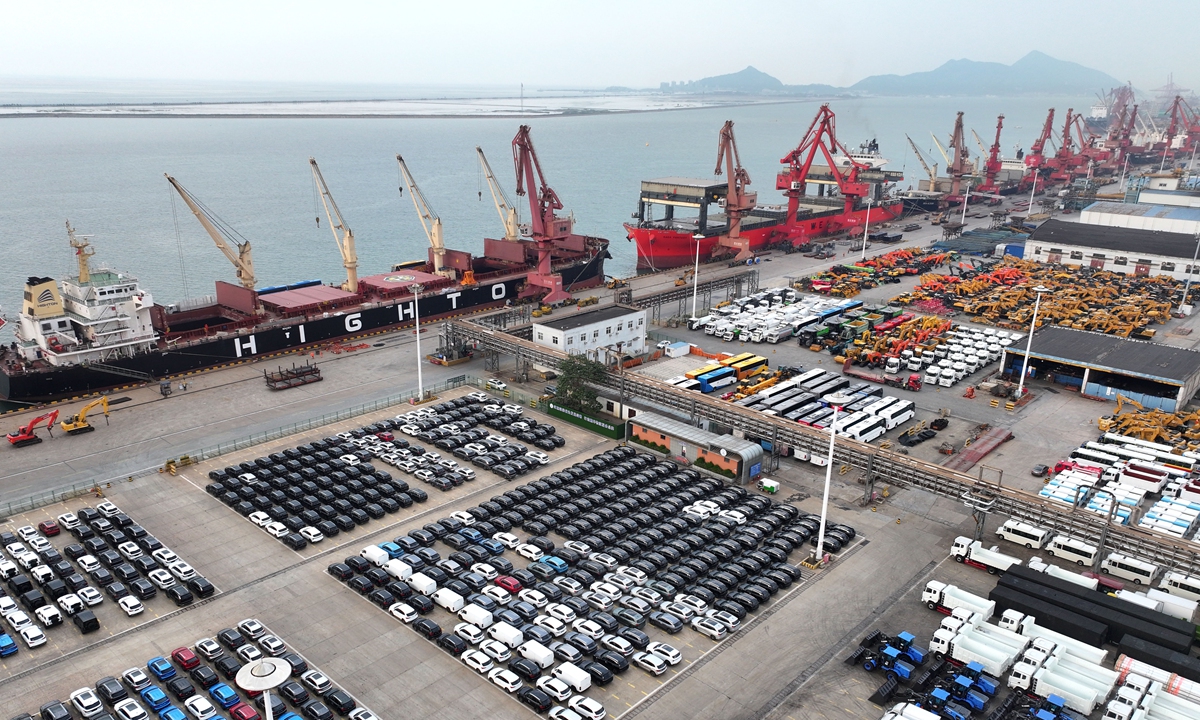
A large number of Chinese-made vehicles gather at the Lianyungang Port in East China's Jiangsu Province on May 28, 2026, preparing for shipment and export. Photo: VCG
Domestic carmaker SAIC Motor delivered its 100 millionth vehicle in Shanghai on the afternoon of Thursday, becoming the first Chinese automaker to surpass 100 million units in cumulative production and sales, according to the Xinhua News Agency.
Industry insiders pointed out that the landmark achievement filled the gap for Chinese automakers in the "100-million-unit club." According to Xinhua, previously, only automakers from countries like the US, Japan, Germany and the South Korea had reached the 100-million-vehicle milestone.
Industry experts believe that SAIC Motor's achievement is underpinned by the systemic advantages accumulated by China's automotive industry over decades. These include a vast domestic market, a complete and independent industrial chain, highly clustered industrial ecosystems, mature supporting capabilities, and the advantages of opening-up and cooperation, per the experts.
SAIC Motor's achievement as China's first "100-million-unit carmaker" symbolized the remarkable transformation of the country's automotive sector over more than 70 years - from starting from scratch to becoming a global powerhouse, according to the Xinhua report.
This landmark also represented a significant milestone for "Made in China," said Xinhua.
Profound transformation
Industry insiders said SAIC Motor's success showcases the profound transformation of China's automotive industry.
In 1955, its predecessor, the Shanghai Internal Combustion Engine Parts Manufacturing Company, was established. In 1958, the first Phoenix-brand sedan was successfully produced, marking Shanghai's breakthrough in passenger vehicle manufacturing, according to SAIC Motor's website.
Over the decades, SAIC evolved from a small workshop-style factory to a modern intelligent manufacturing giant, Zhang Xiang, secretary-general of the International Intelligent Vehicle Engineering Association, told the Global Times on Thursday.
"From complete reliance on imported technology to mastering core technologies; from a domestic focus to building a global ecosystem. SAIC's growth over more than 70 years is a microcosm of Chinese manufacturing's remarkable rise and breakthrough," said Zhang.
What contributed to SAIC Motor's success is China's complete industrial ecosystem built over the past decades.
China has built the world's most comprehensive automotive supply chain, covering everything from raw materials and power batteries to electric motors, controllers, chips, vehicle assembly, and after-sales services. This system offers unmatched efficiency, cost control, and iteration speed, Hu Qimu, a professor at the Maritime Silk Road Institute of Huaqiao University, told the Global Times on Thursday.
For example, Ningde-based CATL leads the global battery market. Tesla's Shanghai Gigafactory is also an example of the resilience of China's supply chain, as it has achieved a production pace of one vehicle every 30 seconds, according to the company's statement sent to the Global Times.
In terms of the speed of research and development (R&D), major automotive clusters in Shanghai, the Guangdong-Hong Kong-Macao Greater Bay Area, and Beijing-Tianjin-Hebei region have compressed new vehicle development cycles dramatically - from the global average of 36 months to under 20 months, according to industry insiders and relevant media reports.
While traditional giants like SAIC, FAW, Dongfeng, and GAC continue to transform, new carmakers such as BYD, NIO, XPeng, Li Auto, Zeekr, and Xiaomi are emerging as powerful innovation engines.
BYD became the first domestic automaker to fully transition to electrification, halting fuel vehicle sales in 2022. New forces such as Nio and Xpeng have created differentiated advantages in battery technology, battery swapping, high-level intelligent driving, and smart cabins, observers noted.
"Innovation is also a crucial factor of China's current automobile industry," said Hu.
As BBC reported on Thursday, Chinese tech giants like Xiaomi, Huawei and Alibaba are now making EVs, bringing consumer technology into the car industry. As cars increasingly rely on software, from driver assistance to entertainment systems, these companies are giving Chinese carmakers yet another edge. "They're not racing the West anymore. They are racing each other," per BBC report citing an analyst.
Following Nio's launched of its new SUV model on Wednesday, major Chinese EV makers including BYD, XPeng, and Leapmotor are also expected to unveil major products and technology updates during the upcoming Shenzhen Auto Show, Yahoo Finance reported on Thursday, which showcased the fast innovative iteration of China's automobile industry.
Industry insiders have said that the automotive industry is experiencing transformative changes. Technologies such as artificial intelligence (AI) and big data are deeply integrating with vehicle manufacturing, fundamentally reshaping the competitive landscape and the entire value chain.
Notably, SAIC's 100 millionth vehicle - an IM LS9 Hyper - was delivered to Momenta CEO Cao Xudong, the company told the Global Times on Thursday.
Momenta, a Chinese technology provider of intelligent driving, has been providing autonomous driving software for SAIC's premium IM brand since 2021, exemplifying deepening collaboration between traditional automakers and technology companies.
"Since our founding in 2016, Momenta has been committed to leveraging groundbreaking AI technology to create a better life," said Cao.
New-era cooperation
Momenta is also a partner for many foreign carmakers operating in China. For example, in February, Mercedes-Benz Group and Momenta signed an updated strategic cooperation memorandum of understanding in Beijing and jointly announced that they will further deepen their collaboration in the field of future mobility, according to corporate statements sent to the Global Times.
This was one of the examples showcasing how China's cooperation model with foreign automakers has evolved.
For SAIC, in November 2024, it signed an extension for the joint venture contract with Volkswagen Group until 2040, further strengthening their long-term partnership, both companies said in their statements.
Foreign brands are now actively seeking partnerships with Chinese companies in new energy and intelligent technologies. Volkswagen is also collaborating with XPeng to jointly develop new-energy vehicles, while Audi is partnering with SAIC and Huawei to advance high-level intelligent driving technologies. Mercedes-Benz has upgraded its Shanghai R&D center into a global core innovation hub. Foreign automakers are now increasingly embracing China's intelligent electric vehicle (EV) technologies, achieving mutual benefit and win-win outcomes.
This shift from "learning through joint ventures" to "joint innovation and leadership" reflects the growing technological confidence of Chinese automakers, said Hu.
Foreign automakers have also deeply integrated into China's automotive production and supply chains. For example, Taicang, a small city in East China's Jiangsu Province, has developed a comprehensive industrial cluster encompassing more than 700 upstream and downstream automotive parts enterprises, including over 200 foreign-funded companies, according to Xinhua.
Thanks to its well-established industrial and supply chain system, 70 percent of automotive components can be sourced locally within Taicang, which is also an epitome of the industrial chain in the Yangtze River Delta.
"China's advantages in the complete industrial chain, cost optimization, and its leadership in the intelligent EV sector have enabled domestic brands to accelerate their globalization efforts," said Hu.
Industry insiders said that SAIC Motor's milestone is not only a celebration of past achievements but also a new starting point. As China's auto industry continues to advance in intelligence, electrification, and globalization, Chinese brands will play an even more influential role in the global automotive landscape.
RELATED ARTICLES